When to Start Mammograms and When Your Plan May Differ
The USPSTF recommends starting routine mammograms at 40; your risk may call for a different plan.
The 2024 US Preventive Services Task Force recommends a mammogram every two years from ages 40 through 74. For women at average risk, the American Cancer Society offers the option to start yearly mammograms at 40 to 44, recommends yearly mammograms at 45 to 54, and allows yearly or every-other-year mammograms from 55 onward. Certain high-risk women need a different plan. A new breast change calls for evaluation, not a wait for screening. 562

A routine schedule and a separate high-risk plan
If you’re deciding when to book a routine mammogram, the US Preventive Services Task Force’s 2024 recommendation is screening every two years from age 40 through 74. Screening looks for cancer before symptoms appear. It doesn’t tell you what to do about a lump you’ve already noticed. 53
The American Cancer Society (ACS) gives women at average risk the option to start yearly mammograms at ages 40 to 44. It recommends yearly mammograms at 45 to 54; from 55 onward, women can switch to every other year or continue yearly. So both organizations address screening from age 40, but ACS makes starting before 45 optional and recommends yearly screening at 45 to 54, while the USPSTF recommends every two years from 40. Mammograms can find cancer early, but screening can also lead to false positives and overdiagnosis. Those benefits and limitations are worth discussing when choosing between the schedules. ACS also says screening can continue as long as a woman is in good health and expected to live at least 10 more years. These are recommendations about routine screening, not personal start or stop dates determined by age alone. 65
First check whom a recommendation is for. ACS has separate guidance for women at average risk and those at high risk. For women at high risk based on certain factors, ACS recommends both a breast MRI and a mammogram every year, typically starting at age 30. That is not a competing routine schedule for everyone in their 30s. Nor does it mean that anyone with a relative who has had breast cancer automatically needs MRI. It means your risk history deserves a closer look before an age-only schedule is treated as your whole plan. 6
What could change your screening plan?
A known BRCA gene change, a personal history of breast cancer, certain prior breast conditions, and dense breast tissue are among the factors relevant to breast cancer risk. Family history matters too. The details are useful: which relatives had cancer, what kind, and on which side of your family. 16
For MRI screening, ACS identifies women whose estimated lifetime breast cancer risk is about 20% to 25% or greater, using tools based mainly on family history, among those who should receive its high-risk approach. It recommends against MRI screening when estimated lifetime risk is below 15% and says there isn’t enough evidence to recommend for or against yearly MRI for some women with estimates of 15% to 20% from tools based mainly on family history. Different risk tools can give the same person different estimates, and an estimate can change over time. 6
That makes a risk discussion more useful than guessing from one fact. For example, if your mother was recently diagnosed with breast cancer, ask whether that changes your risk estimate and screening plan. If you’ve previously been told you have a benign breast condition, ask which condition it was and whether it affects your plan. A personal history of breast cancer also warrants a plan based on that history rather than an assumption that routine age-based screening is sufficient. 16
Pregnancy, breastfeeding, and later life
Pregnancy or breastfeeding can make breast changes harder to assess, but neither is a reason to ignore a new symptom. American College of Radiology guidance says imaging of symptoms during pregnancy should not be delayed. It also says mammography is safe during pregnancy, while the choice of screening is tailored to age and cancer risk; imaging during lactation is broadly similar to imaging when not breastfeeding. If you’re due for screening or notice a change, tell the imaging team that you’re pregnant or breastfeeding so the purpose and choice of imaging are clear. 4
The USPSTF recommendation described above runs through age 74. ACS instead frames continuing screening around health and an expectation of at least 10 more years of life. Neither statement makes your 75th birthday an automatic stop date. 56
A new change is not a screening appointment
Screening is for when you have no symptoms. If you notice a new lump or swelling in your breast or armpit, skin dimpling, an unusual nipple change, or nipple discharge when you aren’t pregnant or breastfeeding, arrange an assessment rather than waiting for your next routine mammogram. These changes can have causes other than cancer, but they deserve checking. Breast pain on its own is not usually a sign of breast cancer. 32
For your next screening decision, bring your age, any changes in family history, and the date and result of your most recent mammogram, if you’ve had one. Include any prior breast diagnoses and whether you were told to get further tests. Ask whether anything from that history needs follow-up before choosing the timing of your next routine screen. Then ask: Am I following a routine mammogram schedule, or is there a reason to assess whether I need a different screening plan? If you have a new symptom, ask about evaluating it instead of waiting for screening. 1362
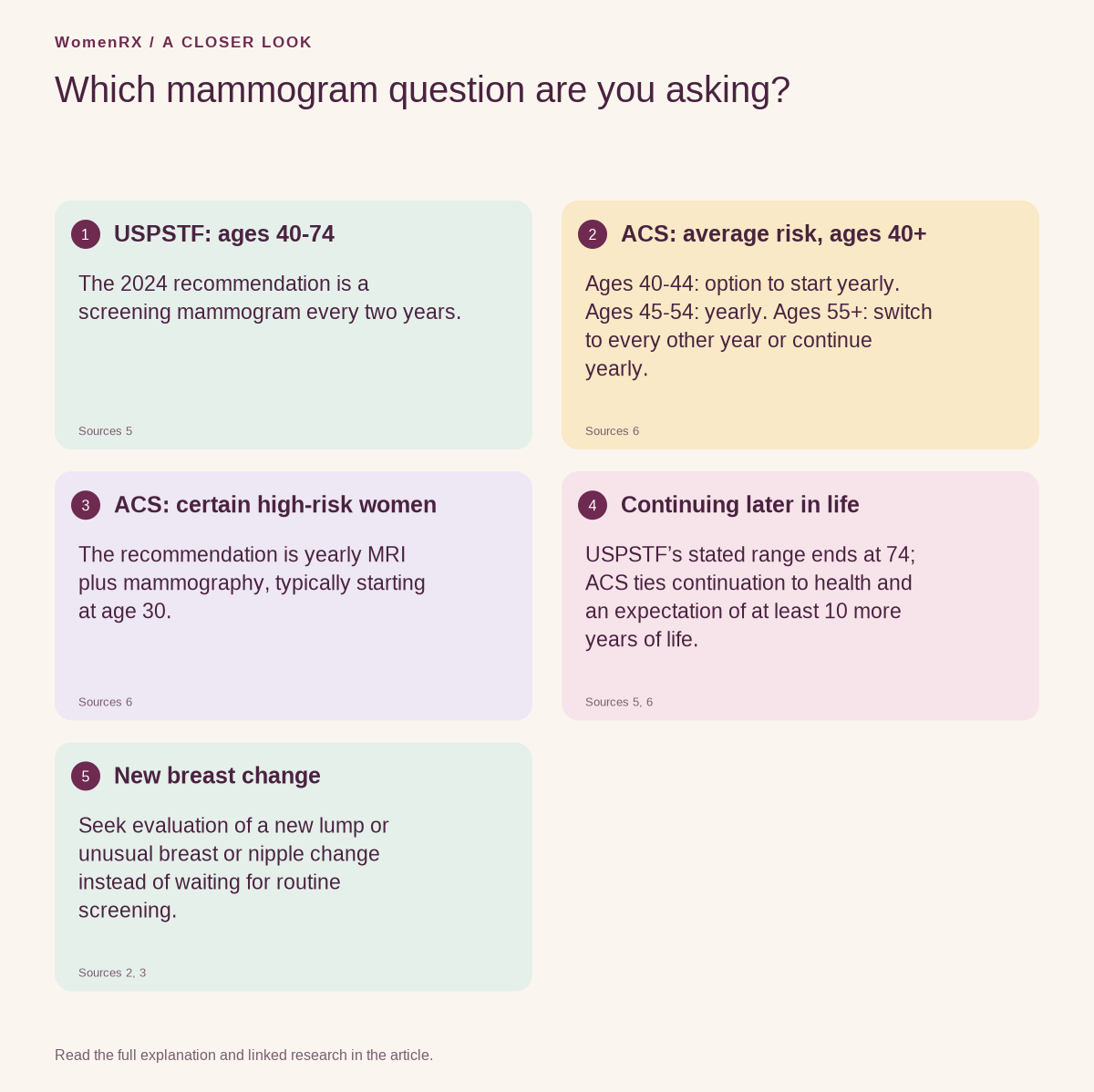
Which mammogram question are you asking?
USPSTF: ages 40-74: The 2024 recommendation is a screening mammogram every two years.5
ACS: average risk, ages 40+: Ages 40-44: option to start yearly. Ages 45-54: yearly. Ages 55+: switch to every other year or continue yearly.6
ACS: certain high-risk women: The recommendation is yearly MRI plus mammography, typically starting at age 30.6
Continuing later in life: USPSTF’s stated range ends at 74; ACS ties continuation to health and an expectation of at least 10 more years of life.56
New breast change: Seek evaluation of a new lump or unusual breast or nipple change instead of waiting for routine screening.23
Read the figure as text
Compare the routine schedules by age, then check whether your risk or a new symptom calls for a different approach.- USPSTF: ages 40-74: The 2024 recommendation is a screening mammogram every two years.5
- ACS: average risk, ages 40+: Ages 40-44: option to start yearly. Ages 45-54: yearly. Ages 55+: switch to every other year or continue yearly.6
- ACS: certain high-risk women: The recommendation is yearly MRI plus mammography, typically starting at age 30.6
- Continuing later in life: USPSTF’s stated range ends at 74; ACS ties continuation to health and an expectation of at least 10 more years of life.56
- New breast change: Seek evaluation of a new lump or unusual breast or nipple change instead of waiting for routine screening.23
Sources you can check
- Breast Cancer | Breast Cancer Symptoms | MedlinePlusAccessed 2026-09-25Return to first citation
- Symptoms of breast cancer in women - NHSAccessed 2026-09-25Return to first citation
- Health Screening: MedlinePlusAccessed 2026-09-25Return to first citation
- ACR Appropriateness Criteria® Breast Imaging of Pregnant and Lactating Women.Expert Panel on Breast Imaging:, diFlorio-Alexander RM, Slanetz PJ, Moy L, Baron P, Didwania AD, Heller SL, Holbrook AI, Lewin AA, Lourenco AP, Mehta TS, Niell BL, Stuckey AR, Tusc... · Journal of the American College of Radiology : JACR · 2018Return to first citation
- Women's screening preferences shift after being informed about the 2024 USPSTF breast cancer screening guideline.Parmet T, Yoder G, McCaffery K, Hersch J, Schapira MM, Lewis CL, Cappella JN, Tate C, Morse B, Scherer LD. · Patient education and counseling · 2026Return to first citation
- ACS Breast Cancer Screening Guidelines | American Cancer SocietyAccessed 2026-09-26Return to first citation