When Social Fear Starts Shrinking Your Life
The clearest clue isn’t whether you’re shy; it’s whether fear of being judged is limiting what you do.
Social anxiety may be worth discussing when fear of scrutiny, embarrassment, or rejection repeatedly leads you to avoid situations, or makes work, school, relationships, or daily tasks harder. Shyness or occasional nerves alone don’t establish a disorder. A clinician can ask about the pattern, its effects, and whether another health issue could be contributing. 1 3

The difference is more than being quiet
You can prefer a small gathering, need time to warm up, or feel nervous before speaking in a meeting without having social anxiety disorder. A more useful question is what the fear is doing to your choices and daily life.
Social anxiety centers on fear in situations where you might be watched or evaluated. You may worry about embarrassment, rejection, or showing signs of anxiety. That fear can lead you to avoid conversations, class participation, public speaking, or other situations. It deserves attention when it interferes with work, school, relationships, or ordinary tasks. 1 3
For example, you might want to attend a work event but repeatedly skip it because you expect others to judge you. Or you might put off asking a question in class even when you need the answer. These examples can help describe a pattern; they aren’t a test or a diagnosis.
Being introverted doesn’t by itself mean you fear scrutiny. And if a particular person or setting feels unsafe, caution in that situation deserves to be taken seriously, not treated as a symptom. Social anxiety isn’t unique to women: MedlinePlus describes it as affecting men and women equally. 1
Notice what happens before and after
If you’re trying to put the experience into words, think of one or two recent situations. What did you expect might happen? Did you skip the situation, leave early, or stay while feeling distressed? What became harder as a result?
You don’t need a formal diary or a perfect explanation. A few concrete examples can help a clinician understand your symptoms and how they affect you. An assessment may also include your medical history and, when appropriate, a check for another health problem that could be contributing. 1
Your circumstances belong in the conversation, too. For example, caregiving or work hours may limit when you can attend appointments; privacy concerns may affect where you feel comfortable talking. Those details aren’t diagnostic signs. They help explain what kind of support is practical for you.
A way to start the first conversation
You could begin with: “I’m avoiding situations because I’m afraid of being judged, and it’s affecting __.” Then describe a specific example: what you feared, what you did, and what the consequence was. If a situation felt genuinely unsafe, say that as well.
Ask how the clinician would assess what’s happening and what treatment could help with the situations you’re avoiding. If scheduling, caregiving, cost, privacy, or transportation could make care difficult, it’s reasonable to bring that up early.
How CBT can address avoidance
Cognitive behavioral therapy, or CBT, helps you work on thoughts and behaviors connected to fear. It may include exposure, in which you work toward facing situations you’ve been avoiding as part of treatment. 1
CBT is a treatment option for social anxiety, but a comparison of two CBT approaches doesn’t establish which format is best for every person. In that study, social anxiety symptoms decreased in both manualized CBT and treatment-as-usual CBT groups. The treatment-as-usual group came from routine-care data rather than a direct random assignment between those two approaches, which limits what the comparison can tell us. 2
In a separate, small longitudinal study, 46 people with social anxiety underwent nine weeks of internet-delivered CBT. Researchers reported reductions in social anxiety symptoms that were sustained at a 36-month follow-up. That finding doesn’t mean every online program, or every person using one, will have the same result. 4
Treatment should address the situations and effects that matter in your life. Asking what CBT would involve, including how a therapist approaches avoided situations, can help you decide whether a proposed plan fits your needs. 1
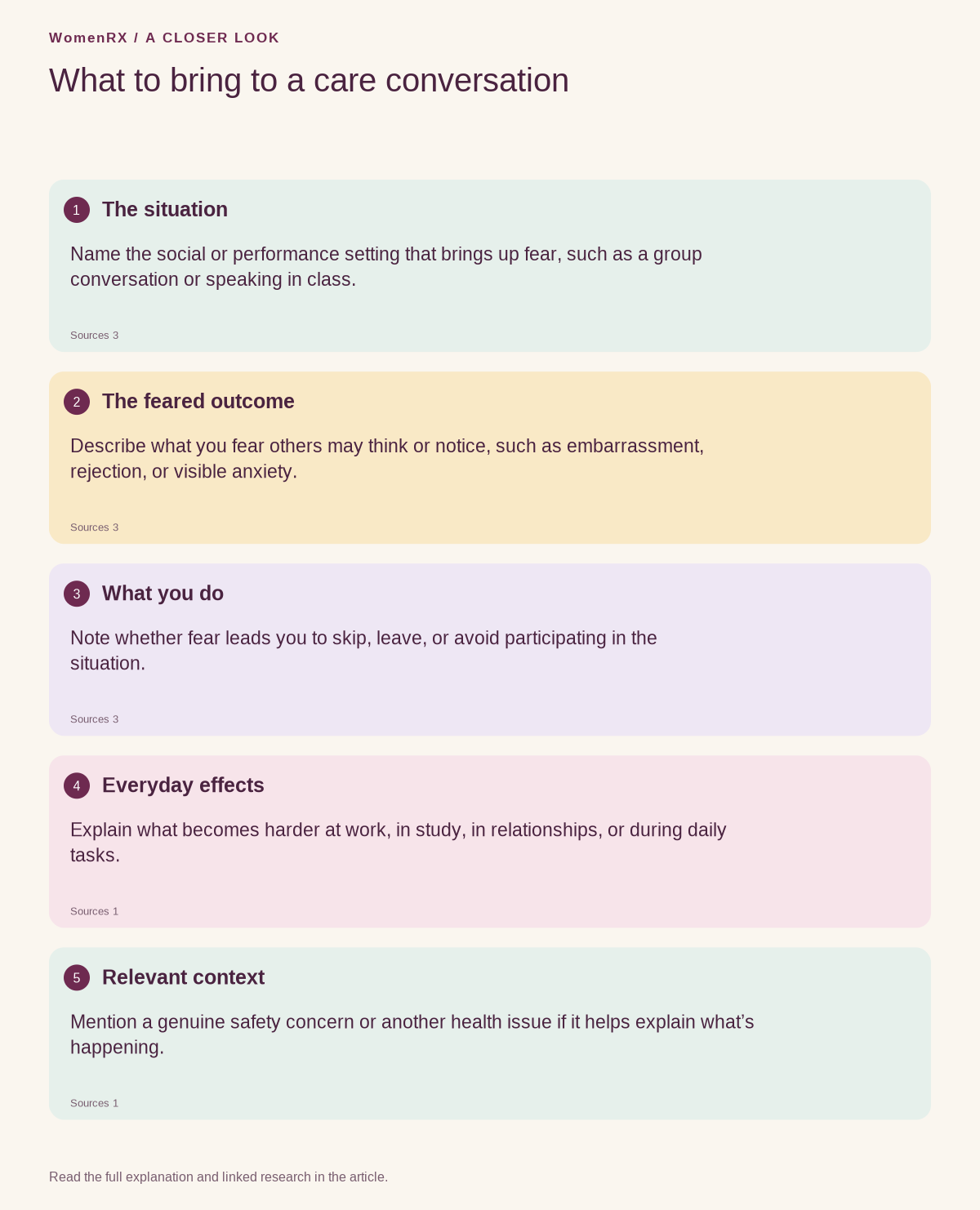
What to bring to a care conversation
The situation: Name the social or performance setting that brings up fear, such as a group conversation or speaking in class.3
The feared outcome: Describe what you fear others may think or notice, such as embarrassment, rejection, or visible anxiety.3
What you do: Note whether fear leads you to skip, leave, or avoid participating in the situation.3
Everyday effects: Explain what becomes harder at work, in study, in relationships, or during daily tasks.1
Relevant context: Mention a genuine safety concern or another health issue if it helps explain what’s happening.1
Read the figure as text
Use these prompts to organize a couple of examples, not to score or diagnose yourself.- The situation: Name the social or performance setting that brings up fear, such as a group conversation or speaking in class.3
- The feared outcome: Describe what you fear others may think or notice, such as embarrassment, rejection, or visible anxiety.3
- What you do: Note whether fear leads you to skip, leave, or avoid participating in the situation.3
- Everyday effects: Explain what becomes harder at work, in study, in relationships, or during daily tasks.1
- Relevant context: Mention a genuine safety concern or another health issue if it helps explain what’s happening.1
More questions, answered
Does feeling nervous before a presentation mean I have social anxiety?
Not on its own. Anxiety can be a normal response to a stressful situation. Consider the broader pattern: whether fear of scrutiny repeatedly leads you to avoid situations or interferes with daily life. 1
Sources you can check
- Anxiety: MedlinePlusAccessed 2026-09-25Return to first citation
- Manualized versus treatment-as-usual cognitive behavioral therapy for social anxiety disorder: A comparative study.Pirke J, Schürmann-Vengels J, Leibing E, Margraf J, Odyniec P, Schulte D, Teismann T, Willutzki U. · Journal of anxiety disorders · 2026Return to first citation
- Advancing Undergraduate Student Mental Healthcare of Social Anxiety Disorder: Evaluating the Acceptance of AR-Assisted Cognitive Behavioral Therapy Through TAM-Based Constructs.Zhou Z, Zhou Y, Ouyang B, Man SS, Chan AHS. · Healthcare (Basel, Switzerland) · 2026Return to first citation
- Plasma short-chain fatty acid concentrations in social anxiety disorder and changes after cognitive behavioral therapy.Cai W, Stiernborg M, Wolthon A, Landberg R, Manzouri A, Furmark T, Lavebratt C, Månsson KNT. · Translational psychiatry · 2026Return to first citation