What to Do After a GLP-1 Coverage Denial
The denial notice can tell you what the plan rejected, what to send next, and when you need to act.
Start with the written denial, not a new prescription request. Find the stated reason, the instructions for appealing, and the deadline that applies to your plan. Ask your insurer what criteria or documents were missing, then ask your prescriber for records that address that reason. Keep copies and submission dates. An internal appeal can lead to a written decision; some denials may also qualify for external review.56

A denial of Wegovy (semaglutide) or Zepbound (tirzepatide) can feel like a verdict. Treat it first as a specific decision to examine. The useful question is what did the plan say no to, and why? A request for approval before treatment and a claim for payment after treatment aren't the same thing, so check which one your notice addresses.5
Read the reason before gathering records
Put the denial notice beside your insurance card. Locate the medication or service named, the claim or request number, the stated reason for denial, the appeal instructions, and any deadline printed on the notice. If you can't find a deadline or don't understand the reason, call the number on the notice and ask where those details appear in your plan's rules. Write down the answer and the name and date of the call. HealthCare.gov recommends keeping notices, copies of submitted materials, and notes from appeal-related calls.5
The reason determines what you do next. For example, a notice saying the plan doesn't offer the benefit raises a different question from one saying the treatment wasn't medically necessary. Both are among the types of denials HealthCare.gov says can be appealed, but clinical records alone can't establish that a plan includes an excluded benefit. Ask the insurer which plan provision it used and whether there's an appeal route for that decision.5
If the notice points to clinical criteria or missing information, ask for the criteria applied to this request. Then ask your prescriber's office for a copy of what it originally submitted and any records that directly address the missing point. For example, if a criterion concerns treatment history, relevant visit notes or a record of prior treatment may be more useful than an unrelated medical file. Ask whether the office can explain those records in a letter. HealthCare.gov says an internal appeal can include additional information, such as a letter from your doctor.5
Turn the notice into a short action list
Use these questions to make the next call and the prescriber's follow-up more specific:
- To the insurer: “Was this a denial of prior authorization or a claim for payment? What exact plan rule or clinical criterion led to it? What forms, submission method, and deadline apply to my internal appeal?” Ask for the claim or request number if it isn't clear on the notice.5
- To the prescriber's office: “What was sent with the original request? Can I get copies? Does the denial call for a specific visit note, treatment-history record, or explanation you can provide?” Give the office a copy of the notice rather than asking it to appeal without the reason. These are examples of records to check, not documents every plan requires.5
- Before submitting: Check that the appeal identifies you and the denied request, uses any forms your insurer requires, and includes the additional material you want considered. HealthCare.gov says you can use the insurer's forms or write an appeal that includes your name, claim number, and insurance ID number.5
- After submitting: Keep a copy of the appeal and attachments. Record when and how you submitted them, any confirmation you received, and the date and details of follow-up calls. Follow your insurer's submission instructions: HealthCare.gov says to submit copies of supporting records and keep the originals, but to send the original internal-appeal request and any request for someone else to file on your behalf. Keep copies of those requests, too.5
This is a way to organize an appeal, not a guarantee that one will succeed. A complete appeal makes it easier to see whether the insurer reconsidered the point you raised and what options remain.
If the internal appeal is denied
The insurer should send a written decision at the end of its internal appeal process. If it still denies the request, that decision should explain how to ask for an external review.5 External review is a separate step in which a reviewer outside the insurer considers an eligible denial. HealthCare.gov identifies denials involving medical judgment, including disagreements about whether treatment is medically necessary, among the types that can go to external review. Don't assume a benefit exclusion qualifies on the same basis. Read your final denial for the available route and its filing instructions.6
Check the deadline on each notice rather than carrying the first date forward. Ask the insurer where to send a further request and how to confirm receipt. If someone from your prescriber's office will file on your behalf, check whether your plan requires a signed authorization; HealthCare.gov includes that paperwork among the records to keep when another person files an appeal for you.5
If you're comparing the cost of paying yourself
An appeal and a self-pay purchase are different decisions. For context, NovoCare's Wegovy injection offer, observed September 25, 2026, listed $199 per box for the first two eligible starter-strength fills through December 31, 2026, and standard offer prices of $349 per box for the listed usual injection strengths. Eligibility conditions apply, and prices can change. The introductory price isn't the ongoing price.12 NovoCare says purchases through its self-pay offer are outside insurance: they can't be submitted for reimbursement or counted toward a deductible or out-of-pocket limit. Compare the offer's current terms with your own plan costs before deciding what you can afford while an appeal is pending.2
If pregnancy planning affects the treatment request
Your appeal should address the plan rule or clinical criterion cited in the denial. If you're planning a pregnancy, your treatment plan may also change. Tell your prescriber if that's relevant before asking for a letter describing ongoing treatment. Wegovy's prescribing information calls for stopping it before a planned pregnancy, while Zepbound's information says weight loss isn't recommended during pregnancy and to stop the medication when pregnancy is recognized. Your prescriber can help clarify what treatment period the appeal should address rather than submitting a plan that no longer matches your circumstances.34
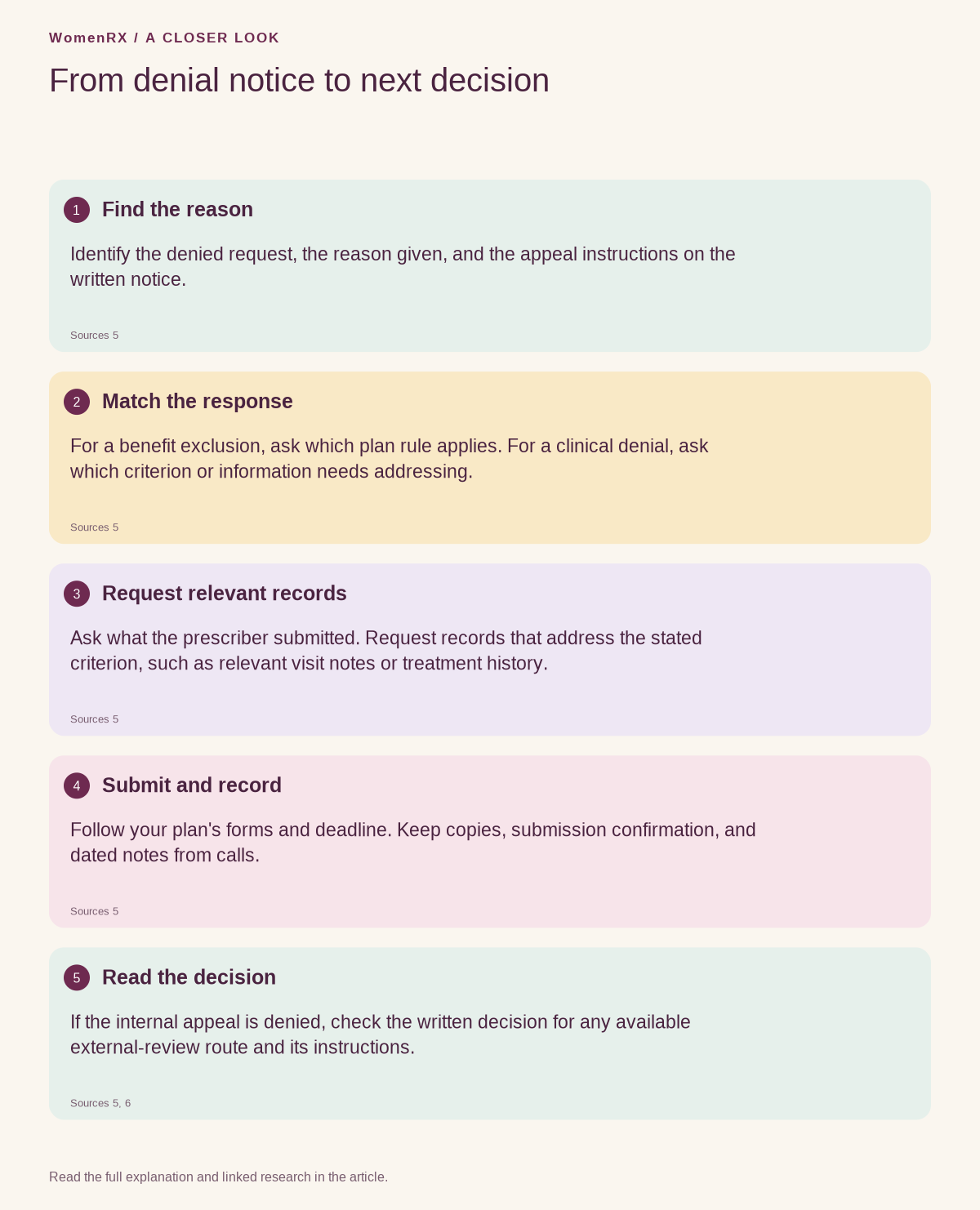
From denial notice to next decision
Find the reason: Identify the denied request, the reason given, and the appeal instructions on the written notice.5
Match the response: For a benefit exclusion, ask which plan rule applies. For a clinical denial, ask which criterion or information needs addressing.5
Request relevant records: Ask what the prescriber submitted. Request records that address the stated criterion, such as relevant visit notes or treatment history.5
Submit and record: Follow your plan's forms and deadline. Keep copies, submission confirmation, and dated notes from calls.5
Read the decision: If the internal appeal is denied, check the written decision for any available external-review route and its instructions.56
Read the figure as text
Follow the reason and instructions in your own notices; the route depends on what the plan denied.- Find the reason: Identify the denied request, the reason given, and the appeal instructions on the written notice.5
- Match the response: For a benefit exclusion, ask which plan rule applies. For a clinical denial, ask which criterion or information needs addressing.5
- Request relevant records: Ask what the prescriber submitted. Request records that address the stated criterion, such as relevant visit notes or treatment history.5
- Submit and record: Follow your plan's forms and deadline. Keep copies, submission confirmation, and dated notes from calls.5
- Read the decision: If the internal appeal is denied, check the written decision for any available external-review route and its instructions.56
More questions, answered
Can my prescriber file the appeal for me?
A prescriber or another person may be able to file on your behalf. Check your insurer's instructions and whether you need to sign an authorization. Keep a copy of anything you sign and of the appeal submitted for you.5
Does a denial mean external review is available?
Not necessarily. External review covers certain kinds of denials, including those involving medical judgment. If an internal appeal is denied, the written final decision should tell you how to request external review when that route applies.56
Sources you can check
- NovoCare: Wegovy semaglutide self-pay pricesAccessed 2026-09-25Return to first citation
- NovoCare: Wegovy self-pay offer quantities and eligibilityAccessed 2026-09-25Return to first citation
- ZEPBOUND (TIRZEPATIDE) INJECTION, SOLUTION ZEPBOUND (TIRZEPATIDE) INJECTION, SOLUTION ZEPBOUND KWIKPEN (TIRZEPATIDE) INJECTION, SOLUTION [ELI LILLY AND COMPANY] | US prescribing information and patient instructionsAccessed 2026-09-25Return to first citation
- WEGOVY (SEMAGLUTIDE) INJECTION, SOLUTION WEGOVY (SEMAGLUTIDE) TABLET [NOVO NORDISK PHARMACEUTICAL INDUSTRIES, LP] | US prescribing information and patient instructionsAccessed 2026-09-25Return to first citation
- Internal appeals | HealthCare.govAccessed 2026-09-25Return to first citation
- External Review | HealthCare.govAccessed 2026-09-25Return to first citation