Wegovy Prior Authorization: What to Check First
Before a request goes in, confirm your plan’s rules, the reason Wegovy was prescribed, and who will follow up if the insurer asks for more information.
Wegovy coverage and prior-authorization rules differ across plans. 3 Before submission, ask your insurer for its current criteria and your clinician’s office what they plan to send. Confirm the request names the prescribed product and indication. Check any clinical thresholds and required records against your own plan’s criteria, then record the submission date and how to check for updates.

Start with your plan’s current rules
Prior authorization means the insurer wants to review a request before deciding whether it will cover a medication. For Wegovy, the first question is not “What does insurance usually require?” It’s “What does my specific plan require right now?” Coverage for obesity medications varies, and prior authorization is one of the access barriers described across U.S. insurance plans. 3
Call the number on your insurance card or check the plan’s current drug-coverage information. Ask for the criteria for Wegovy (semaglutide) and the specific use your clinician prescribed it for. Don’t rely only on a general search result or a rule from another employer’s plan: an insurer’s requirements may not apply to your particular plan, and rules can change.
Useful questions to ask:
- Is Wegovy covered under my plan for the reason it was prescribed?
- Is prior authorization required, and are there any other review steps?
- Where can I get the current criteria and the forms, if forms are required?
- Does the plan specify clinical records or other information that must be submitted?
- How will I find out whether the request is approved, denied, or missing information?
- If it’s denied, how do I get the written reason and information about the next review step?
Write down the date, the department or representative you spoke with, and the answer to each question. If you have coverage through an employer, it may also be useful to ask whether the plan has an exclusion for weight-management medications. A broad review of U.S. coverage describes variation among commercial plans and differences in coverage by indication and payer type. 3
Make sure the request describes your prescription accurately
Before the request is sent, confirm that the clinician’s office knows which product is being requested and the reason it was prescribed. Ask whether the insurer’s form requires a particular way to document that indication. This matters because coverage rules can differ by indication; a 2026 review, for example, describes a distinction between coverage for weight loss and coverage for a cardiovascular indication in eligible patients. That distinction does not mean one use will be covered by your plan. 3
Ask the office what information it plans to submit and whether anything is still missing from you. The plan may have its own documentation requirements, so treat any examples you hear from other people as questions to verify, not a universal checklist. A practical way to prevent confusion is to ask the staff member handling the request to tell you which plan criteria they are addressing and what records they’ll use to do so.
You can also confirm who is responsible for sending the request and who will contact you if the insurer asks for more information. Keep your own copy of any plan criteria or insurer messages you can access. If the request is denied, get the written decision and ask what reason the plan gave, what process applies next, and whether your clinician’s office will help with that step.
Track the handoff, not just the submission
A request can stall if it’s unclear whether the insurer received it, whether it needs more information, or who is meant to respond. To avoid guessing about processing time or documents, ask the insurer how to check status, what else it needs, and when it makes sense to check back.
A simple tracker can keep the moving parts in one place:
| What to track | Your note |
|---|---|
| Plan’s current criteria | Where you found them and when |
| Prescribed product and indication | Confirmed with the clinician’s office |
| Request sent | Date and submitting office or person |
| Insurer status | Pending, decision made, or more information requested |
| Next action | Who will do what, and when you’ll follow up |
| Final decision | Save the written approval or denial and any next-step instructions |
If the insurer asks for more information, note exactly what it requested and whether the clinician’s office or you are responsible for responding. If you can’t tell whether the request was submitted, ask the clinic to confirm the date and submission route, then check with the insurer using that information.
A 2026 practical guide discusses documentation and prior-authorization workflows in several state Medicaid programs for youth. Its examples include clinical details and prior-treatment information, but the programs and requirements differ by state. Those youth Medicaid examples should not be treated as a standard document list for an adult or a commercial plan. 2
Keep pregnancy planning separate from coverage paperwork
Authorization is an insurance decision; pregnancy planning is a separate conversation with your prescriber. Wegovy’s U.S. prescribing information says to discontinue the medication at least two months before a planned pregnancy. If pregnancy is possible or you’re thinking about trying, raise that timing with your prescriber rather than letting the authorization process stand in for treatment planning. 1
Don’t assume the authorization rules differ because you’re a woman. Ask your plan which criteria apply to your request.
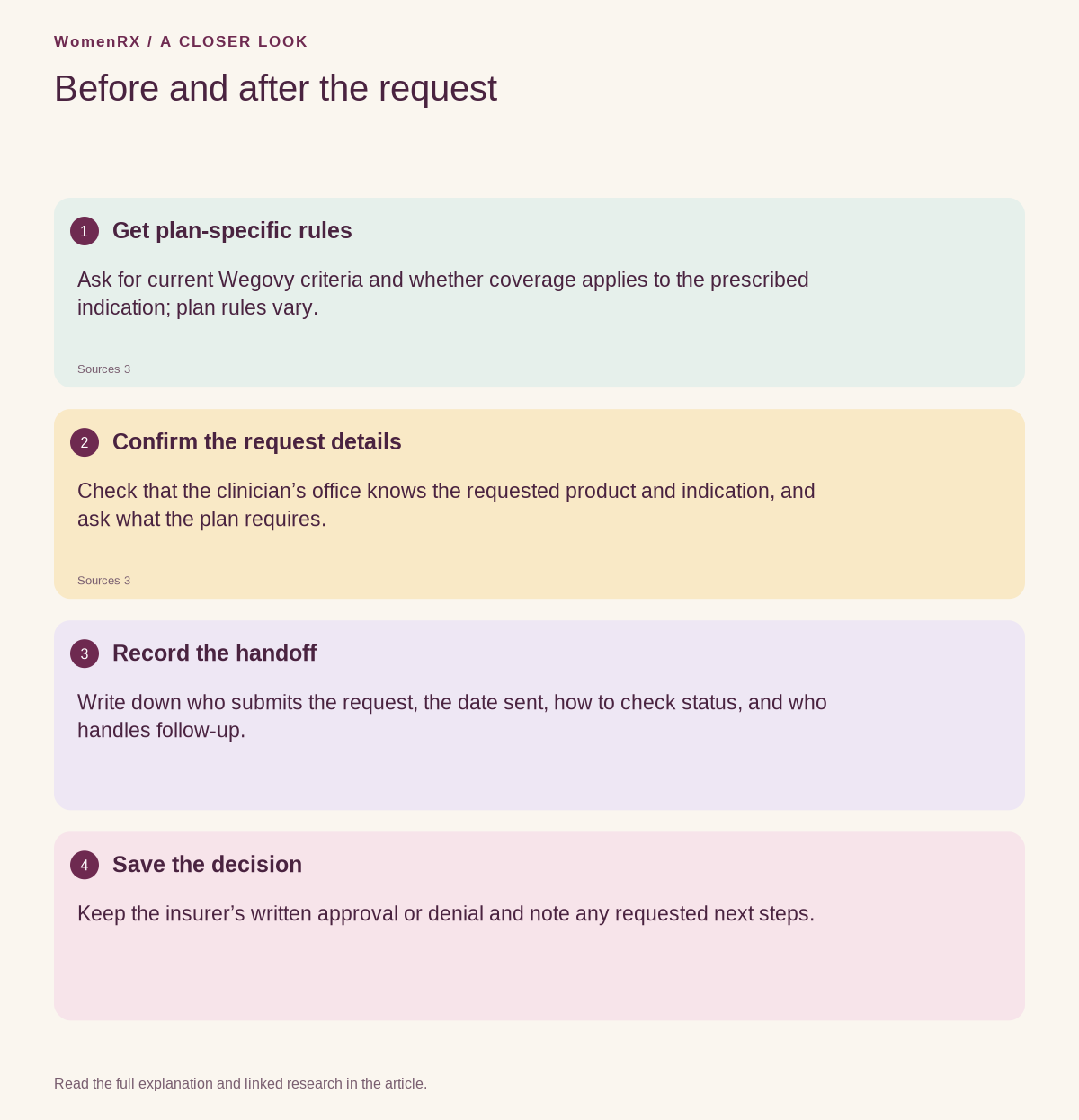
Before and after the request
Get plan-specific rules: Ask for current Wegovy criteria and whether coverage applies to the prescribed indication; plan rules vary.3
Confirm the request details: Check that the clinician’s office knows the requested product and indication, and ask what the plan requires.3
Record the handoff: Write down who submits the request, the date sent, how to check status, and who handles follow-up.
Save the decision: Keep the insurer’s written approval or denial and note any requested next steps.
Read the figure as text
Use these checkpoints to separate plan rules, clinical documentation, submission status, and follow-up responsibilities.- Get plan-specific rules: Ask for current Wegovy criteria and whether coverage applies to the prescribed indication; plan rules vary.3
- Confirm the request details: Check that the clinician’s office knows the requested product and indication, and ask what the plan requires.3
- Record the handoff: Write down who submits the request, the date sent, how to check status, and who handles follow-up.
- Save the decision: Keep the insurer’s written approval or denial and note any requested next steps.
More questions, answered
Does meeting a BMI threshold guarantee Wegovy approval?
Not necessarily. Ask your insurer for the current criteria that apply to your plan, then ask the clinician’s office how the request addresses them. Coverage and authorization requirements vary across plans. 3
What should I do if the insurer denies the request?
Ask for the written decision and the reason for denial. Then ask the insurer what next review step applies and whether your clinician’s office can help respond. The relevant process depends on your plan, so ask the insurer for the instructions that apply to your decision.
Sources you can check
- WEGOVY (SEMAGLUTIDE) INJECTION, SOLUTION WEGOVY (SEMAGLUTIDE) TABLET [NOVO NORDISK PHARMACEUTICAL INDUSTRIES, LP] | US prescribing information and patient instructionsAccessed 2026-09-25Return to first citation
- Using Early and Periodic Screening, Diagnostic, and Treatment (EPSDT) to improve access to obesity pharmacotherapy: A practical guide for clinicians caring for youth with obesity across United States Medicaid programs: Abbreviated title: Using EPSDT to Improve Access to Obesity Pharmacotherapy.Moore JM, O'Hara VM, Totman C, Sweeney B, Hampl S, Vidmar AP. · Obesity pillars · 2026Return to first citation
- GLP-1 receptor agonists in primary care: readiness, equity, and the risk of a two-tiered obesity treatment landscape.Ahmed MM, Nazari R, Othman ZK, Musa SS, Okesanya OJ, Adebayo UO, Branda F, Elmi AH, Lucero Prisno DE. · Therapeutic advances in endocrinology and metabolism · 2026Return to first citation