How to Check Medicare or Medicaid GLP-1 Coverage
A 2026 Medicare program may offer a $50 copay to eligible people, while Medicaid coverage still depends on your state and plan.
Start with the exact medicine, its formulation, and the reason it’s prescribed. Eligible people with Medicare Part D may be able to get certain GLP-1 medicines for weight reduction through the Medicare GLP-1 Bridge, which runs from July 1, 2026, through December 31, 2027, with a $50 copay. It’s separate from ordinary Part D coverage. Medicaid rules vary by state and plan.673

First, name the prescription and the reason for it
“Does Medicare cover GLP-1s?” is too broad to get you a useful cost estimate. Write down the brand, whether it’s a tablet or injection, and the condition your prescriber is treating. For example, Wegovy has tablet and injection forms; don’t assume a coverage answer for one form applies to the other.1
The reason matters just as much. Medicare Part D coverage expanded in 2024 for Wegovy’s cardiovascular-risk indication in people with overweight or obesity and cardiovascular disease. That did not make every prescription for weight loss an ordinary Part D benefit.5 In 2026, there’s also a separate route for some weight-reduction prescriptions.
If you have Medicare, check two coverage routes
For weight reduction: The Medicare GLP-1 Bridge offers certain GLP-1 medicines to eligible people with qualifying Part D coverage. It runs from July 1, 2026, through December 31, 2027. Your prescriber must submit a prior authorization request showing that you meet the program’s clinical criteria. Having Part D alone doesn’t establish eligibility.67
The Bridge copay is $50 for an eligible prescription. Because the program operates outside the Part D benefit, the Part D deductible doesn’t apply, the copay doesn’t count toward Part D out-of-pocket costs, and the Part D low-income subsidy doesn’t reduce that copay.6 To check your situation and the current list of eligible medicines, start at Medicare.gov/glp1bridge or call 1-800-MEDICARE. Ask about your exact product and formulation, your plan type, and the prior authorization criteria.67
For another covered indication: Ask your Part D plan to check the prescription under its regular drug benefit, using the diagnosis your prescriber is treating. Confirm that the exact product is on the formulary, whether prior authorization or another restriction applies, and what you would owe at the pharmacy. Don’t use the Bridge’s $50 copay as your estimate for an ordinary Part D fill. An analysis comparing Part D plans in 2024 and 2025 found changes in GLP-1 coverage and first-fill costs, which is one reason a current, plan-specific quote is more useful than a general price.26
If you have both Medicare and Medicaid, don’t assume that rules out the Bridge. Eligible people with both programs can use it if they have a qualifying Part D plan type and meet its authorization criteria. Check which program would handle this prescription before relying on either program’s quoted cost.7
If you have Medicaid, start with your state and plan
There isn’t one national Medicaid answer for a GLP-1 prescribed for weight reduction. Research on Medicaid policies found variation by state and by indication; a separate study of diabetes medicines found that restrictions also differed between state fee-for-service programs and managed care plans.34
Ask your state Medicaid program or the member-services number on your plan card: “Is this exact medicine and formulation covered for my diagnosis? Is prior authorization required? What would I pay, and where can it be filled?” If the answer is no, ask whether that means the medicine is excluded for your indication or that an authorization request hasn’t been approved. Those are different questions to bring back to your prescriber.
You may hear about BALANCE, a federal model intended to expand access to selected GLP-1 medicines. Participation by state Medicaid agencies is voluntary, so the model’s existence doesn’t mean your state or plan covers your prescription. Check the current policy where you live rather than assuming a federal announcement has changed your benefits.8
One treatment question worth raising alongside cost
Coverage is only one part of choosing a medicine. If pregnancy is in your plans, tell your prescriber before settling on a GLP-1 option: Wegovy’s prescribing information warns of potential fetal harm and calls for stopping it ahead of a planned pregnancy.1 That conversation can happen alongside the coverage check, so you’re comparing options that fit both your health needs and your circumstances.
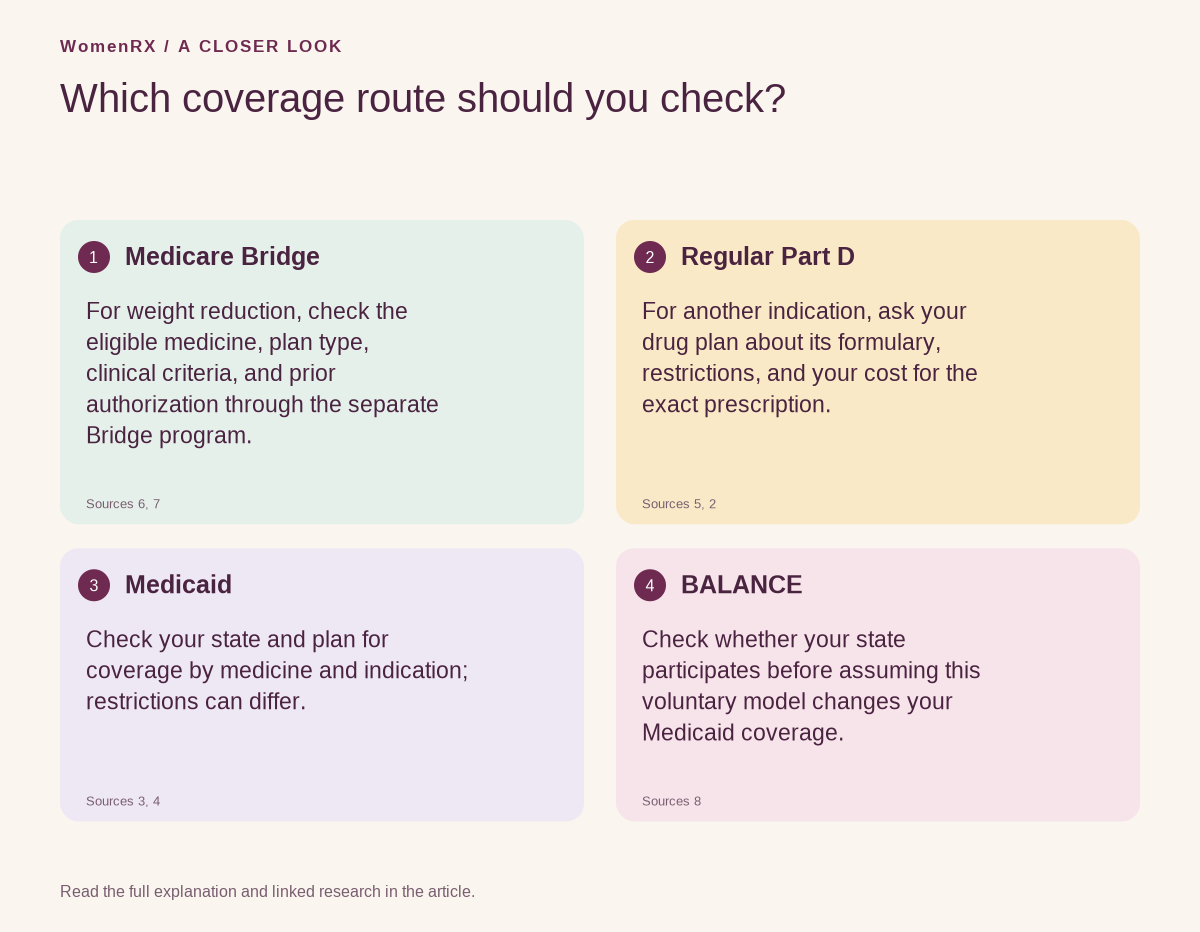
Which coverage route should you check?
Medicare Bridge: For weight reduction, check the eligible medicine, plan type, clinical criteria, and prior authorization through the separate Bridge program.67
Regular Part D: For another indication, ask your drug plan about its formulary, restrictions, and your cost for the exact prescription.52
Medicaid: Check your state and plan for coverage by medicine and indication; restrictions can differ.34
BALANCE: Check whether your state participates before assuming this voluntary model changes your Medicaid coverage.8
Read the figure as text
The same prescription question goes to different places depending on your program and indication.- Medicare Bridge: For weight reduction, check the eligible medicine, plan type, clinical criteria, and prior authorization through the separate Bridge program.67
- Regular Part D: For another indication, ask your drug plan about its formulary, restrictions, and your cost for the exact prescription.52
- Medicaid: Check your state and plan for coverage by medicine and indication; restrictions can differ.34
- BALANCE: Check whether your state participates before assuming this voluntary model changes your Medicaid coverage.8
More questions, answered
Does a $50 Bridge copay count toward my Part D out-of-pocket costs?
No. The Medicare GLP-1 Bridge operates outside the Part D benefit, so its $50 copay doesn’t count toward Part D out-of-pocket costs.6
Sources you can check
- WEGOVY (SEMAGLUTIDE) INJECTION, SOLUTION WEGOVY (SEMAGLUTIDE) TABLET [NOVO NORDISK PHARMACEUTICAL INDUSTRIES, LP] | US prescribing information and patient instructionsAccessed 2026-09-25Return to first citation
- Assessing the impact of the Inflation Reduction Act on Medicare prescription drug coverage.Zhang YW, Blyumin MG, Qu C, Guo X, Zhang M. · American journal of health-system pharmacy : AJHP : official journal of the American Society of Health-System Pharmacists · 2026Return to first citation
- State-level variation in the use of glucagon-like peptide-1 receptor agonists for weight loss and diabetes: a real-world analysis.Do S, Christensen K, Inneh A, Peasah S, Good C. · Journal of managed care & specialty pharmacy · 2026Return to first citation
- Availability of Cardioprotective Medications for Type 2 Diabetes in the Medicaid Program.Makam AN, Bailey L, Anderson N, Bellitti K, Skinner S, Nguyen OK. · Annals of internal medicine · 2025Return to first citation
- Changes in Semaglutide Fills Following Expanded FDA and Medicare Policies.Scannell C, Romley JA, Myerson R, Goldman D, Qato DM. · The American journal of managed care · 2026Return to first citation
- Medicare GLP-1 BridgeAccessed 2026-09-25Return to first citation
- Information for ProvidersAccessed 2026-09-25Return to first citation
- BALANCE (Better Approaches to Lifestyle and Nutrition for Comprehensive hEalth) ModelAccessed 2026-09-25Return to first citation