What “Nervous System Regulation” Really Means
Your stress response is normal body physiology, and calming practices may help without literally resetting your nervous system.
“Nervous system regulation” is often wellness shorthand for how your body responds to stress and settles afterward. Stress can temporarily change heart rate, blood pressure, breathing, and alertness; that response can be useful, not a sign that something is broken. For ongoing stress, practical options include movement, sleep, relaxation, and support from people you trust. 14
Regulation is a process, not a diagnosis
You might hear that a breathing exercise, yoga class, or supplement will “regulate” your nervous system. In everyday wellness advice, the phrase is usually broad shorthand for how your body responds to stress and recovers. A stress response isn’t automatically a problem to fix.
When your brain and body respond to a challenge, stress hormones can make you more alert and raise your heart rate, blood pressure, and blood sugar. That quick response can help you react to danger or meet a deadline. Stress that continues for weeks or longer is different and can affect health. 1
The autonomic nervous system helps control involuntary functions such as heartbeat, breathing, and blood pressure. During a stress response, sympathetic activity may increase while parasympathetic, or vagal, activity decreases. These are parts of a changing body response, not proof that your system is permanently stuck in one mode. 4
What a body signal can, and can’t, tell you
Heart rate variability, or HRV, describes variation in the time between heartbeats. Researchers use it as one noninvasive, nonspecific marker of autonomic activity. It offers a clue about cardiac patterns, not a complete reading of your emotional state or a standalone verdict that your nervous system is “dysregulated.” 4
Researchers also measure other responses, including skin conductance and blood pressure. Different measures capture different aspects of physiology, so a single number can’t tell the whole story of how you’re feeling or why a stress response is happening. 46
Calming practices are options, not resets
You don’t need to choose a practice based on claims that it “resets” your body. Regular movement, enough sleep, relaxing activities such as breathing or muscle relaxation, and support from people you trust are practical ways to manage stress. These are strategies for coping, not promises to switch off stress physiology. 1
Some small human studies have looked at both how people feel and physiological signals. In one study, 23 adults with moderate stress were assigned to eight weeks of yoga or Pilates. Both groups improved on measures of mental health and autonomic function. Because the study was small and compared two active programs, it doesn’t establish that either practice works for everyone or is better than other options. 2
A study of young adults compared two brief mindfulness sessions with an audiobook control. The mindfulness group showed greater respiratory sinus arrhythmia (RSA) augmentation, lower skin conductance, and greater declines in blood pressure than the control group. During a lab stress test, the mindfulness group showed a different pattern of coordination between RSA and skin conductance; blood pressure was also lower immediately after the stressor. These short-term findings don’t establish lasting effects in everyday life. 6
In a randomized study, slow-paced breathing was compared with faster control breathing, both with and without brain stimulation. Slow-paced breathing affected some measured outcomes, including skin conductance responses and pupil dilation. Those findings suggest possible short-term effects on selected measures, not proof of a whole-body reset. 5
If you want to try a practice, think of it as an experiment in comfort and stress management, not a test of whether you’re “regulated.” You could choose an easy walk, a relaxing activity, or a brief breathing or mindfulness practice. Keep it manageable and stop if it makes you feel worse. You don’t have to feel perfectly calm for a practice to be useful.
Women’s physiology isn’t one fixed pattern
A review discusses possible links between hormonal states and stress-related measures such as HRV, but says the clinical usefulness of these measures across women’s life stages still needs validation in longitudinal research. That uncertainty is a reason not to treat one reading, symptom, or life stage as proof that a woman’s nervous system is inherently dysregulated. 3
When stress keeps getting in the way
For ongoing stress, start with practical supports rather than trying to force your body into a particular state. MedlinePlus suggests regular exercise, enough sleep, relaxing activities such as breathing, meditation, or muscle relaxation, avoiding too much caffeine, deciding what needs attention now and what can wait, and asking friends or family for support. These are options to manage stress, not a guarantee that it will disappear. 1
If symptoms are severe and last for two weeks or more, MedlinePlus advises asking a healthcare provider for help. That’s a different step from choosing a calming practice: it gives you a chance to discuss what’s happening and whether ongoing pressures, a difficult life change, or traumatic stress may be involved. Traumatic stress can sometimes lead to PTSD. An online “nervous system” label can’t make those distinctions for you. 1
Stress response, measures, and support
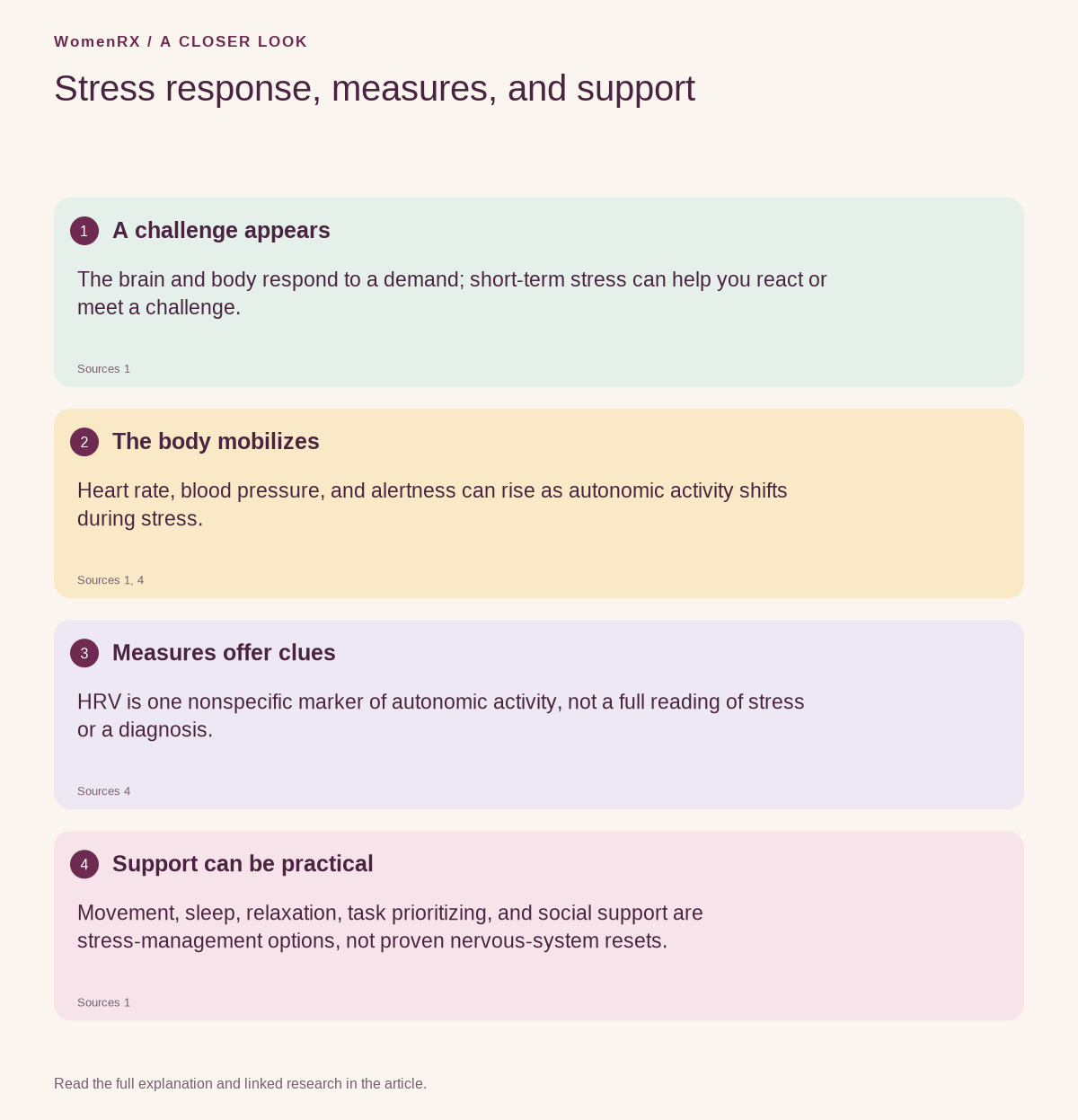
A challenge appears: The brain and body respond to a demand; short-term stress can help you react or meet a challenge.1
The body mobilizes: Heart rate, blood pressure, and alertness can rise as autonomic activity shifts during stress.14
Measures offer clues: HRV is one nonspecific marker of autonomic activity, not a full reading of stress or a diagnosis.4
Support can be practical: Movement, sleep, relaxation, task prioritizing, and social support are stress-management options, not proven nervous-system resets.1
Read the figure as text
This figure separates a normal stress response from the signals researchers measure and practical ways to manage ongoing stress.- A challenge appears: The brain and body respond to a demand; short-term stress can help you react or meet a challenge.1
- The body mobilizes: Heart rate, blood pressure, and alertness can rise as autonomic activity shifts during stress.14
- Measures offer clues: HRV is one nonspecific marker of autonomic activity, not a full reading of stress or a diagnosis.4
- Support can be practical: Movement, sleep, relaxation, task prioritizing, and social support are stress-management options, not proven nervous-system resets.1
More questions, answered
Does a low HRV mean my nervous system is dysregulated?
Not by itself. HRV is a nonspecific marker of autonomic activity, not a complete measure of stress or a standalone diagnosis. Researchers may consider it alongside other physiological measures and how a person is doing. 46
Sources you can check
- Stress: MedlinePlusAccessed 2026-09-25Return to first citation
- Effects of 8-week Pilates or yoga intervention on body composition, flexibility, balance, autonomic nervous system function, and mental health in adults with stress.Song JH, Choi JH, Beak HJ, Park HY. · Physical activity and nutrition · 2026Return to first citation
- Autonomic Nervous System Regulation in Women: Electrophysiological Signatures of Stress Reactivity across the Female Lifespan.Kazdağlı H, Altınoluk T. · Neuropsychobiology · 2026Return to first citation
- Detecting effects of yoga therapy on heart rate variability and autonomic nervous system functioning in adults after cancer treatment: results from a study using single-subject experimental methods.Brunet J, Hussien J, Pitman A, Wurz A, Conte E, Herry C, Polskaia N, Seely A, Seely D. · BioPsychoSocial medicine · 2026Return to first citation
- The Combined Effects of Prefrontal tDCS and Slow-Paced Breathing on Stress and Emotions.Schoonjans E, Allaert J, Verduyn Y, Houfflyn J, De Smet S, Kappen M, Ottaviani C, De Raedt R, Vanderhasselt MA. · Psychophysiology · 2026Return to first citation
- Exploring the impact of a brief mindfulness-based intervention on autonomic functioning: A multisystem approach.Chong LS, Bucher RC, Merritt E, Gordis EB. · Physiology & behavior · 2026Return to first citation