Weight-Loss Supplements: What Human Studies Show
A promising mechanism or change in a blood test isn’t the same as reliable, meaningful weight loss.
Human studies give little reason to expect a weight-loss supplement to add much on its own. In a trial of 66 women, beta-glucan didn’t lead to more weight loss than a low-calorie diet alone; a small probiotic trial also found no added weight benefit over diet. Some ingredients have limited positive results, but side effects can range from headache or trouble sleeping to serious events reported with multi-ingredient products. 1 2
Start with the outcome, not the mechanism
A supplement may be described as increasing metabolism, curbing appetite, or changing a metabolic marker. Those ideas can be reasons to study an ingredient, but they don’t show that taking it produces meaningful weight loss. Human trials need to measure weight directly and compare the supplement with a suitable control. Even then, a small or brief study may not tell you whether the result lasts or applies to you.
The NIH Office of Dietary Supplements notes that evidence for some weight-loss ingredients comes mainly from laboratory or animal studies. Other research is limited by small samples, short duration, or study quality. Products may also combine many ingredients, making it difficult to know which one, if any, accounts for a result. 1
What the human results look like
Beta-glucan: a useful women-specific example, with no added weight loss. In a three-month study, 66 women with overweight followed a low-calorie diet with one of two amounts of oat-bran beta-glucan, or without beta-glucan. All groups lost weight and reduced waist circumference, but the differences between groups weren’t significant. The diet was designed to produce weight loss, so the study doesn’t show that beta-glucan added to it. 1
Probiotics: a small trial didn’t show an extra effect. In an eight-week placebo-controlled pilot trial, 24 adults with obesity and high cholesterol received a probiotic or placebo while following a calorie-restricted diet. Weight and other body measurements fell in both groups, but the researchers found no significant difference between groups in those outcomes. That pattern points to the shared diet, not a demonstrated added benefit from the probiotic. The study was small and brief, and it doesn’t establish what might happen with other products or people. 2
Irvingia: a positive result that needs confirmation. One 10-week trial randomized 102 adults with overweight or obesity to an Irvingia extract or placebo and reported better weight, body-fat, and waist outcomes in the extract group. But the broader evidence described by NIH relied on small, short studies with varying methods and amounts, conducted by the same authors. Women-specific results aren’t given, so the findings can’t tell you whether the effect differs for women. This is a signal to investigate, not dependable proof of lasting weight loss. 1
These examples aren’t a complete ranking of every ingredient on the market. They illustrate why the study details matter: a positive result in one short trial is different from a well-established, lasting effect, and a change in a marker isn’t automatically a change in weight.
What the safety evidence can tell you
Possible harms vary by ingredient. For Irvingia extract, reported effects include headache, trouble sleeping, gas, and flatulence. A report of renal failure in a person with chronic kidney disease was also noted, but a single report can’t establish that Irvingia caused it. 1
Bitter orange products raise a different concern: reports involving products containing bitter orange include chest pain, anxiety, elevated heart rate, stroke, heart attack, and death. Many of those products contained multiple herbal ingredients, so the role of bitter orange itself couldn’t be isolated. These reports don’t prove that bitter orange alone caused each event, but they do make it hard to treat a multi-ingredient product as a known, low-risk choice. 1
The NIH reference also flags possible interactions between some supplement ingredients and medicines, but the findings summarized here don’t establish a specific ingredient-medicine interaction to name. 1 Pregnancy and breastfeeding are separate safety contexts; weight-loss results in other adults don’t establish whether a product is appropriate during either stage.
A practical way to judge a product
Before buying, look for a human study of the same ingredient, not just a similar-sounding product or a proposed mechanism. Then ask:
- Did the study measure body weight or waist size, or only a metabolic marker?
- Was there a comparison group, and did the supplement group do better than that group?
- How many people took part, and how long were they followed?
- Were participants women, and were women’s results reported separately?
- Does the product contain several ingredients, making it hard to connect any result or adverse effect to one of them?
A statistically significant difference by itself doesn’t tell you whether the change is large enough to matter in everyday life. The evidence should also be weighed against safety and cost. In the US, these products don’t go through FDA premarket review and approval as drugs do. 1
The clearest takeaway is modest: don’t treat a lab explanation, a biomarker change, or one small trial as evidence that a supplement will reliably move the scale. In the human examples here, results are mixed, limited, or show no extra benefit over the comparison approach. The reported harms also differ by ingredient, and serious events described with multi-ingredient products can be difficult to attribute to one component. 1 2
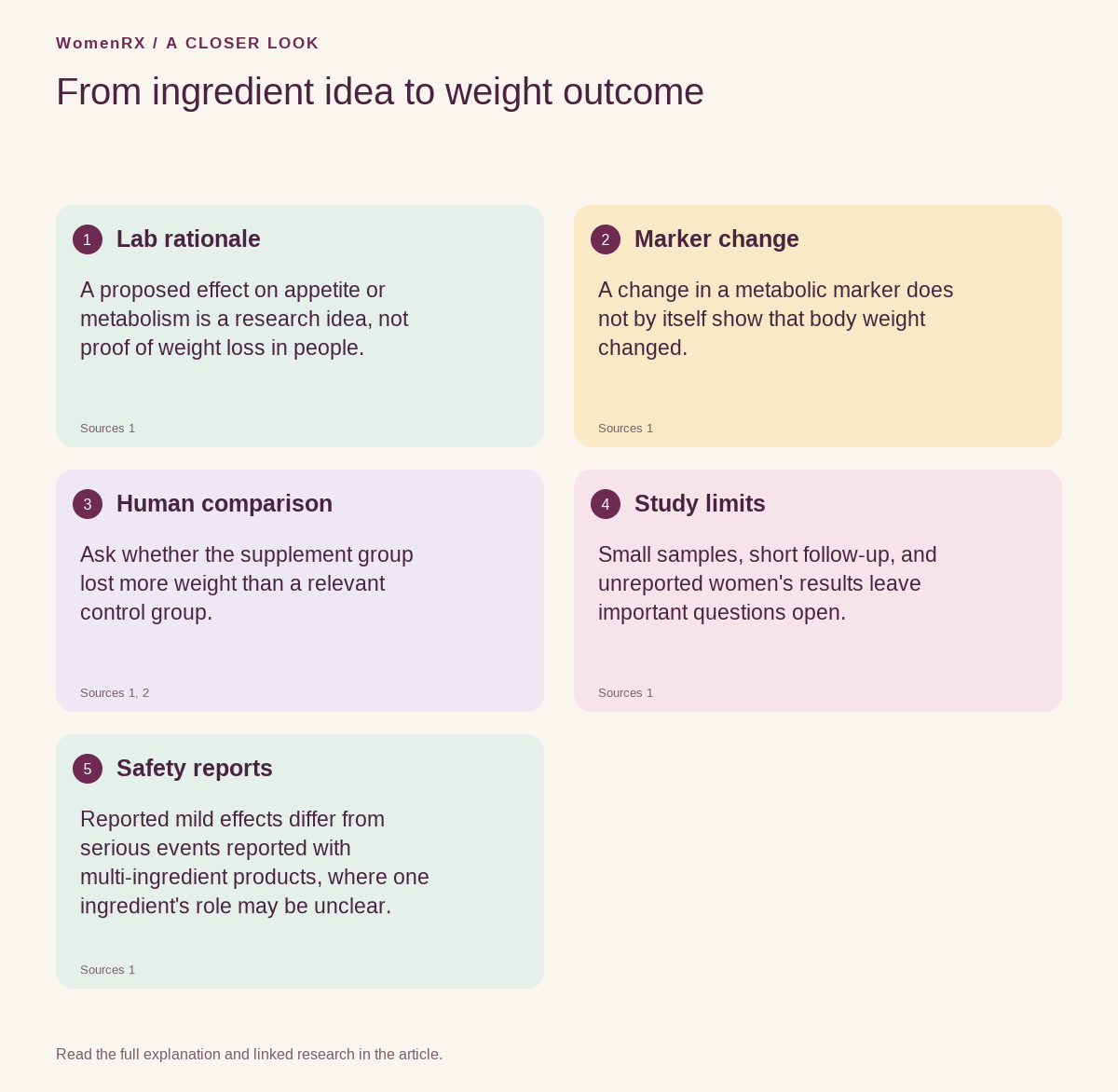
From ingredient idea to weight outcome
Lab rationale: A proposed effect on appetite or metabolism is a research idea, not proof of weight loss in people.1
Marker change: A change in a metabolic marker does not by itself show that body weight changed.1
Human comparison: Ask whether the supplement group lost more weight than a relevant control group.12
Study limits: Small samples, short follow-up, and unreported women's results leave important questions open.1
Safety reports: Reported mild effects differ from serious events reported with multi-ingredient products, where one ingredient's role may be unclear.1
Read the figure as text
A mechanism or marker can suggest what to study, but human comparisons of weight outcomes and a clear view of safety reports matter when judging a weight-loss claim.- Lab rationale: A proposed effect on appetite or metabolism is a research idea, not proof of weight loss in people.1
- Marker change: A change in a metabolic marker does not by itself show that body weight changed.1
- Human comparison: Ask whether the supplement group lost more weight than a relevant control group.12
- Study limits: Small samples, short follow-up, and unreported women's results leave important questions open.1
- Safety reports: Reported mild effects differ from serious events reported with multi-ingredient products, where one ingredient's role may be unclear.1
Sources you can check
- Dietary Supplements for Weight Loss - Health Professional Fact SheetAccessed 2026-09-25Return to first citation
- Effects of probiotic supplementation on blood lipids ın hypercholesterolemic obese patients: a randomized, double-blind, placebo-controlled pilot trial.Bulut S, Kabaran S. · Nutricion hospitalaria · 2025Return to first citation