Water-Weight Changes: What Is Usually Temporary and When to Get Help
A quick change on the scale may involve body water, but new swelling and other symptoms matter more than the number alone.
A quick scale change doesn’t tell you how much, if any, is body fat: your weight includes water. Menstrual-cycle changes can play a part, but don’t assume new swelling is routine. Get emergency help for severe breathing trouble or a heavy, tight chest. Seek prompt medical advice for one-sided leg pain or swelling or new breathlessness. Arrange medical advice for a sudden, unexplained weight change. 361
First, separate a scale change from visible swelling
Your scale measures everything that makes up your body weight, including water, muscle, bone, and fat. One reading can show that your weight changed; it can’t tell you which part changed or why. Diet, activity, stress, and sleep can also influence body weight, so a different reading after an ordinary change in routine doesn’t, by itself, establish that you’re retaining fluid. MedlinePlus advises getting medical advice for a sudden, unexpected gain or loss rather than assuming it has a harmless explanation. 3
Swelling gives you another piece of information. For example, if your shoes suddenly feel tight and one leg looks swollen, that’s a different situation from seeing a higher number without any new symptoms. A familiar scale variation with no new symptoms calls for context, not an attempt to shed fluid. Where the swelling appears and how quickly it began help determine what to do next. The useful question isn’t just “How do I lose this water weight?” It’s “Is there a symptom here that needs attention?” 1356
Look at what changed around the same time
A salty meal or a long stretch of sitting or standing can contribute to swollen ankles or feet. Some medicines, including certain blood-pressure medicines, contraceptive pills, hormone therapy and antidepressants, can also contribute. These are possibilities to review, not proof that a scale change has a harmless cause. 13
Write down where the swelling appears, whether it affects one side or both, and when it started. Add any recent medicine change or unusually long journey. If mild swelling follows prolonged sitting, gentle walking and resting with your legs raised may help. Avoid staying in one position for long stretches. 13
If both ankles or legs stay swollen after a few days of home care, or swelling worsens, arrange an appointment. Unexplained one-sided swelling, or swelling that is sudden, severe, painful, red or hot, needs urgent assessment. 13
What your menstrual cycle can, and can’t, explain
If you menstruate, a familiar change around your period may help put a scale reading in context. In a study that measured 42 women twice weekly, body weight was about 0.45 kg higher during menstruation than in the first week of the cycle. The researchers attributed most of that difference to extracellular water. That’s an average from one study, not a target or a way to identify the cause of your own weight change. 6
Cycle-related swelling isn’t perfectly predictable, either. A separate study of 29 university students found no significant difference in total body weight or total body water across the phases measured, although some regional water measurements differed. Taken together, these small studies support the possibility of cycle-related variation, not a rule that any amount of swelling near your period is harmless. 56
Let symptoms set the next step
Get emergency help now if you have severe difficulty breathing, can’t get words out because of breathlessness, or your chest feels tight or heavy. Don’t wait to see whether your weight changes again. 1
Seek prompt medical advice if you develop difficulty breathing or pain or swelling in one leg. Breathlessness that worsens during ordinary activities or when lying down, especially with swollen ankles, also needs medical assessment. These symptoms have several possible causes; the scale can’t sort them out. 1
Arrange medical advice for an unexplained change if your weight rises or falls suddenly without an apparent reason, even when you feel otherwise well. The change doesn’t establish that you’re retaining fluid, but it’s worth finding out what’s behind it. If swelling is new or keeps concerning you, don’t label it a routine cycle change simply because of the timing. 356
Gradual ankle swelling can occur in pregnancy. A sudden increase in swelling of the face, hands or feet, especially with a severe headache, vision problems or pain below the ribs, needs immediate contact with your maternity care team. Do not wait for a food change to fix it. 14
Don’t try to force the number down
Deliberately dehydrating yourself isn’t a solution to an unexplained scale change. Your body needs a balance of water and electrolytes, and too little water can disrupt that balance. A lower reading after losing fluid would still not tell you why your weight changed or whether swelling needs attention. 113
If the change seems tied to a familiar point in your cycle and you have no new swelling or concerning symptoms, you don’t need to make a single reading mean more than it does. If swelling is new, the change is unexpected, or symptoms appear, use those details to decide on care rather than trying to make the scale move first. 631
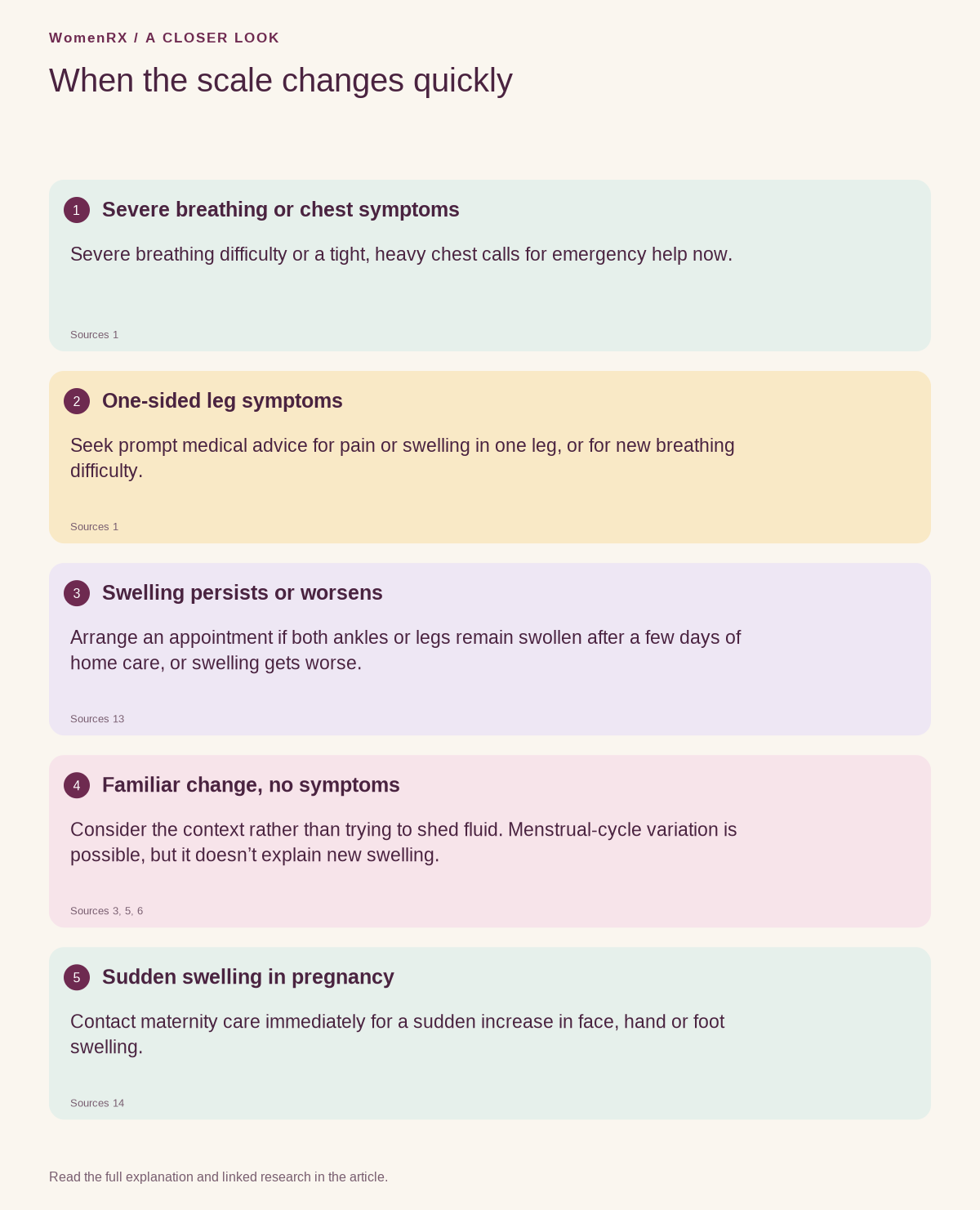
When the scale changes quickly
Severe breathing or chest symptoms: Severe breathing difficulty or a tight, heavy chest calls for emergency help now.1
One-sided leg symptoms: Seek prompt medical advice for pain or swelling in one leg, or for new breathing difficulty.1
Swelling persists or worsens: Arrange an appointment if both ankles or legs remain swollen after a few days of home care, or swelling gets worse.13
Familiar change, no symptoms: Consider the context rather than trying to shed fluid. Menstrual-cycle variation is possible, but it doesn’t explain new swelling.356
Sudden swelling in pregnancy: Contact maternity care immediately for a sudden increase in face, hand or foot swelling.14
Read the figure as text
Start with symptoms, then consider whether the change fits a familiar pattern. The scale alone can’t identify its cause.- Severe breathing or chest symptoms: Severe breathing difficulty or a tight, heavy chest calls for emergency help now.1
- One-sided leg symptoms: Seek prompt medical advice for pain or swelling in one leg, or for new breathing difficulty.1
- Swelling persists or worsens: Arrange an appointment if both ankles or legs remain swollen after a few days of home care, or swelling gets worse.13
- Familiar change, no symptoms: Consider the context rather than trying to shed fluid. Menstrual-cycle variation is possible, but it doesn’t explain new swelling.356
- Sudden swelling in pregnancy: Contact maternity care immediately for a sudden increase in face, hand or foot swelling.14
Sources you can check
- Shortness of breath - NHSAccessed 2026-09-25Return to first citation
- Body Weight: MedlinePlusAccessed 2026-09-25Return to first citation
- The difference between subjective symptoms and objective symptom of edema during the menstrual cycle.Takano Y, Shirai T, Tanaka Y, Sakamoto K, Yokota H, Hirabayashi R, Ishigaki T, Komiya M, Edama M. · Scientific reports · 2026Return to first citation
- Changes in body weight and body composition during the menstrual cycle.Kanellakis S, Skoufas E, Simitsopoulou E, Migdanis A, Migdanis I, Prelorentzou T, Louka A, Moschonis G, Bountouvi E, Androutsos O. · American journal of human biology : the official journal of the Human Biology Council · 2023Return to first citation
- Fluid and Electrolyte Balance: MedlinePlusAccessed 2026-09-25Return to first citation
- NHS: Swollen ankles, feet and legsAccessed 2026-09-26Return to first citation
- NHS: Swollen ankles, feet and fingers in pregnancyAccessed 2026-09-26Return to first citation