Uterine Polyps: What May Contribute and When They Matter
Polyps are focal growths in the uterine lining, and their significance depends on bleeding, menopause status, and what you hope to do next.
Uterine, or endometrial, polyps are localized growths of tissue in the lining of the uterus. They can occur before or after menopause and may cause bleeding, though some cause no symptoms. Age, obesity, ovulatory disorders, and tamoxifen use are associated with a greater prevalence, but an association cannot explain why one person developed a polyp. Bleeding after menopause needs assessment; treatment otherwise depends on symptoms, risk, and fertility goals. 5 2
What a polyp is, and what may contribute
An endometrial polyp is a localized overgrowth of glands and supporting tissue in the lining of the uterus. Polyps can be present during the reproductive years or after menopause. Some are found during an evaluation for another reason; others are linked with abnormal bleeding or fertility concerns. 3 5
Age, obesity, ovulatory disorders, and tamoxifen use are associated with a higher prevalence of polyps. These are risk associations, not proof that a particular factor caused an individual polyp. Research into how polyps develop has not established a simple explanation that can account for every case. 5 7
The bleeding pattern matters
Before menopause, bleeding between periods is a common way a polyp may show up. But bleeding changes can have other causes, too. Ultrasound can help look for a polyp, while some common causes of bleeding before menopause, including infection and bleeding related to contraception, may not be diagnosed by ultrasound alone. 4 5
After menopause, bleeding or spotting should be assessed, even if it happens only once. Polyps are one possible cause, but they are not the only one. Evaluation is also meant to identify or rule out other endometrial problems, including cancer. 1 5
A transvaginal ultrasound is often an initial look at the uterus. If the lining or a possible growth needs a closer look, sonohysterography or hysteroscopy may be considered. Hysteroscopy lets the clinician look inside the cavity and can allow a polyp to be removed; tissue can then be examined. The choice of tests depends on the bleeding pattern and the findings so far. 4 5 6
When observation, removal, or another approach may come up
A suspected polyp does not automatically mean surgery. For a small polyp without symptoms, observation may be reasonable in some situations. If bleeding is troubling, if menopause or other risk factors affect concern about abnormal tissue, or if diagnosis remains uncertain, removal and tissue examination may be discussed. A guideline describes expectant, medical, and surgical management as options shaped by symptoms, malignancy risk, and patient choice. 2 5
For many people who need treatment, hysteroscopic removal is an option. Medication may help with symptoms in some cases, but it does not take the place of evaluating persistent or changing bleeding. The best choice is not determined by the word “polyp” alone. 2 5
If you are trying to conceive, mention that when discussing evaluation. Polyps are associated with infertility, but how much they contribute to infertility or affect the success of assisted reproduction remains unclear. That uncertainty makes your fertility goals relevant to the decision, without making removal an automatic answer for everyone. 5
A practical way to frame the discussion is: What did the imaging show? Is the bleeding pattern expected for my stage of life? Is further testing needed to assess the uterine lining? And how would observation or removal fit with my symptoms and fertility goals? These questions connect the finding to the decision, rather than assuming every polyp has the same meaning.
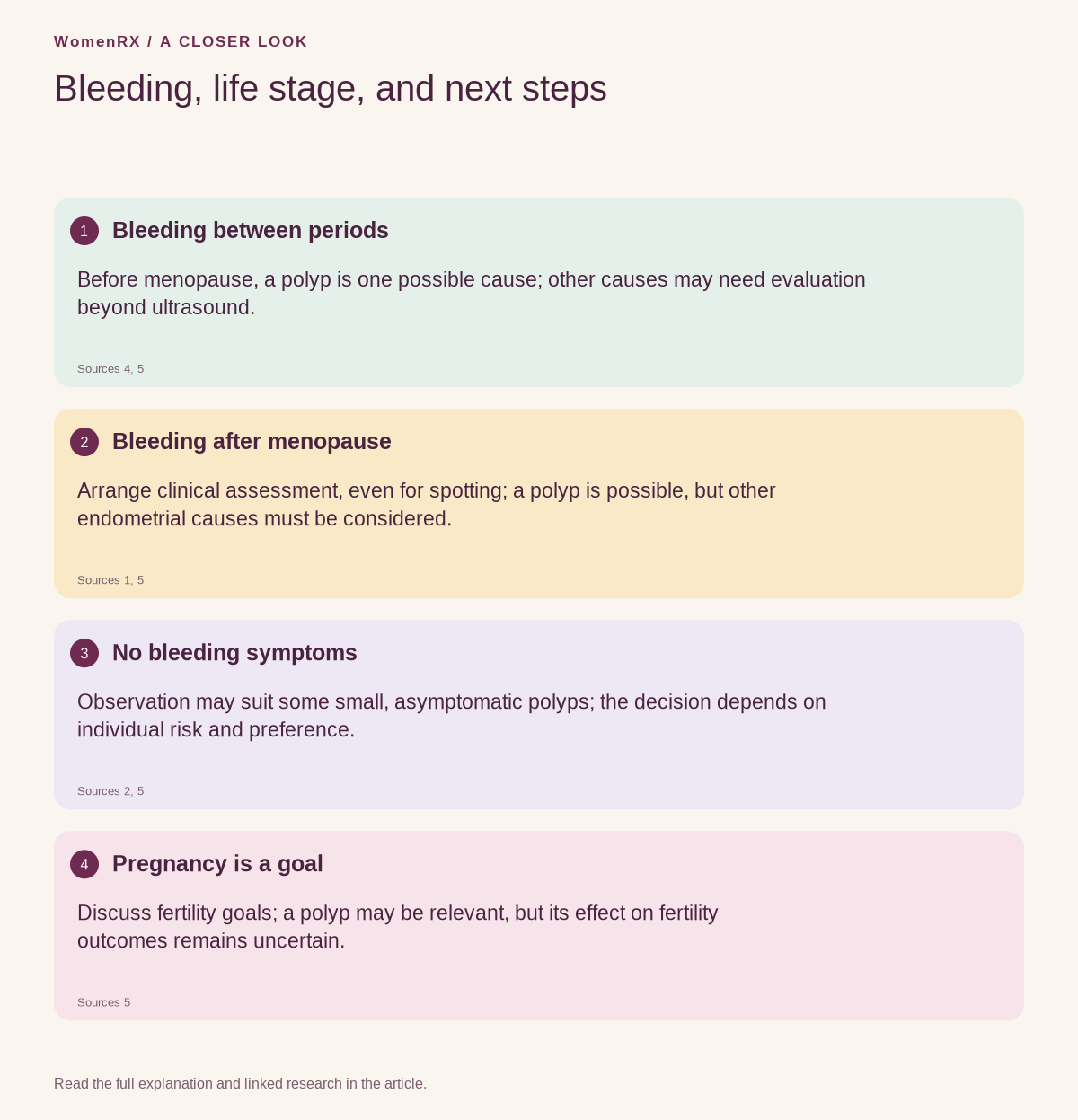
Bleeding, life stage, and next steps
Bleeding between periods: Before menopause, a polyp is one possible cause; other causes may need evaluation beyond ultrasound.45
Bleeding after menopause: Arrange clinical assessment, even for spotting; a polyp is possible, but other endometrial causes must be considered.15
No bleeding symptoms: Observation may suit some small, asymptomatic polyps; the decision depends on individual risk and preference.25
Pregnancy is a goal: Discuss fertility goals; a polyp may be relevant, but its effect on fertility outcomes remains uncertain.5
Read the figure as text
A suspected polyp is interpreted alongside bleeding pattern, menopausal status, imaging, and fertility goals.- Bleeding between periods: Before menopause, a polyp is one possible cause; other causes may need evaluation beyond ultrasound.45
- Bleeding after menopause: Arrange clinical assessment, even for spotting; a polyp is possible, but other endometrial causes must be considered.15
- No bleeding symptoms: Observation may suit some small, asymptomatic polyps; the decision depends on individual risk and preference.25
- Pregnancy is a goal: Discuss fertility goals; a polyp may be relevant, but its effect on fertility outcomes remains uncertain.5
More questions, answered
Does a uterine polyp mean cancer?
No. Polyps are commonly benign, but abnormal or postmenopausal bleeding may lead to evaluation because a polyp can sometimes contain abnormal tissue and other causes of bleeding need consideration. Tissue examination, when performed, helps determine what is present. 3 6
Can a polyp affect fertility?
Polyps are associated with infertility, but their role in infertility and in assisted-reproduction outcomes remains unclear. If pregnancy is a goal, make that part of the discussion about whether to investigate or treat a finding. 5
Sources you can check
- CLIMARA PRO (ESTRADIOL AND LEVONORGESTREL) PATCH [BAYER HEALTHCARE PHARMACEUTICALS INC.] | US prescribing information and patient instructionsAccessed 2026-09-25Return to first citation
- Guideline No. 447: Diagnosis and Management of Endometrial Polyps.Bougie O, Randle E, Thurston J, Magee B, Warshafsky C, Rittenberg D. · Journal of obstetrics and gynaecology Canada : JOGC = Journal d'obstetrique et gynecologie du Canada : JOGC · 2024Return to first citation
- Analysis of the results of invasive diagnostic procedures in patients referred to gynecologic department due to abnormal uterine bleeding.Soja M, Masternak M, Piwowarczyk I, Janas Ł, Szyłło K, Nowak M. · Przeglad menopauzalny = Menopause review · 2020Return to first citation
- Imaging techniques in the management of abnormal vaginal bleeding in non-pregnant women before and after menopause.Valentin L. · Best practice & research. Clinical obstetrics & gynaecology · 2014Return to first citation
- Endometrial Polyps.Han MN, Munro MG. · Obstetrics and gynecology · 2026Return to first citation
- To treat or not to treat? An evidence-based practice guide for the management of endometrial polyps.Sheng KK, Lyons SD. · Climacteric : the journal of the International Menopause Society · 2020Return to first citation
- Endometrial polyps are non-neoplastic but harbor epithelial mutations in endometrial cancer drivers at low allelic frequencies.Sahoo SS, Aguilar M, Xu Y, Lucas E, Miller V, Chen H, Zheng W, Cuevas IC, Li HD, Hitrys D, Wachsmann MB, Bishop JA, Cantarell B, Gagan J, Koduru P, SoRelle JA, Castrillon DH. · Modern pathology : an official journal of the United States and Canadian Academy of Pathology, Inc · 2022Return to first citation