Tirzepatide: What to Know Before You Consider It
Tirzepatide can produce substantial weight loss, but the reason for treatment, weekly injections, side effects, and pregnancy plans all matter to the decision.
Tirzepatide is a once-weekly injection used in the US for type 2 diabetes, obesity, and obstructive sleep apnea. Weight-loss trials show substantial benefits compared with placebo, while digestive side effects are common. Before discussing it, know which condition you’re treating, whether pregnancy or oral contraception affects your plans, and what ongoing treatment would involve. 1258
Start with the reason you might take it
Tirzepatide acts on two hormone receptors, GIP and GLP-1, involved in the body’s response to food. It’s given as a weekly injection. In the US, tirzepatide is used for type 2 diabetes, obesity, and obstructive sleep apnea. Mounjaro and Zepbound are tirzepatide products with separate US instructions. The prescribed product and reason for treatment matter: a weight-loss result from a trial without diabetes doesn’t tell you exactly what to expect from diabetes treatment, and sleep apnea treatment is about more than a change on the scale. 1235
If your main question is weight loss, the evidence is stronger than a promising mechanism alone. In a 52-week randomized trial of 210 Chinese adults with obesity, or overweight and a weight-related condition, participants received tirzepatide or placebo alongside a lifestyle intervention. Mean weight change was −13.6% with tirzepatide 10 mg, −17.5% with 15 mg, and −2.3% with placebo. These are group averages, not a prediction for an individual, and the trial excluded people with diabetes. Its enrollment criteria were also specific to that study, not a guide to US prescribing eligibility. 8
About half of that trial’s participants were women, but the reported results don’t give a separate weight-loss estimate for women. There’s no reason to turn the overall result into a claim that tirzepatide works differently for women. 8
What treatment involves beyond the first injection
Treatment starts at a lower dose and increases gradually to reduce digestive side effects. The US Zepbound information describes a weekly 2.5 mg starting dose for four weeks, followed by 5 mg weekly; later increases, when appropriate, are spaced at least four weeks apart. Mounjaro’s information also describes a weekly 2.5 mg starting dose and gradual increases when more blood-sugar control is needed. These are product schedules, not a reason to choose or change a dose yourself. The exact device and its instructions also matter. 12
That gradual approach has a practical consequence: the first few weeks aren’t a final test of whether treatment is worthwhile. In a later, exploratory analysis of tirzepatide trial participants, digestive side effects were more frequent early in treatment, and having them was not a useful way to predict greater weight loss. A conversation about follow-up should cover how you’ll assess both benefit and tolerability over time, rather than treating nausea or an early scale reading as the whole answer. 7
The tradeoffs worth discussing plainly
Digestive symptoms are the most familiar downside. In the 52-week trial, gastrointestinal events were the most frequent treatment-emergent adverse events with tirzepatide; most were mild to moderate. Gallstones or gallbladder inflammation are also possible serious problems, and severe abdominal pain deserves prompt medical attention rather than an assumption that it’s ordinary treatment-related nausea. 86
Other medicines and plans can change the discussion. If you take insulin for diabetes, your diabetes-treatment plan may need review when tirzepatide is considered. If you have a procedure involving general anesthesia or deep sedation coming up, tell the care team about tirzepatide: delayed stomach emptying can raise concerns about regurgitation and aspiration. A perioperative review recommends stopping this class of medicines before surgery; ask your anesthesia and prescribing teams when to stop tirzepatide. 64
Pregnancy, breastfeeding, and contraception
These questions deserve space before treatment begins, not as an afterthought. Tirzepatide isn’t used during pregnancy in NHS patient guidance because there isn’t enough information to establish safety for the baby. That guidance also advises against its use while breastfeeding because of uncertainty about passage into breast milk. If you want to become pregnant, NHS guidance says to stop tirzepatide at least four weeks before trying. If you’re pregnant, planning pregnancy, or breastfeeding, raise that at the outset so the treatment plan fits your situation. 6
There’s a more immediate contraception issue even if pregnancy isn’t in your plans. Tirzepatide delays stomach emptying and may make oral hormonal contraceptives less effective, particularly after starting treatment and after a dose increase. Both US product information sheets advise switching to a non-oral contraceptive method or adding a barrier method for four weeks after starting and four weeks after each dose escalation. This warning is about pills taken by mouth, not a demonstrated loss of effectiveness for non-oral hormonal methods. 12
Three questions that make the discussion more useful
Ask which condition and product are we treating with? The answer determines which evidence and treatment goals are most relevant. Ask what would we look for at follow-up? For example, a person treating type 2 diabetes has a blood-sugar goal as well as any weight change, while someone considering weight management may want to weigh progress against side effects and the demands of weekly treatment. Finally, ask what will this specific prescription involve for me? That includes the injection device, contraception or pregnancy plans where relevant, and whether your insurance covers the prescribed product. Those practical answers can shape the decision just as much as a trial average can. 123
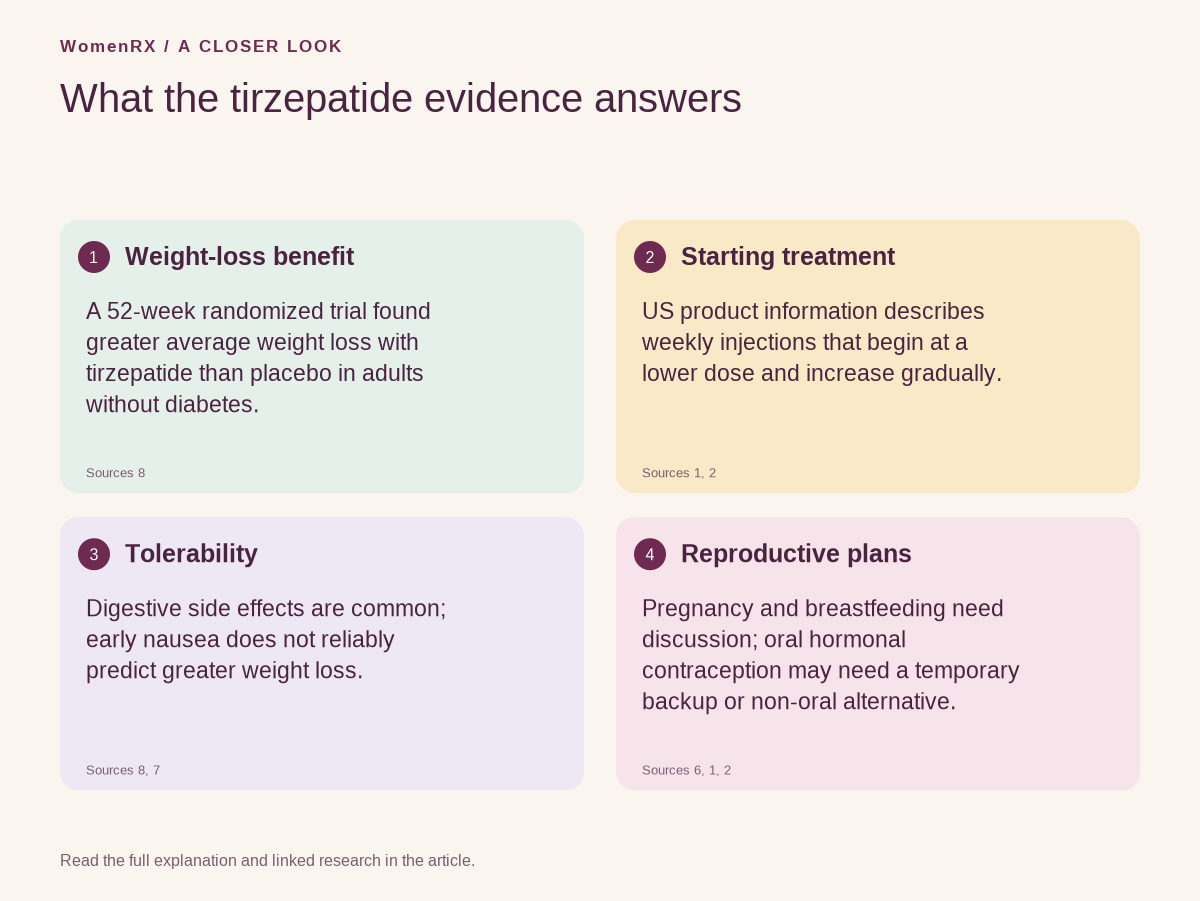
What the tirzepatide evidence answers
Weight-loss benefit: A 52-week randomized trial found greater average weight loss with tirzepatide than placebo in adults without diabetes.8
Starting treatment: US product information describes weekly injections that begin at a lower dose and increase gradually.12
Tolerability: Digestive side effects are common; early nausea does not reliably predict greater weight loss.87
Reproductive plans: Pregnancy and breastfeeding need discussion; oral hormonal contraception may need a temporary backup or non-oral alternative.612
Read the figure as text
The same medicine raises different questions about benefit, day-to-day treatment, and personal safety.- Weight-loss benefit: A 52-week randomized trial found greater average weight loss with tirzepatide than placebo in adults without diabetes.8
- Starting treatment: US product information describes weekly injections that begin at a lower dose and increase gradually.12
- Tolerability: Digestive side effects are common; early nausea does not reliably predict greater weight loss.87
- Reproductive plans: Pregnancy and breastfeeding need discussion; oral hormonal contraception may need a temporary backup or non-oral alternative.612
More questions, answered
Does nausea mean tirzepatide is working better?
No. An exploratory analysis of trial participants found that digestive side effects were more common early on but were minimally useful for predicting greater weight loss. You don’t need to treat feeling unwell as a sign of success. 7
Are Mounjaro and Zepbound interchangeable names?
They contain the same active ingredient, tirzepatide, but have separate US product instructions. Check the prescribed product, indication, and device instructions rather than assuming either brand is indicated for every condition or that every detail transfers between them. 125
Sources you can check
- ZEPBOUND (TIRZEPATIDE) INJECTION, SOLUTION ZEPBOUND (TIRZEPATIDE) INJECTION, SOLUTION ZEPBOUND KWIKPEN (TIRZEPATIDE) INJECTION, SOLUTION [ELI LILLY AND COMPANY] | US prescribing information and patient instructionsAccessed 2026-09-25Return to first citation
- MOUNJARO (TIRZEPATIDE) INJECTION, SOLUTION MOUNJARO KWIKPEN (TIRZEPATIDE) INJECTION, SOLUTION [ELI LILLY AND COMPANY] | US prescribing information and patient instructionsAccessed 2026-09-25Return to first citation
- [Tirzepatide (Mounjaro®) : a GIP/GLP-1 receptor dual agonist for the treatment of type 2 diabetes].Scheen A. · Revue medicale de Liege · 2025Return to first citation
- Update on Perioperative Medication Management for the Hand Surgeon: A Focus on Diabetes, Weight Loss, Rheumatologic, and Antithrombotic Medications.Xu W, Schmiesing C, Chang J. · The Journal of hand surgery · 2024Return to first citation
- Weight Changes With Tirzepatide and Concomitant Weight-Inducing Medications: Post Hoc Analysis of Randomized Clinical Trials.Galindo RJ, Gudzune KA, Look M, Lee CJ, Benabbad I, Cao D, Meng Q, Mojdami D. · JAMA network open · 2026Return to first citation
- Tirzepatide: a medicine to manage type 2 diabetes and treat obesity - NHSAccessed 2026-09-25Return to first citation
- Tirzepatide Efficacy and Tolerability According to Early Weight Response: A Post Hoc Analysis of the SURMOUNT-1 and SURMOUNT-2 Trials.Kokkinos A, Thethi T, Lee CJ, Neff LM, Stefanski A, Cao D, Rodriguez A, Bartee A. · Diabetes, obesity & metabolism · 2026Return to first citation
- Tirzepatide for Weight Reduction in Chinese Adults With Obesity: The SURMOUNT-CN Randomized Clinical Trial.Zhao L, Cheng Z, Lu Y, Liu M, Chen H, Zhang M, Wang R, Yuan Y, Li X. · JAMA · 2024Return to first citation