Tirzepatide and Retatrutide: What the Evidence Shows
They share two hormone targets, but only tirzepatide is an approved obesity medicine in the U.S.
Tirzepatide and retatrutide both target GLP-1 and GIP receptors; retatrutide also targets the glucagon receptor. Tirzepatide is approved in the U.S. for obesity, while retatrutide remains investigational. Their trial results aren’t a head-to-head contest: studies differ in participants, duration and design, and the reported evidence doesn’t establish a women-specific advantage for either medicine. 2 3
They act on overlapping, not identical, targets
Tirzepatide acts on the GLP-1 and GIP receptors. Retatrutide acts on those two receptors and the glucagon receptor, making it a triple agonist. That describes how the medicines differ biologically; it doesn’t prove that the added target makes retatrutide more effective, safer or a better fit for a particular person. Those questions require clinical outcome comparisons. 2 3
Why trial percentages don’t make a winner
The clearest obstacle to a simple comparison is that the headline results come from different studies. In the phase 2 obesity trial summarized in a review, retatrutide produced mean weight loss of up to 24.2% after 48 weeks. In SURMOUNT-1, the review reports 20.9% mean weight loss after 72 weeks with tirzepatide 15 mg weekly among participants with obesity without diabetes, compared with 3.1% with placebo. Those figures come from separate trials, with different follow-up periods. They do not tell us what would happen if participants were assigned to one medicine or the other in the same study. 3
A 2026 systematic review and network meta-analysis gives another perspective, but not a direct contest either. At one year, it estimated mean weight change versus lifestyle modification alone of −14.9% for tirzepatide, with moderate-to-high certainty. It reported weight reductions of 13.1% to 14.6% for a group of emerging agents that included retatrutide, with very-low-to-low certainty for those agents’ results as a group. The range is not a retatrutide-specific estimate. These are indirect estimates assembled across trials, and the certainty differs. They shouldn’t be read as proof that one drug beats the other. 1
That evidence gap matters in practice: a larger number from a shorter trial can’t be used to predict which medicine would lead to greater weight loss for you. Differences in participants, comparison groups, follow-up and how results are analyzed all affect what a trial result means. A direct randomized comparison would help answer the question more cleanly. A review describes a phase 3 program for retatrutide, including a planned comparison with tirzepatide; results from such a trial are needed before there’s a direct efficacy answer. 3
What the findings say about women
A headline result from a mixed adult obesity trial isn’t automatically a women-specific result. The reported trial summaries don’t provide enough detail on women’s representation or sex-stratified outcomes to say whether either medicine works better for women. That’s a limit on what can be concluded, not evidence that women respond differently, or the same.
For a personal decision, the more useful question is not which trial percentage looks biggest. It’s whether a medicine is approved for the condition being treated and how its known benefits and risks fit your health circumstances. The comparison here can’t answer that for an individual woman.
What’s available for clinical use in the U.S.
Tirzepatide is approved for obesity treatment in the U.S. Retatrutide is still investigational and undergoing clinical trials, so it isn’t an approved alternative for routine obesity treatment. A medicine being studied, even in later-stage trials, isn’t the same as a medicine with established approval for clinical use. 2 3
So, the short version is: the medicines have different receptor profiles, but there’s no completed head-to-head result in this evidence to establish superiority. Tirzepatide is an approved clinical option; retatrutide remains under investigation. Trial results may help clarify the comparison, but the existing percentages aren’t a fair one-on-one scorecard.
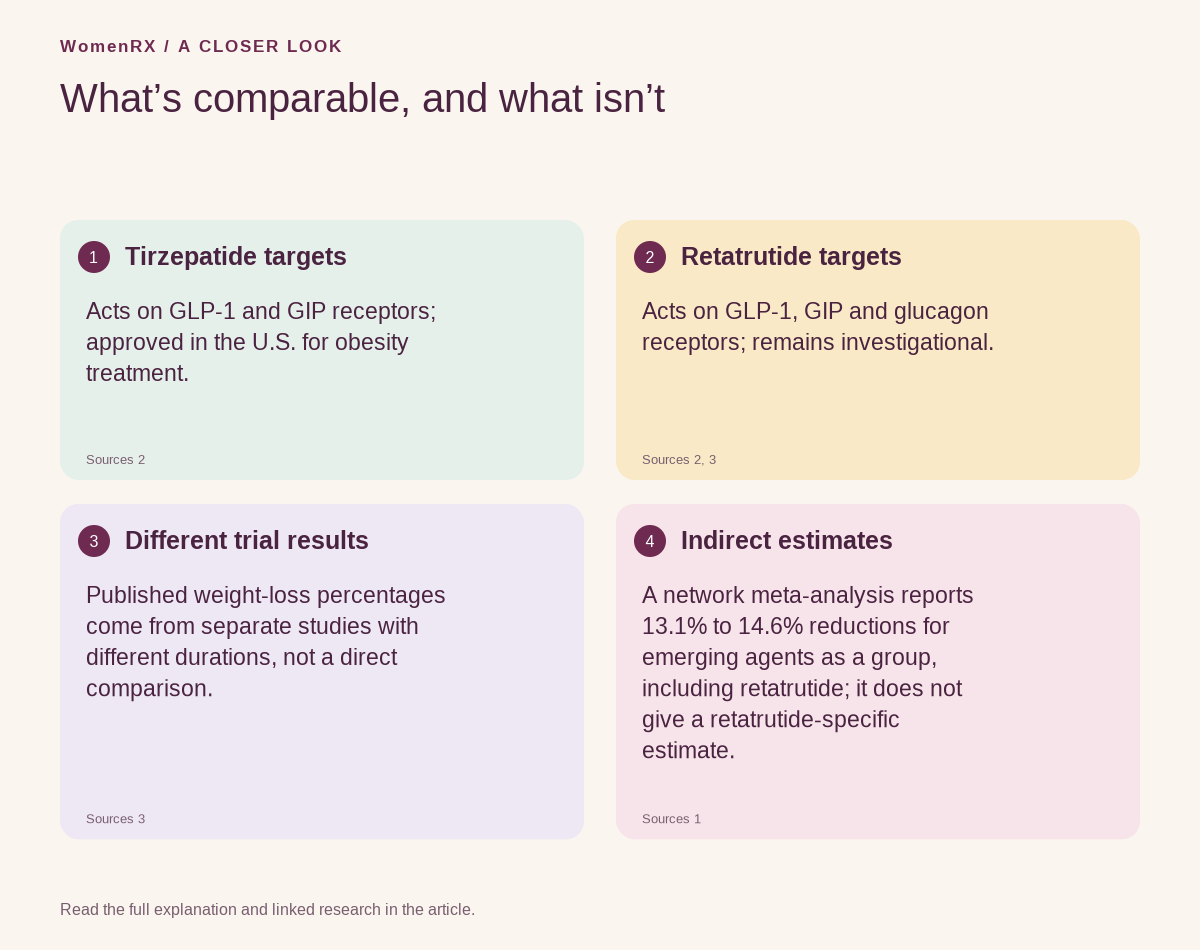
What’s comparable, and what isn’t
Tirzepatide targets: Acts on GLP-1 and GIP receptors; approved in the U.S. for obesity treatment.2
Retatrutide targets: Acts on GLP-1, GIP and glucagon receptors; remains investigational.23
Different trial results: Published weight-loss percentages come from separate studies with different durations, not a direct comparison.3
Indirect estimates: A network meta-analysis reports 13.1% to 14.6% reductions for emerging agents as a group, including retatrutide; it does not give a retatrutide-specific estimate.1
Read the figure as text
A quick comparison of drug targets, evidence type and clinical status, with the limits made explicit.- Tirzepatide targets: Acts on GLP-1 and GIP receptors; approved in the U.S. for obesity treatment.2
- Retatrutide targets: Acts on GLP-1, GIP and glucagon receptors; remains investigational.23
- Different trial results: Published weight-loss percentages come from separate studies with different durations, not a direct comparison.3
- Indirect estimates: A network meta-analysis reports 13.1% to 14.6% reductions for emerging agents as a group, including retatrutide; it does not give a retatrutide-specific estimate.1
Sources you can check
- Comparative effects of drugs for adults with overweight or obesity: systematic review and network meta-analysis.Nong K, Shi Q, Xie X, Wang Y, Agarwal A, Guyatt GH, Zhang H, Gao Y, Khunti K, Le Roux CW, Widyahening IS, Fan Q, Liu T, Mao Y, Florez ID, Du H, Pan X, Zou X, Wang C, Sun X, Li J, H... · BMJ (Clinical research ed.) · 2026Return to first citation
- The role of GLP-1 and GIP receptor agonists in the treatment of diabetes and obesity.Roskoski R. · Pharmacological research · 2026Return to first citation
- Triple Agonism Based Therapies for Obesity.Goldney J, Hamza M, Surti F, Davies MJ, Papamargaritis D. · Current cardiovascular risk reports · 2025Return to first citation