Tirzepatide for Weight Management: What to Decide and Revisit
The useful questions go beyond whether tirzepatide can help you lose weight: the product, side effects, pregnancy plans, and long-term fit all matter.
Tirzepatide can support long-term weight reduction for eligible adults when used alongside changes to eating and physical activity. For weight management, the U.S. product is Zepbound, a weekly injection whose dose is increased gradually. Before starting, consider your health conditions, other medicines, pregnancy or breastfeeding plans, and what would make treatment worth continuing for you. 15
Start with the goal, then the product
A weight-management decision is about more than a number on the scale. For example, you might hope to improve a weight-related health condition, maintain weight loss you've struggled to keep, or find an approach you can live with long term. Those goals help make the benefits and tradeoffs of medication more concrete.
Zepbound is the tirzepatide product indicated in the U.S. to reduce excess body weight and maintain weight reduction long term in adults with obesity, or adults with overweight and at least one weight-related condition. It's used with a reduced-calorie diet and increased physical activity. Tirzepatide is also sold as Mounjaro for type 2 diabetes, so check which product and purpose you're discussing. Zepbound shouldn't be used alongside another tirzepatide product or a GLP-1 receptor agonist. 15
BMI is one starting point, not the whole decision. An adult BMI of 30 or higher is classified as obesity; a BMI of 27 or higher together with a weight-related health problem is a common threshold for considering weight-management medication. Your health history, current medicines, preferences, and ability to sustain the treatment also matter. 25
What might you expect? A 2026 review describes substantial average weight loss with tirzepatide in obesity trials, but an average can't predict your own result. Treatment is meant to support changes in eating and activity, not replace them. 41
Understand the slow start
For Zepbound, the labeled starting dose is 2.5 mg injected once weekly for four weeks, followed by 5 mg once weekly. Further increases, when appropriate, are in 2.5 mg steps after at least four weeks at the current dose. For weight reduction and maintenance, the labeled maintenance doses are 5 mg, 10 mg, or 15 mg weekly; the maximum recommended dose is 15 mg weekly. The starting dose isn't a maintenance dose. The gradual increase is intended to reduce gastrointestinal side effects, and the maintenance choice takes both response and tolerability into account. This is a framework for understanding a treatment plan, not a reason to increase a dose just because the calendar says you can. 1
Before the first injection, make sure you're shown how to use the presentation you actually receive. Zepbound comes with presentation-specific instructions, and a change in presentation calls for new training. That practical detail matters as much as remembering the weekly injection day. 1
Know which side effects change the plan
Nausea, diarrhea, vomiting, constipation, and abdominal discomfort are common. In two pooled, placebo-controlled Zepbound weight-reduction trials, gastrointestinal reactions were reported by 56% of participants at each Zepbound dose studied, compared with 30% taking placebo. Most nausea, vomiting, and diarrhea events occurred while doses were being increased and decreased over time. If symptoms make it hard to eat or drink, that belongs in the dose-tolerability discussion rather than being treated as proof you need to push through to a higher dose. 1
Some symptoms need faster attention. Persistent or severe abdominal pain, sometimes reaching the back and with or without vomiting, can signal pancreatitis and warrants prompt medical assessment. Ongoing vomiting or diarrhea can cause dehydration; the Zepbound information calls for kidney-function monitoring when adverse reactions could cause significant fluid loss. Serious allergic reactions have also been reported. 1
Review your history before treatment, too. Zepbound must not be used if you have a personal or family history of medullary thyroid carcinoma or have multiple endocrine neoplasia syndrome type 2 (MEN 2), or if you've had a serious allergic reaction to tirzepatide or a Zepbound ingredient. The thyroid warning comes from tumors seen in rats; whether tirzepatide causes these tumors in humans is unknown. Severe stomach-emptying problems also matter because Zepbound is not recommended for people with severe gastroparesis. 1
If you take insulin or a medicine that prompts the pancreas to release insulin, such as a sulfonylurea, combining it with Zepbound can raise the risk of low blood sugar. Zepbound also delays stomach emptying and may affect how some oral medicines are absorbed; the prescribing information specifically calls for monitoring medicines that need precise blood levels, such as warfarin. Bring your actual medication list into this discussion rather than assuming all pills are affected in the same way. 1
Make reproductive plans part of the decision
If pregnancy is possible, contraception deserves attention before the first dose and before dose increases. Zepbound can reduce the effectiveness of oral hormonal contraceptives because it delays stomach emptying. Its prescribing information advises switching to a non-oral method or adding a barrier method for four weeks after starting Zepbound and four weeks after each dose increase. Non-oral hormonal contraceptives are not expected to be affected by this interaction. 1
Weight loss isn't recommended during pregnancy, and the Zepbound information says to discontinue it when pregnancy is recognized. Human pregnancy data are insufficient to determine its drug-related risks; animal studies raise concern about fetal harm. If you're planning a pregnancy, talk through that plan before beginning weight-management medication rather than guessing at a stopping interval. 15
Breastfeeding is a different question from pregnancy. In a small study after a single dose, tirzepatide was undetectable or present at low levels in breast milk, but there are no available data on its effects on a breastfed infant or milk production. That leaves a decision about your need for treatment and breastfeeding, not a proven all-clear for ongoing use. 1
If you're in perimenopause or postmenopause, the same treatment questions still apply: what health outcome you're aiming for, which other conditions and medicines matter, and how you're tolerating treatment. There isn't an established menopause-specific Zepbound dose or a reliable way to predict an individual woman's response. Menopause alone shouldn't be used to promise a particular result. 13
Reassess benefit and burden together
Follow-up should answer two questions at once: Is treatment helping with the goals you chose, and is it workable? Consider weight change alongside any relevant weight-related health measures, side effects, eating and activity changes, and whether the weekly treatment remains practical. Zepbound's labeled dose choices explicitly depend on response and tolerability. 15
Don't judge a slow start as though it were the finished treatment. General NIDDK guidance suggests revisiting a weight-management medication if someone hasn't lost at least 5% of starting weight after 12 weeks on its full dose; that isn't a rule for declaring Zepbound unsuccessful during its starting-dose period. If treatment is helping and side effects are manageable, longer-term use may be considered. Some weight regain after stopping weight-management medication is likely, so a decision to stop deserves a maintenance plan, too. 51
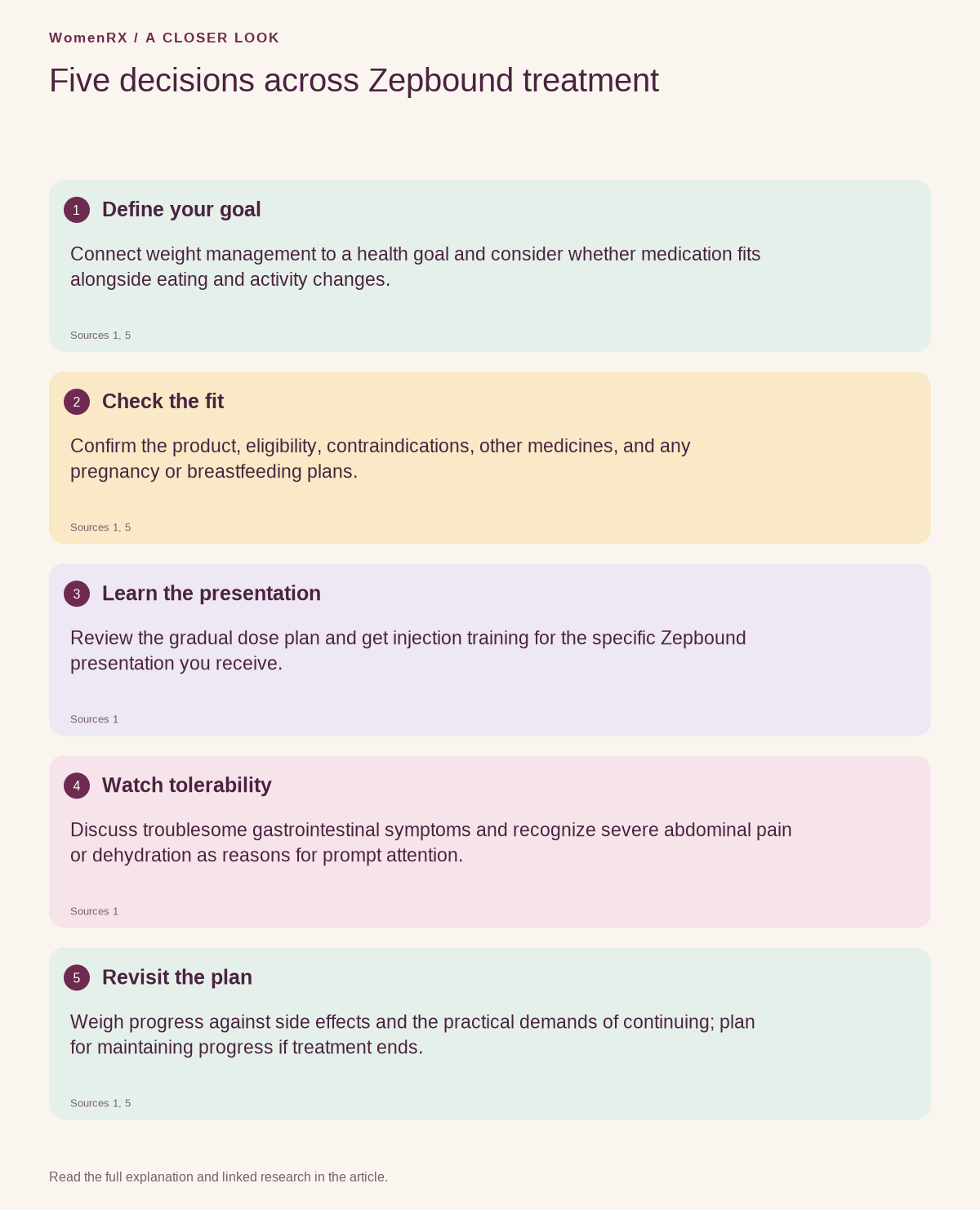
Five decisions across Zepbound treatment
Define your goal: Connect weight management to a health goal and consider whether medication fits alongside eating and activity changes.15
Check the fit: Confirm the product, eligibility, contraindications, other medicines, and any pregnancy or breastfeeding plans.15
Learn the presentation: Review the gradual dose plan and get injection training for the specific Zepbound presentation you receive.1
Watch tolerability: Discuss troublesome gastrointestinal symptoms and recognize severe abdominal pain or dehydration as reasons for prompt attention.1
Revisit the plan: Weigh progress against side effects and the practical demands of continuing; plan for maintaining progress if treatment ends.15
Read the figure as text
Use this path to separate the questions that matter before starting from those that matter once treatment is underway.- Define your goal: Connect weight management to a health goal and consider whether medication fits alongside eating and activity changes.15
- Check the fit: Confirm the product, eligibility, contraindications, other medicines, and any pregnancy or breastfeeding plans.15
- Learn the presentation: Review the gradual dose plan and get injection training for the specific Zepbound presentation you receive.1
- Watch tolerability: Discuss troublesome gastrointestinal symptoms and recognize severe abdominal pain or dehydration as reasons for prompt attention.1
- Revisit the plan: Weigh progress against side effects and the practical demands of continuing; plan for maintaining progress if treatment ends.15
More questions, answered
What if I have surgery or a procedure planned?
Tell the team providing anesthesia or deep sedation that you take Zepbound. It delays stomach emptying, and aspiration has been reported with GLP-1 receptor agonists during such procedures. The Zepbound information says evidence is insufficient to determine whether changing fasting instructions or temporarily stopping treatment reduces that risk, so don't make up your own stopping schedule. 1
Sources you can check
- ZEPBOUND (TIRZEPATIDE) INJECTION, SOLUTION ZEPBOUND (TIRZEPATIDE) INJECTION, SOLUTION ZEPBOUND KWIKPEN (TIRZEPATIDE) INJECTION, SOLUTION [ELI LILLY AND COMPANY] | US prescribing information and patient instructionsAccessed 2026-09-25Return to first citation
- Obesity: MedlinePlusAccessed 2026-09-25Return to first citation
- Do Fasting GLP-1 and GIP Levels Predict the Initial Pharmacological Response to Semaglutide and Tirzepatide?La Vignera S, Fioriglio C, Condorelli RA. · Diagnostics (Basel, Switzerland) · 2026Return to first citation
- The Role of GLP1 Receptor Agonists and Multi-agonist Incretin Therapies for Specific Obesity-related Health Conditions: Evidence and Rationale for Prioritisation.Albor C, Anyiam O, Boyle LD, Makaronidis J, Tan R, Iftikhar S, Burzic A, Lajeunesse Trempe F, Stanley M, Bhatti A, Scragg J, Badawy L, Moqeem K, Idris I, Andrews RC, Sen Gupta P, H... · Current obesity reports · 2026Return to first citation
- Prescription Medications to Treat Overweight & Obesity - NIDDKAccessed 2026-09-25Return to first citation