Tirzepatide and the Pill: When Backup Matters
Zepbound’s label advises extra contraceptive protection for four weeks after starting and after each dose increase if you use hormonal birth control by mouth.
Tirzepatide may make oral hormonal birth control less effective by slowing stomach emptying. The Zepbound label advises switching to a nonoral contraceptive or adding a barrier method for four weeks after starting treatment and for four weeks after each dose increase. The precaution is about oral hormonal contraceptives, not every contraceptive method. 2
What the Zepbound label says
If you take a hormonal birth control pill, plan for a conversation about extra protection when you start Zepbound and whenever your dose increases. The US prescribing information advises using a nonoral contraceptive or adding a barrier method for four weeks after treatment begins and four weeks after each dose escalation. 2
That wording matters: the advice applies after each increase, not just the first one. If you’re unsure when an increase is planned, ask your prescriber or pharmacist how to coordinate contraception with your treatment schedule.
Why a medicine that slows digestion matters to a pill
Tirzepatide delays gastric emptying, meaning food and medicines can move out of the stomach more slowly. The delay is greatest after the first dose and lessens over time, according to the product information. The label says this effect may reduce the efficacy of oral hormonal contraceptives. 2
A review of six clinical studies found that one study examined tirzepatide with an oral hormonal contraceptive and reported changes in measures of the contraceptive’s drug exposure. The review does not establish how often this leads to contraceptive failure in everyday use. The label’s time-limited precaution gives you a practical plan to discuss without claiming that pregnancy is inevitable or that the pill always fails. 3
The warning is about pills, not every method
The label specifically addresses oral hormonal contraceptives. Birth control pills can contain progestin alone or a combination of estrogen and progestin. 12 A patch, vaginal ring, injection, implant, or IUD is not an oral contraceptive; the label recommends considering a nonoral method rather than saying all methods are affected. 12
If you prefer to stay on the pill, ask whether adding a barrier method is appropriate for the label’s four-week windows and how to use it. Condoms are one example of a barrier method. 12 Choosing a method depends on your preferences and circumstances, so it’s worth discussing the options before treatment starts or a dose changes.
Questions to settle before a start or dose increase
You can make the conversation specific:
- “Is my birth control an oral hormonal contraceptive covered by this warning?”
- “When will I start, or when is my next dose increase, and what four-week period should I plan for?”
- “Would a barrier method or a nonoral contraceptive fit my needs?”
- “If I want to become pregnant, what should we plan before I try?”
The last question deserves its own conversation. Zepbound’s medication guide says to tell your healthcare provider if you’re pregnant or plan to become pregnant, and warns that the medicine may harm an unborn baby. The information here doesn’t establish a specific amount of time to stop treatment before trying to conceive, so ask your prescriber for a plan suited to you. 2
The useful distinction is straightforward: the label’s contraception precaution is tied to taking hormonal birth control by mouth, and it applies for four weeks after starting and after each dose increase. If pregnancy is a possibility, make a plan for those windows rather than assuming your usual pill routine is enough.
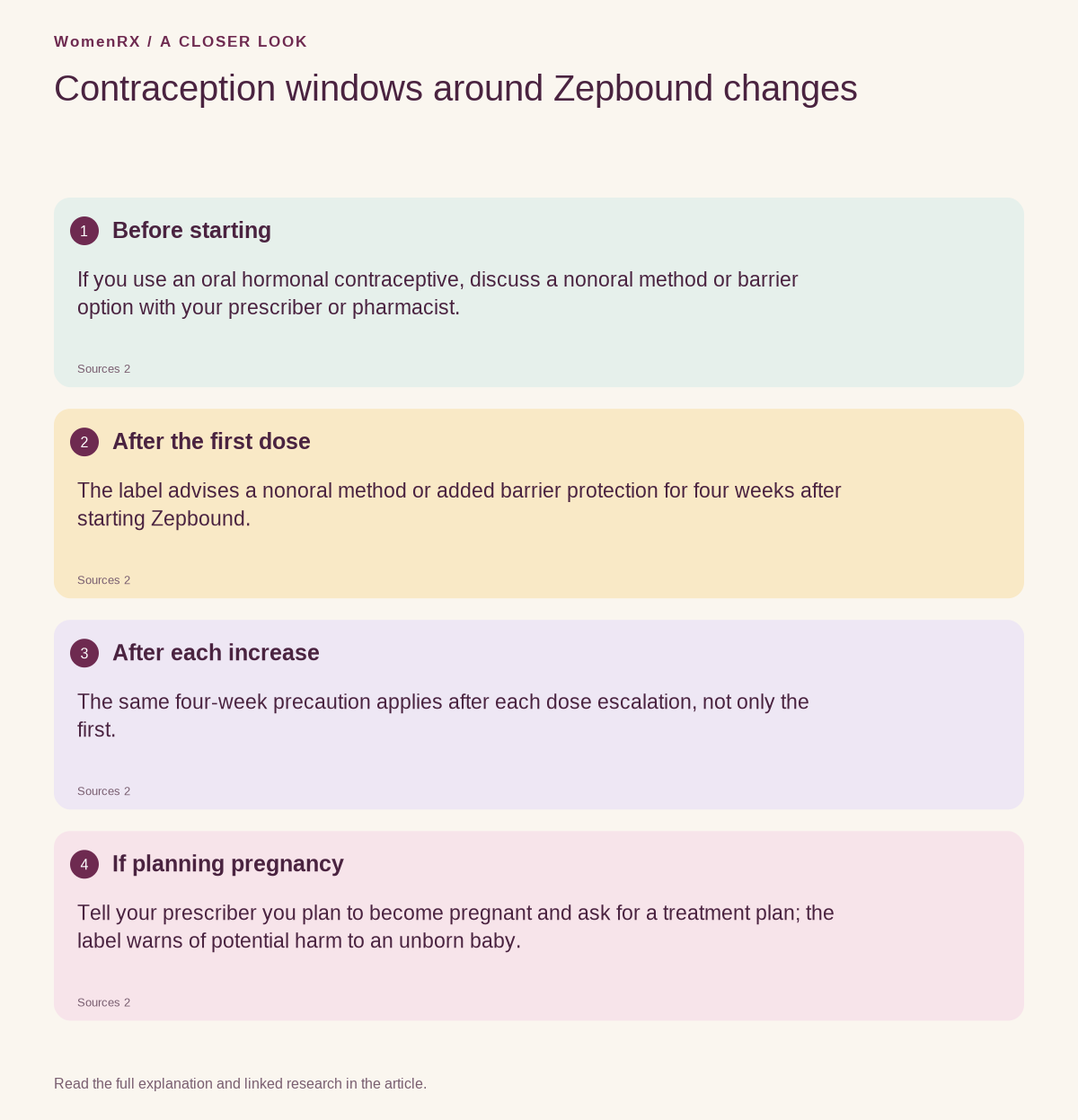
Contraception windows around Zepbound changes
Before starting: If you use an oral hormonal contraceptive, discuss a nonoral method or barrier option with your prescriber or pharmacist.2
After the first dose: The label advises a nonoral method or added barrier protection for four weeks after starting Zepbound.2
After each increase: The same four-week precaution applies after each dose escalation, not only the first.2
If planning pregnancy: Tell your prescriber you plan to become pregnant and ask for a treatment plan; the label warns of potential harm to an unborn baby.2
Read the figure as text
The product label’s precaution applies to oral hormonal contraceptives after treatment starts and after each dose increase.- Before starting: If you use an oral hormonal contraceptive, discuss a nonoral method or barrier option with your prescriber or pharmacist.2
- After the first dose: The label advises a nonoral method or added barrier protection for four weeks after starting Zepbound.2
- After each increase: The same four-week precaution applies after each dose escalation, not only the first.2
- If planning pregnancy: Tell your prescriber you plan to become pregnant and ask for a treatment plan; the label warns of potential harm to an unborn baby.2
Sources you can check
- Birth Control | Contraception | Contraceptives | MedlinePlusAccessed 2026-09-25Return to first citation
- ZEPBOUND (TIRZEPATIDE) INJECTION, SOLUTION ZEPBOUND (TIRZEPATIDE) INJECTION, SOLUTION ZEPBOUND KWIKPEN (TIRZEPATIDE) INJECTION, SOLUTION [ELI LILLY AND COMPANY] | US prescribing information and patient instructionsAccessed 2026-09-25Return to first citation
- The impact of tirzepatide and glucagon-like peptide 1 receptor agonists on oral hormonal contraception.Skelley JW, Swearengin K, York AL, Glover LH. · Journal of the American Pharmacists Association : JAPhA · 2024Return to first citation