The Second Trimester: Changes, Checkups, and Warning Signs
Symptoms may ease or change in the second trimester, while prenatal visits help catch concerns you might not feel.
The second trimester runs from weeks 13 through 28. Nausea and fatigue may ease, while a growing abdomen, aches, skin changes, constipation, or the first sensation of movement may become part of your day. Your experience may differ, even from a previous pregnancy. Keep up with prenatal visits, and seek immediate care for warning signs such as a worsening headache, vision changes, bleeding, or leaking fluid.9568
What might feel different
For many women, the second trimester feels easier than the first, but it isn't a symptom-free stretch. Nausea and fatigue may fade as your abdomen grows. You might notice back, abdominal, groin, or thigh aches; darker patches of skin; tingling hands; or some swelling. You might have several of these changes or none of them. A previous pregnancy isn't a reliable script for this one.9
Constipation is another common possibility. Pregnancy-related hormonal changes can slow intestinal movement, although constipation has more than one potential contributor. A systematic review found it across all trimesters, with considerable variation between the studies it combined. If it's affecting your day, bring it up at a visit rather than assuming you have to put up with it.5
You may also begin to feel movement during this trimester. Around 20 weeks, it may feel like a slight flutter, but that example isn't a deadline for when you personally must feel it. Once you're familiar with your baby's movement, a noticeable slowing or stopping calls for immediate medical care. There is no single number of movements that defines normal for every pregnancy.98
What your visits are checking
A prenatal visit isn't only about the symptoms you can describe. Visits commonly include blood-pressure and weight checks and routine prenatal tests. High blood pressure often has no symptoms; blood-pressure conditions can develop after 20 weeks, which is one reason those checks matter even when you feel well.67
Testing discussions may also change as pregnancy progresses. Prenatal tests can check your health as well as provide information about the fetus. Gestational diabetes, for example, usually causes no symptoms and is commonly found through blood-sugar testing. Ask what screening is planned for you and when, particularly if you've had gestational diabetes before.12
This is also a useful time to ask whether an anatomy ultrasound is planned and when, and to clarify any chromosome-testing options. Available chromosome-testing options can depend on when you enter care. Ask which choices apply to you and what each proposed test is intended to tell you.34
For a closer look at those separate decisions, see MedlinePlus on prenatal testing and MedlinePlus on high blood pressure in pregnancy.17
When not to wait for the next checkup
Some discomforts overlap with warning signs. Mild swelling, for example, can happen during pregnancy; sudden or extreme swelling of your face or hands needs immediate medical care. A headache that won't go away or gets worse, especially with vision changes, also needs immediate attention. After 20 weeks, preeclampsia is one possible concern, but you don't need to identify the cause before getting help.987
Seek immediate medical care for bleeding heavier than spotting, fluid leaking from the vagina, severe belly pain that doesn't go away, fever of 100.4°F or higher, trouble breathing, chest pain, or fainting. Severe pain, redness, or swelling in one leg also belongs on that list. These aren't symptoms to save for a routine visit.8
Not every concern fits neatly into a list. For example, itching can occur as your skin changes, but itching with nausea, loss of appetite, vomiting, jaundice, or fatigue warrants a call to your pregnancy care team. If a change feels wrong or you can't tell how serious it is, contact them and say that you're pregnant.98
Three questions worth taking to a visit
Your questions can reflect what is actually happening for you, not a standard trimester checklist:
- Which changes should I call about? Mention a specific symptom, such as new itching or constipation, and ask what change would make it more concerning.958
- Which tests are next, and what would the results tell us? Ask how planned screening differs from diagnostic testing and whether your history changes the timing.132
- What is the plan for checking my blood pressure and discussing movement? Blood pressure can rise without symptoms, and a change in movement matters once you know what is usual for your baby.678
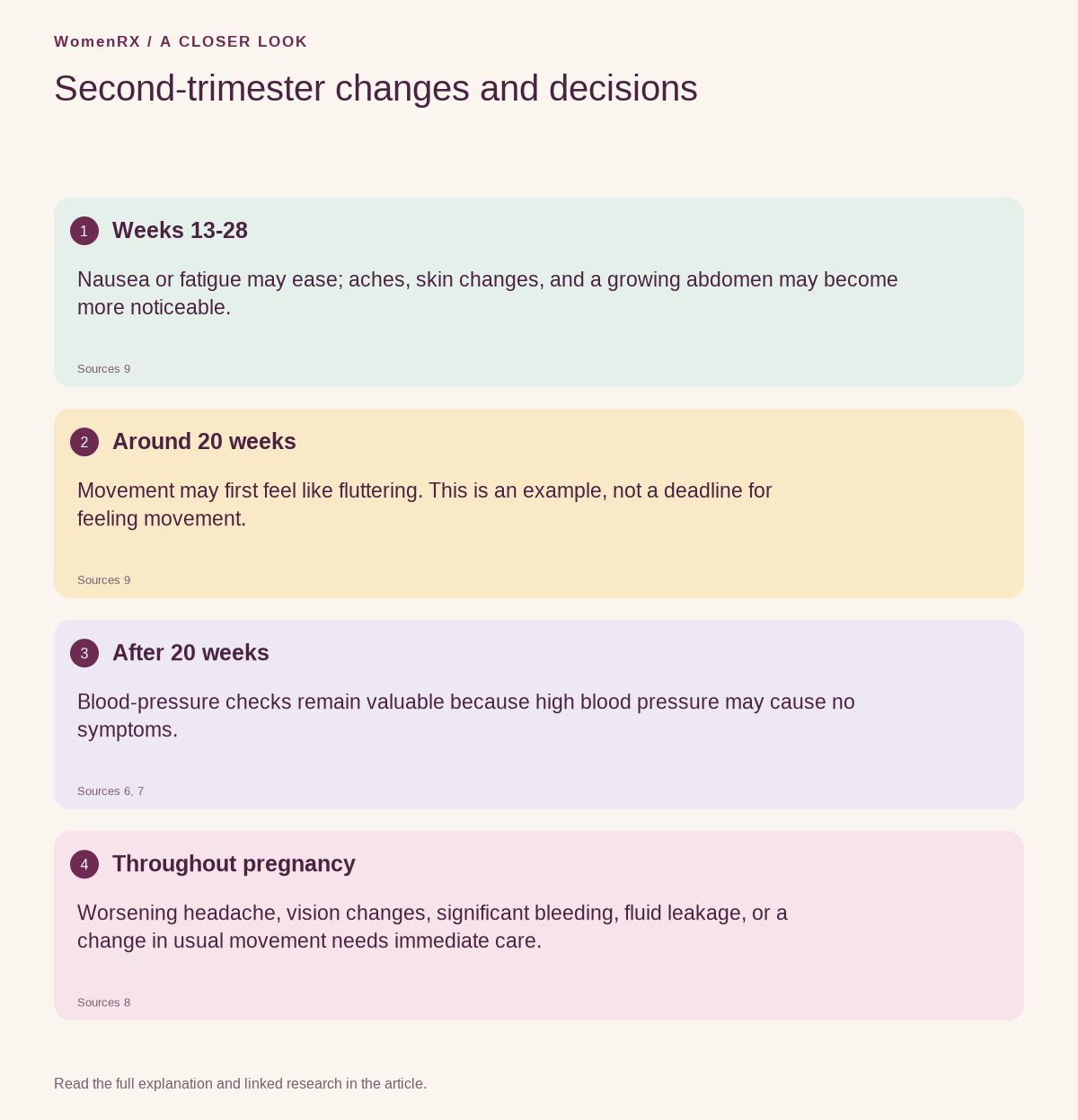
Second-trimester changes and decisions
Weeks 13-28: Nausea or fatigue may ease; aches, skin changes, and a growing abdomen may become more noticeable.9
Around 20 weeks: Movement may first feel like fluttering. This is an example, not a deadline for feeling movement.9
After 20 weeks: Blood-pressure checks remain valuable because high blood pressure may cause no symptoms.67
Throughout pregnancy: Worsening headache, vision changes, significant bleeding, fluid leakage, or a change in usual movement needs immediate care.8
Read the figure as text
A guide to when certain topics may arise, not a schedule every pregnancy will follow.- Weeks 13-28: Nausea or fatigue may ease; aches, skin changes, and a growing abdomen may become more noticeable.9
- Around 20 weeks: Movement may first feel like fluttering. This is an example, not a deadline for feeling movement.9
- After 20 weeks: Blood-pressure checks remain valuable because high blood pressure may cause no symptoms.67
- Throughout pregnancy: Worsening headache, vision changes, significant bleeding, fluid leakage, or a change in usual movement needs immediate care.8
More questions, answered
Should I feel better than I did in the first trimester?
You might, but you don't have to. Nausea and fatigue may ease while other changes become more noticeable, and even your own pregnancies can feel different from one another.9
Can I tell whether I have gestational diabetes from how I feel?
Usually not. Gestational diabetes often has no symptoms and is commonly detected through blood-sugar screening, so it's worth knowing what testing is planned for you.2
Sources you can check
- Prenatal Testing | Gestational Diabetes | MedlinePlusAccessed 2026-09-25Return to first citation
- Gestational diabetes - NHSAccessed 2026-09-25Return to first citation
- NSGC practice guideline: prenatal screening and diagnostic testing options for chromosome aneuploidy.Wilson KL, Czerwinski JL, Hoskovec JM, Noblin SJ, Sullivan CM, Harbison A, Campion MW, Devary K, Devers P, Singletary CN. · Journal of genetic counseling · 2013Return to first citation
- No. 352-Technical Update: The Role of Early Comprehensive Fetal Anatomy Ultrasound Examination.Nevo O, Brown R, Glanc P, Lim K. · Journal of obstetrics and gynaecology Canada : JOGC = Journal d'obstetrique et gynecologie du Canada : JOGC · 2017Return to first citation
- Global prevalence of constipation during pregnancy: a systematic review and meta-analysis.Salari N, Mohamadi S, Hemmati M, Fallahi A, Rasoulpoor S, Zarei H, Shohaimi S, Mohammadi M. · BMC pregnancy and childbirth · 2024Return to first citation
- Prenatal Care | Prenatal Testing | MedlinePlusAccessed 2026-09-25Return to first citation
- High Blood Pressure in Pregnancy | Preeclampsia | MedlinePlusAccessed 2026-09-25Return to first citation
- Urgent Maternal Warning Signs and Symptoms | HEAR HER Campaign | CDCAccessed 2026-09-25Return to first citation
- Stages of pregnancyAccessed 2026-09-25Return to first citation