Taking Bupropion: Check the Formulation First
Bupropion comes in different release forms, so your exact prescription matters when you take it, miss a dose, or need a refill.
Check whether your prescription is immediate-release (IR), sustained-release (SR), or extended-release (XL).23 Then follow the directions for that exact product. The formulations release medication differently, so don’t work out a switch or a missed-dose plan from the tablet strength alone.3 If the instructions don’t answer what to do after a missed dose, ask your pharmacist before deciding what to take next.
The letters on the label change the plan
Bupropion is available as immediate-release (IR), sustained-release (SR), and extended-release (XL) tablets. These formulations release the medication at different rates. A review of human pharmacokinetic research found that absorption is more prolonged with XL than with IR or SR. That difference is why the formulation name matters alongside the strength printed on the bottle.23
If a refill looks different, check the full medication name, including IR, SR, or XL, against your previous bottle and your current prescription. Don’t assume tablets with the same amount of bupropion have the same directions, and don’t change formulations by guesswork. A pharmacist can tell you whether the refill matches what was prescribed.
There’s another reason to check the full name: bupropion also appears in combination medicines. Contrave, for example, contains both bupropion and naltrexone.1 Its directions are for that combination product, not for a bupropion-only prescription. Tell your prescriber or pharmacist about all the medicines you take so they can spot a possible overlap.
If you miss a dose, check before making it up
A missed-dose answer needs to match your exact product and prescription. If the bottle or accompanying instructions aren’t clear, ask your pharmacist what to do now and what to do if it happens again, before deciding what to take next. Bupropion can cause seizures in overdose, and extended-release products can cause delayed seizures after an overdose.2
If you may have taken too much, seek urgent medical advice rather than waiting to see how you feel. Agitation, a racing heartbeat, and seizures are reported features of bupropion overdose.2
What to bring up at follow-up
Follow-up is a chance to check both how treatment is going and whether the plan still fits your life. Mention effects such as trouble sleeping, agitation, nausea, dry mouth, or headaches, especially if they’re making it hard to keep taking the medication as prescribed. These are reported adverse effects at therapeutic doses; your prescriber can help assess what they mean for you.2
Make sure your prescriber knows about a history of seizures or an eating disorder, as well as any medicines or circumstances that could raise seizure risk. Bupropion lowers the seizure threshold, and certain preexisting risk factors make its use unsafe even at standard doses.23
Bring an up-to-date medication list, including any new prescriptions. Bupropion can affect how the body handles some other medicines through an enzyme called CYP2D6; that’s a reason to have potential interactions checked rather than changing either medicine yourself.3 If you’re pregnant, planning a pregnancy, or breastfeeding, say so when discussing your treatment plan. The right conversation is about your circumstances and the exact medicine you take, not an assumption that one formulation or a combination product answers the question for all of them.
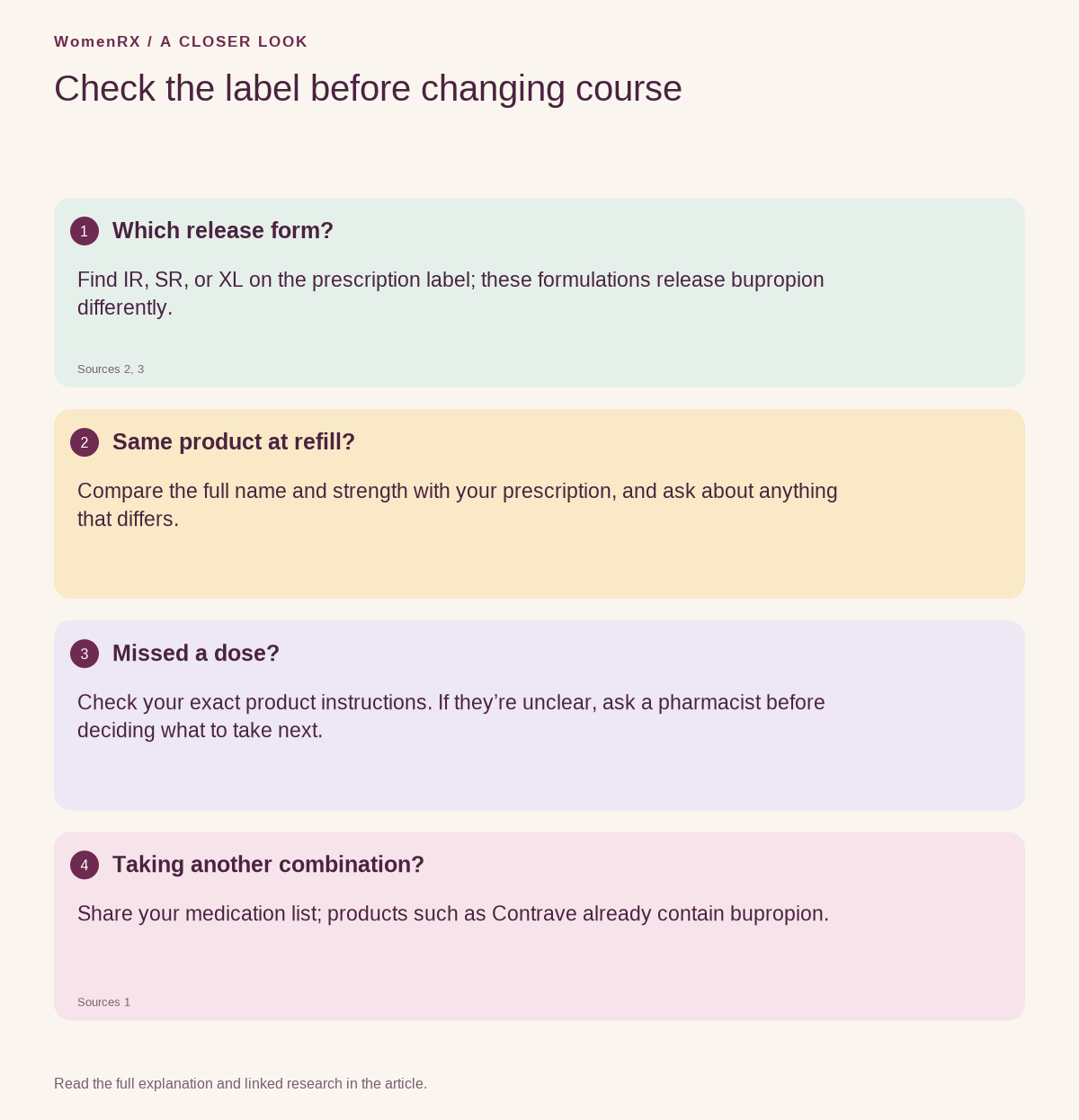
Check the label before changing course
Which release form?: Find IR, SR, or XL on the prescription label; these formulations release bupropion differently.23
Same product at refill?: Compare the full name and strength with your prescription, and ask about anything that differs.
Missed a dose?: Check your exact product instructions. If they’re unclear, ask a pharmacist before deciding what to take next.
Taking another combination?: Share your medication list; products such as Contrave already contain bupropion.1
Read the figure as text
Four distinct questions help you get advice that fits your prescription.- Which release form?: Find IR, SR, or XL on the prescription label; these formulations release bupropion differently.23
- Same product at refill?: Compare the full name and strength with your prescription, and ask about anything that differs.
- Missed a dose?: Check your exact product instructions. If they’re unclear, ask a pharmacist before deciding what to take next.
- Taking another combination?: Share your medication list; products such as Contrave already contain bupropion.1
More questions, answered
Does a refill with a different-looking tablet mean my prescription changed?
Appearance alone won’t tell you whether the formulation or directions are the same. Compare the full name and strength on the new label with your prescription, and ask the pharmacist to resolve any difference before you use it.
Sources you can check
- CONTRAVE EXTENDED-RELEASE (NALTREXONE HYDROCHLORIDE AND BUPROPION HYDROCHLORIDE) TABLET, EXTENDED RELEASE [NALPROPION PHARMACEUTICALS LLC] | US prescribing information and patient instructionsAccessed 2026-09-25Return to first citation
- Bupropion ToxicityAlberter AA, Chambers AJ, Schaffer DH. · 2026Return to first citation
- Bupropion for major depressive disorder: Pharmacokinetic and formulation considerations.Jefferson JW, Pradko JF, Muir KT. · Clinical therapeutics · 2005Return to first citation