Starting Bupropion: What to Track and When to Reassess
Track both how you feel and what you can do; study check-in points can inform a conversation, but they don’t set a personal deadline for improvement.
When you start bupropion, note your starting mood, interest, sleep, and ability to manage everyday tasks, then bring changes and unwanted effects to follow-up. A randomized trial assessed outcomes after eight weeks, but that study point isn’t a promise about when you’ll respond. If symptoms worsen sharply or suicidal thoughts emerge, contact your prescriber promptly rather than waiting for a routine visit. 2 4 1
Measure more than mood
A useful follow-up conversation is about whether life is changing, not just whether you feel “better.” Depression can affect sleep, eating, work, and other daily activities, and symptoms don’t look the same for everyone. 2
Before or soon after starting, jot down a few things you’d like to compare later: your mood, interest in activities, sleep, and one or two everyday tasks that matter to you. For example, you might note whether getting ready for work, cooking, or replying to messages feels easier, harder, or about the same. These notes aren’t a diagnostic test; they give you concrete examples to discuss instead of relying on memory alone.
At follow-up, separate three questions: What has improved? What hasn’t changed? What feels worse or difficult to tolerate? A change in one area doesn’t necessarily mean the whole picture has shifted. Emotional responsiveness may also be worth discussing: in three eight-week trials, average emotional responsiveness improved across treatment groups, but some participants still reported difficulty feeling normal emotions at the final assessment. 3
Treat study time points as reference points
An eight-week randomized trial compared extended-release bupropion with escitalopram in Chinese patients with major depressive disorder. It measured depression symptoms at week eight. That tells you when researchers assessed group outcomes in that study, not when any one person should expect a result. 4
Another study followed people with treatment-resistant depression during 12 weeks of next-step treatment. Its participants and treatment situation were different, so it doesn’t provide a standard timeline for someone starting bupropion for the first time. 5
Taken together, these findings support a practical distinction: early check-ins can help you discuss tolerability and changes you notice, while judging the overall benefit may require looking at symptoms and daily function over time. The studies don’t establish a women-specific response clock or show that response timing differs by sex. The timing and purpose of your own follow-up should be agreed with your prescriber, rather than borrowed from a trial schedule.
Make the follow-up specific
Bring a short comparison, not a perfect diary. You could use three headings: better, unchanged, and harder. Under each, add one example from daily life and any unwanted changes you’ve noticed. If you can’t identify a clear improvement, say so; incomplete progress is useful information for reviewing the plan, not a reason to change your medication on your own. Depression treatment can involve trying different medicines, and medication concerns or side effects are reasons to contact your prescriber. 2
If depression worsens sharply, or you develop suicidal thoughts or unusual changes in mood, behavior, or thinking, don’t wait for a planned follow-up; contact your prescriber promptly. Bupropion is the active ingredient in several antidepressants, and official information for a bupropion-containing product advises close attention to worsening depression and new suicidal thoughts or behavior. 1
Mention pregnancy, plans to become pregnant, breastfeeding, or a major reproductive-stage change when discussing treatment. Those circumstances are reasons to make the conversation specific to you; the response findings described above don’t establish what treatment choice or timeline applies in those situations.
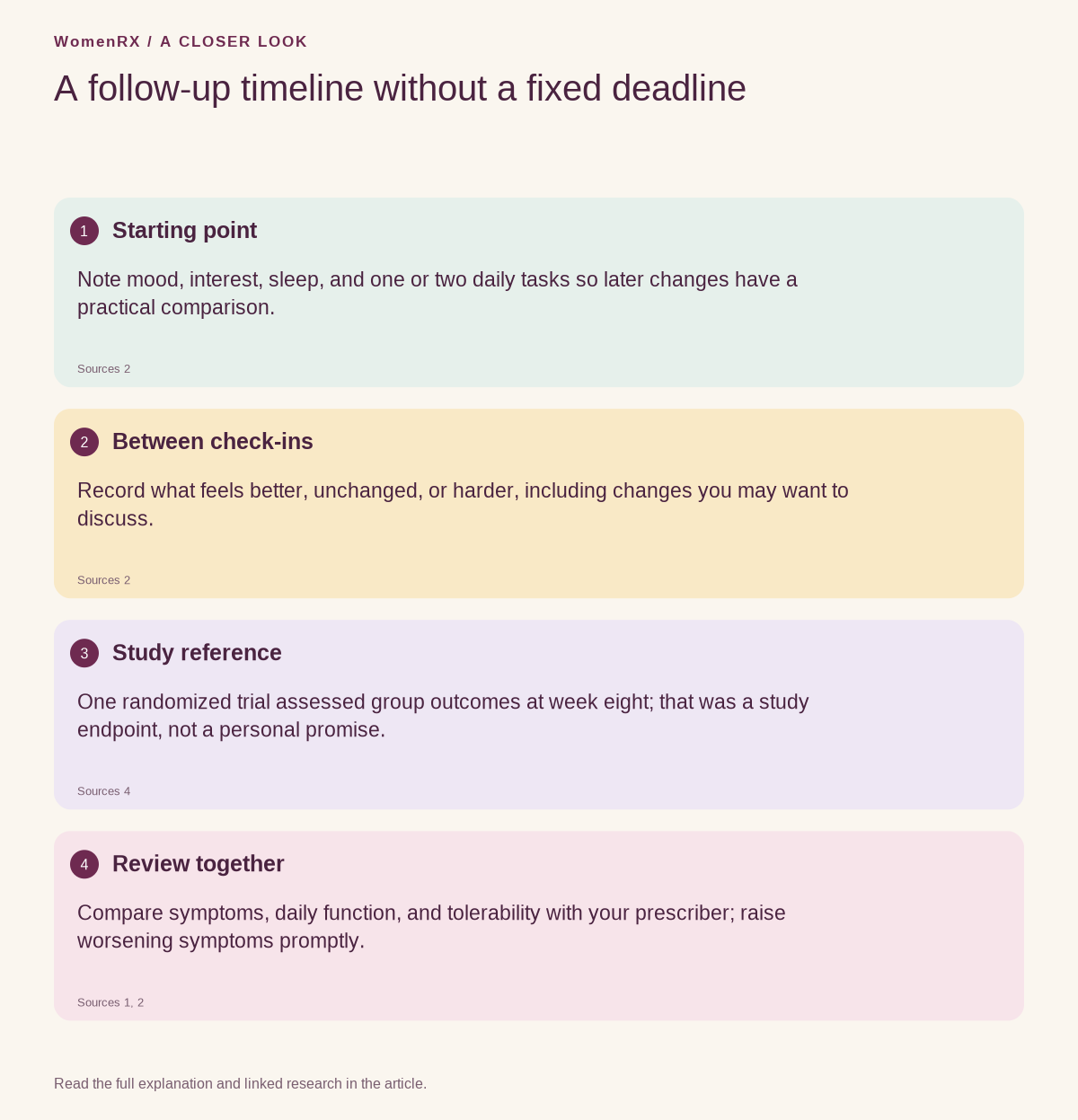
A follow-up timeline without a fixed deadline
Starting point: Note mood, interest, sleep, and one or two daily tasks so later changes have a practical comparison.2
Between check-ins: Record what feels better, unchanged, or harder, including changes you may want to discuss.2
Study reference: One randomized trial assessed group outcomes at week eight; that was a study endpoint, not a personal promise.4
Review together: Compare symptoms, daily function, and tolerability with your prescriber; raise worsening symptoms promptly.12
Read the figure as text
Use these stages to organize a clinician-guided conversation; the research assessment point is not a guaranteed personal milestone.- Starting point: Note mood, interest, sleep, and one or two daily tasks so later changes have a practical comparison.2
- Between check-ins: Record what feels better, unchanged, or harder, including changes you may want to discuss.2
- Study reference: One randomized trial assessed group outcomes at week eight; that was a study endpoint, not a personal promise.4
- Review together: Compare symptoms, daily function, and tolerability with your prescriber; raise worsening symptoms promptly.12
Sources you can check
- CONTRAVE EXTENDED-RELEASE (NALTREXONE HYDROCHLORIDE AND BUPROPION HYDROCHLORIDE) TABLET, EXTENDED RELEASE [NALPROPION PHARMACEUTICALS LLC] | US prescribing information and patient instructionsAccessed 2026-09-25Return to first citation
- Depression: MedlinePlusAccessed 2026-09-25Return to first citation
- Emotional blunting with bupropion and serotonin reuptake inhibitors in three randomized controlled trials for acute major depressive disorder.Peters EM, Balbuena L, Lodhi RJ. · Journal of affective disorders · 2022Return to first citation
- Efficacy and safety of bupropion hydrochloride extended-release versus escitalopram oxalate in Chinese patients with major depressive disorder: Results from a randomized, double-blind, non-inferiority trial.Shen Y, Zhao Q, Yu Y, Tan Y, Zhang H, Xu X, Wang Z, Li Y, Hu J, Zhong J, Li H. · Journal of affective disorders · 2019Return to first citation
- How Does Positive Mental Health Affect Next-Step Treatment Outcomes in Treatment-Resistant Depression? A VAST-D Report.Zisook S, Johnson GR, Planeta B, Mohamed S. · Journal of clinical psychopharmacology · 2025Return to first citation