Silica Supplements: What Safety Evidence Exists?
A short trial in 22 healthy premenopausal women found no reported side effects from one specific silicon compound, but it can’t establish long-term safety or answer questions about other products and medicines.
The best-matched human study tested monomethylsilanetriol (MMST), not every product sold as silica or silicon. Over four weeks, 22 healthy premenopausal women reported no adverse effects and had no serum biochemical changes. That small, short study offers limited reassurance for MMST only; it doesn’t establish long-term safety, benefits for hair or nails, or safety alongside medicines. 2
If you’re considering a silica supplement for your hair, skin, or nails, the first safety question is: what form is actually in the product? “Silica” and “silicon” aren’t enough information to assume that two supplements have been studied in the same way. The human evidence here concerns one particular compound, monomethylsilanetriol, or MMST. It doesn’t settle the safety of every oral silicon product.
What one small human study found
A randomized, placebo-controlled crossover study enrolled 22 healthy premenopausal women, ages 22 to 38. Participants took MMST providing 10.5 mg of silicon per day for four weeks and placebo for four weeks. During the MMST period, the researchers found increased silicon in fasting blood and urine. Participants reported no adverse effects, and the study reported no changes in serum biochemistry compared with placebo. 2
That’s a useful observation, but it’s not the same as showing that MMST is safe for long-term use. The MMST exposure period was four weeks, within a crossover study that lasted eight weeks in total, and the study included a small group of healthy women. Participants taking medication were excluded, so the results don’t answer whether MMST interacts with medicines. Nor was the study designed to show that the supplement improves hair, skin, or nails. 2
Why the form matters
MMST is an organosilicon compound. The study discussed orthosilicic acid as a proposed product of MMST conversion after ingestion; it did not test orthosilicic acid supplements as a separate treatment. The researchers also described MMST as not containing nano-silica particles. That distinction does not establish the safety of nano-silica products or other forms of silicon. 2
There’s also disagreement about what the MMST study proves. Its authors concluded that MMST was safe and that it was converted to orthosilicic acid after ingestion. A published critique argued that the short study and limited complete data were not enough to support a broad safety conclusion, and that conversion to orthosilicic acid wasn’t directly demonstrated by measuring that compound in participants’ blood or urine. 12
The practical takeaway isn’t that MMST has been shown to be harmful. It’s that a promising short-term result for one formulation doesn’t answer every safety question about MMST, other formulations, or longer use.
What to check if you’re weighing a product
Look for the specific ingredient name and the amount of silicon per serving, rather than relying on a front-label claim that says “silica” or “silicon.” If the form isn’t clear, ask the manufacturer what compound the product contains. The MMST study’s results don’t automatically apply to a product with a different form or formulation.
If you take medicines, bring the exact product label to a pharmacist for a product-specific interaction check. The women in the MMST trial weren’t taking medication, so that study cannot tell you whether a particular supplement is safe to combine with yours. 2
And if your goal is fuller hair, healthier skin, or stronger nails, keep the evidence distinction in mind: this trial measured silicon levels and short-term safety markers, not beauty-related benefits. It doesn’t establish that taking MMST improves any of those outcomes. 2
What the MMST Study Can, and Can’t, Tell You
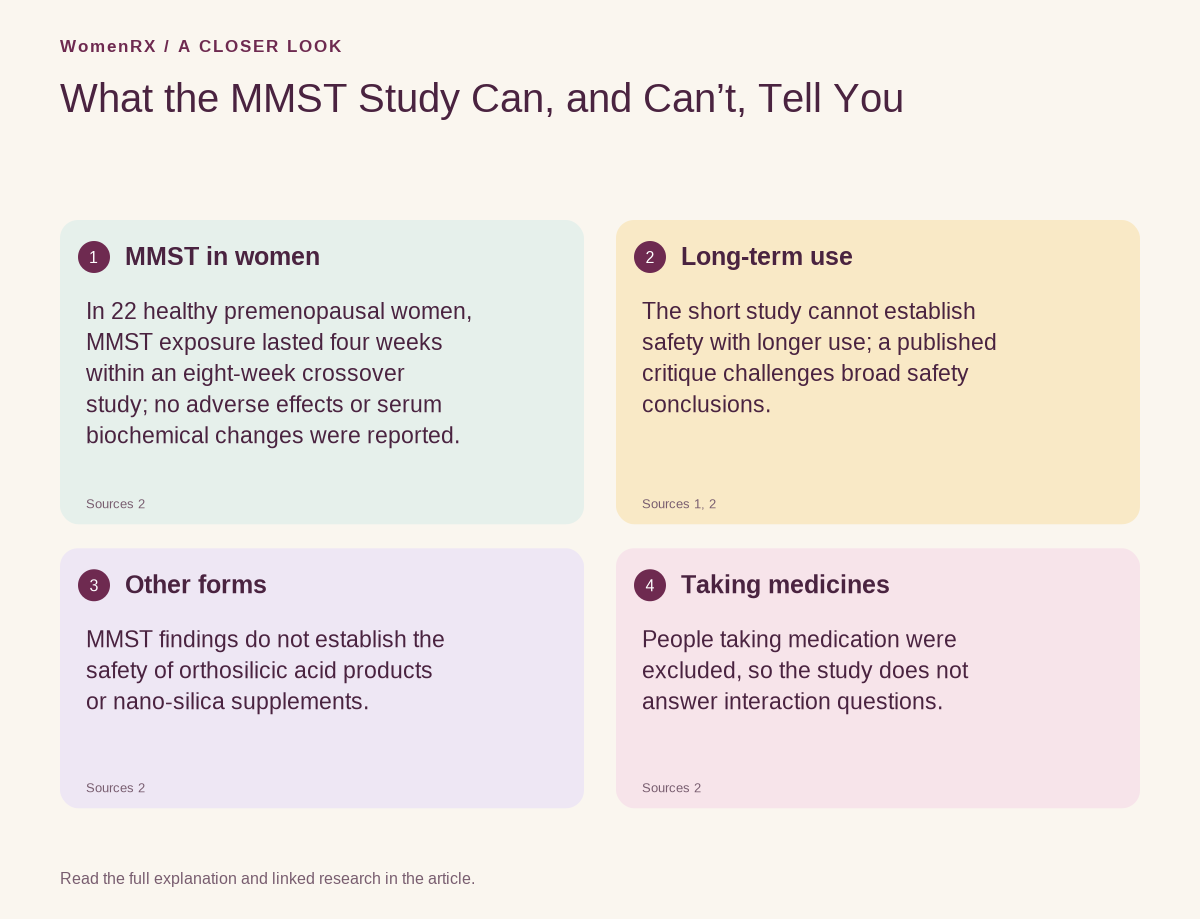
MMST in women: In 22 healthy premenopausal women, MMST exposure lasted four weeks within an eight-week crossover study; no adverse effects or serum biochemical changes were reported.2
Long-term use: The short study cannot establish safety with longer use; a published critique challenges broad safety conclusions.12
Other forms: MMST findings do not establish the safety of orthosilicic acid products or nano-silica supplements.2
Taking medicines: People taking medication were excluded, so the study does not answer interaction questions.2
Read the figure as text
The available human study tested one oral silicon compound for a short period. These distinctions show where its findings apply and where they stop.- MMST in women: In 22 healthy premenopausal women, MMST exposure lasted four weeks within an eight-week crossover study; no adverse effects or serum biochemical changes were reported.2
- Long-term use: The short study cannot establish safety with longer use; a published critique challenges broad safety conclusions.12
- Other forms: MMST findings do not establish the safety of orthosilicic acid products or nano-silica supplements.2
- Taking medicines: People taking medication were excluded, so the study does not answer interaction questions.2
More questions, answered
Did the study show that silica supplements improve hair or nails?
No. The MMST study measured silicon levels and short-term safety markers, not changes in hair, skin, or nails. It doesn’t establish a beauty benefit. 2
Can I assume a silica supplement won’t interact with my medicine?
No. Participants taking medication were excluded from the MMST study, so it didn’t test interactions. Check the exact product with a pharmacist rather than treating the lack of interaction data as proof that none exist. 2
Sources you can check
- There are not enough data to conclude that Monomethylsilanetriol is safe.Vanden Berghe DA. · Nutrition & metabolism · 2013Return to first citation
- The silicon supplement 'Monomethylsilanetriol' is safe and increases the body pool of silicon in healthy Pre-menopausal women.Jugdaohsingh R, Hui M, Anderson SH, Kinrade SD, Powell JJ. · Nutrition & metabolism · 2013Return to first citation