Should You Take Evening Primrose Oil Morning or Night?
The time of day hasn’t been shown to make evening primrose oil work better, so let your product directions and comfort guide your routine.
There’s no established advantage to taking evening primrose oil in the morning rather than at night. The human trials described here used different schedules but didn’t compare times of day or test whether taking it with food changes absorption or stomach comfort.53 Follow your product’s directions; if a clinician gave you a specific plan, follow that instead.
If you’re looking at a bottle of evening primrose oil and wondering whether breakfast or bedtime is the smarter choice, neither has a demonstrated edge. The more useful questions are what your particular product says, whether you can comfortably follow its directions, and whether you’re taking it as part of a clinician-directed plan.
What the study schedules can, and can’t, tell you
In a small trial involving adolescent girls with polycystic ovary syndrome (PCOS), participants were asked to take evening primrose oil at a specified daily time for 12 weeks. The researchers didn’t report that one time of day was better than another. A separate trial in women at 40 weeks of pregnancy used a twice-daily schedule for seven days and likewise did not compare morning with night.53
Those schedules tell us how the researchers organized their trials, not how everyone should take the supplement. They also don’t answer the meal question: neither trial compared taking evening primrose oil with food against taking it on an empty stomach.53 You don’t need to rearrange your day around an assumed absorption window.
Choose a routine without inventing a rule
Start with the directions on your bottle. Products may have different instructions, and a trial schedule isn’t a substitute for them. If the label leaves the time of day open, breakfast and evening are both reasonable choices for a routine you’ll remember. That’s a convenience choice, not a claim that consistency or a particular hour improves the supplement’s effect.
If it leaves your stomach unsettled, look for any with-food directions on the label. You could ask a pharmacist whether trying it with a meal makes sense for your product, but don’t treat that as a proven way to improve absorption or prevent stomach upset. If discomfort keeps happening, reconsider whether continuing it is worthwhile rather than repeatedly changing the clock time.
If a clinician included evening primrose oil in a specific plan, check with them before changing its schedule. For example, the timing of a short-term, supervised plan may have been chosen for a reason that has nothing to do with a general morning-versus-night preference.
Pregnancy or breastfeeding changes the question
Don’t apply an ordinary supplement routine to pregnancy without checking the reason for taking it. One randomized trial in 80 women who completed the study at 40 weeks found no significant difference between evening primrose oil and placebo in outcomes including the need for labor induction or augmentation and the duration of labor. Another trial in women with gestational diabetes tested evening primrose oil together with vitamin D, so it cannot establish the effects of evening primrose oil alone.34 Neither establishes a best time of day or answers whether the supplement is appropriate throughout pregnancy. MedlinePlus advises checking with your pregnancy care provider before taking herbs or supplements during pregnancy.2
If you’re breastfeeding, ask about the particular product before using it. General breastfeeding guidance says some medicines can pass into breast milk, but that guidance does not establish whether evening primrose oil does, or whether morning or night would change an infant’s exposure.1
The practical bottom line is simple: use the directions for the product or the plan you were given, and pick an easy-to-remember time when those directions leave you a choice. There’s no reason to favor bedtime over breakfast on the strength of the evening primrose oil trials discussed here.53
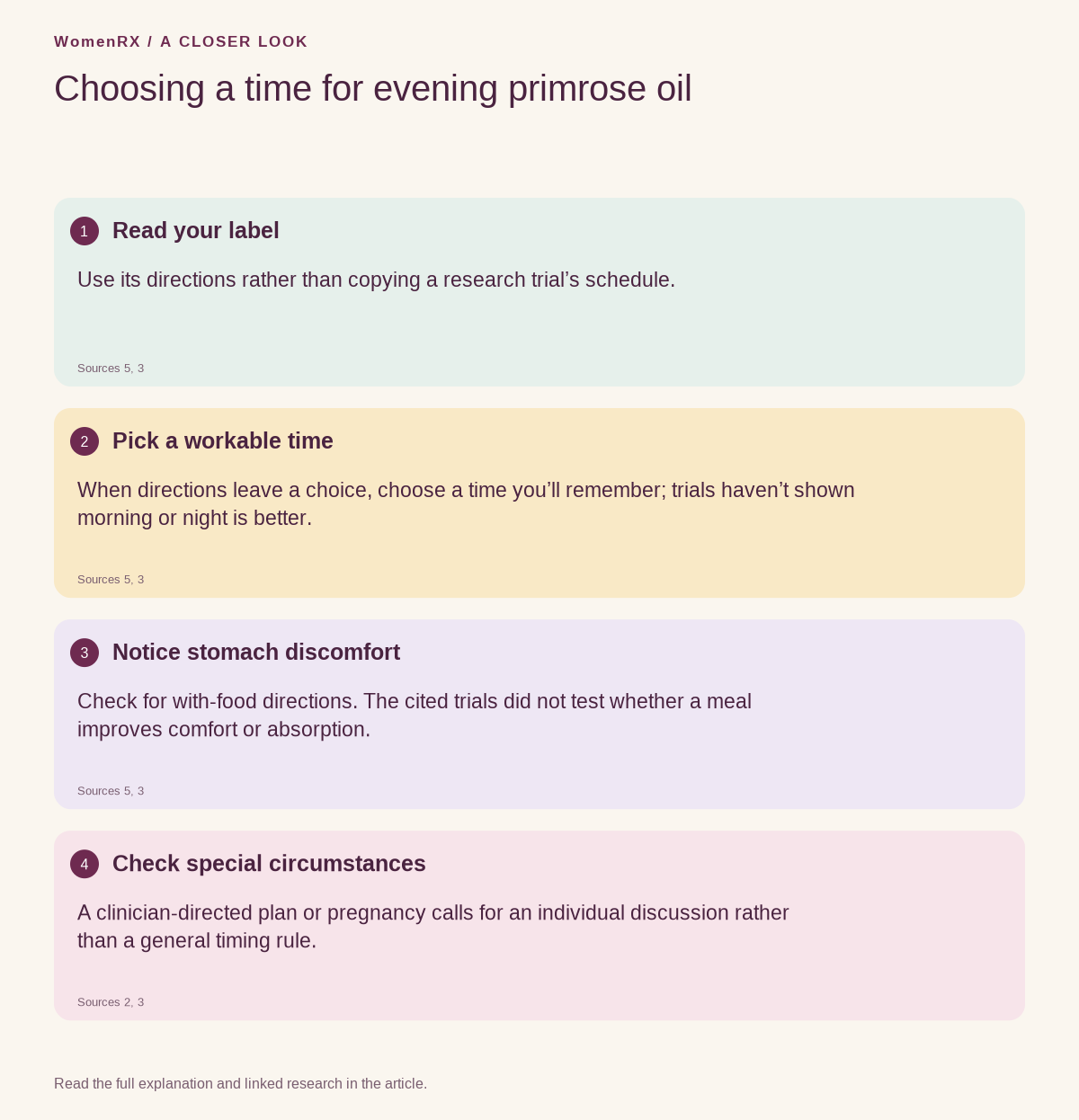
Choosing a time for evening primrose oil
Read your label: Use its directions rather than copying a research trial’s schedule.53
Pick a workable time: When directions leave a choice, choose a time you’ll remember; trials haven’t shown morning or night is better.53
Notice stomach discomfort: Check for with-food directions. The cited trials did not test whether a meal improves comfort or absorption.53
Check special circumstances: A clinician-directed plan or pregnancy calls for an individual discussion rather than a general timing rule.23
Read the figure as text
Use this decision guide when your product does not specify morning or night; it does not represent a tested dosing method.- Read your label: Use its directions rather than copying a research trial’s schedule.53
- Pick a workable time: When directions leave a choice, choose a time you’ll remember; trials haven’t shown morning or night is better.53
- Notice stomach discomfort: Check for with-food directions. The cited trials did not test whether a meal improves comfort or absorption.53
- Check special circumstances: A clinician-directed plan or pregnancy calls for an individual discussion rather than a general timing rule.23
More questions, answered
Should I take evening primrose oil with a meal?
Check your product’s directions first. The cited human trials did not compare with-food and empty-stomach use, so they cannot tell us that a meal improves absorption or prevents stomach upset.53
Sources you can check
- Breastfeeding | Benefits of Breastfeeding | MedlinePlusAccessed 2026-09-25Return to first citation
- Pregnancy and Medicines | MedlinePlusAccessed 2026-09-25Return to first citation
- Evening primrose oil and labour, is it effective? A randomised clinical trial.Kalati M, Kashanian M, Jahdi F, Naseri M, Haghani H, Sheikhansari N. · Journal of obstetrics and gynaecology : the journal of the Institute of Obstetrics and Gynaecology · 2018Return to first citation
- Vitamin D and Evening Primrose Oil Administration Improve Glycemia and Lipid Profiles in Women with Gestational Diabetes.Jamilian M, Karamali M, Taghizadeh M, Sharifi N, Jafari Z, Memarzadeh MR, Mahlouji M, Asemi Z. · Lipids · 2016Return to first citation
- The effect of evening primrose oil on adolescent girl patients with PCOS: A double-blind placebo-controlled randomized study.Mohammadlo L, Rahimi K, Rezaie M, Soufizadeh N, Seyedoshohadaei F, Rahmani K, Bekhradi R. · Avicenna journal of phytomedicine · 2024Return to first citation