Sermorelin for Women: Look Beyond the Hormone Number
What current product records and a small older-adult study can tell you about weight, sleep and wellness claims.
Sermorelin stimulates growth-hormone release, but that mechanism alone does not establish better sleep, weight loss or improved well-being in women. 13 An often-cited older-adult study used a modified GHRH analogue, and its benefits differed between men and women. 11 Check the exact compound and the outcome before treating a hormone increase as a personal benefit.
What sermorelin does
Sermorelin is a synthetic version of a substance that prompts the pituitary gland to release growth hormone. Its historical medical use included children whose bodies were not producing enough growth hormone. 13
That explains the mechanism. It does not make every adult symptom a sign that this pathway needs treatment. If the goal is better sleep, more energy or a change in body composition, ask what evidence connects the proposed treatment to that goal in women like you.
A commonly cited study needs two corrections
The 1997 study enrolled ten women and nine men aged 55 to 71. Participants used placebo for four weeks, then 16 weeks of a modified compound called [Nle27]GHRH-(1-29)-NH2. That identity matters: it should not be casually relabeled as a trial of any modern sermorelin product. 11
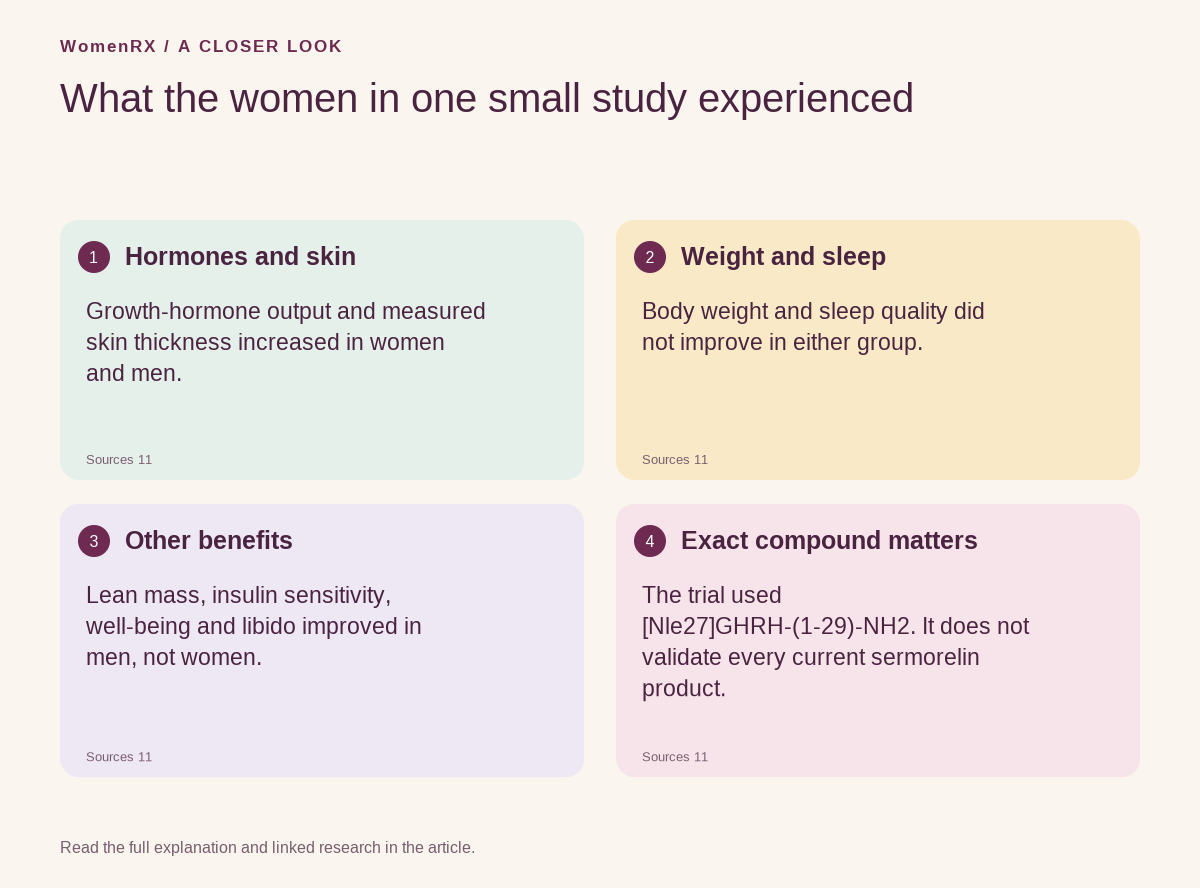
Growth-hormone output and measured skin thickness increased in both women and men. Body weight did not change. Improvements in lean mass, insulin sensitivity, well-being and libido occurred in men, not women; sleep quality did not improve in either group. 11
This small study cannot establish that women never benefit. It also cannot support advertising those male findings as demonstrated benefits for women. A laboratory response, a body-composition result and a feeling of better health are different outcomes.
Is the old GEREF approval still relevant?
FDA's public product records, checked September 26, 2026, list the GEREF products as discontinued. They carry a note that the withdrawal was not for safety or effectiveness reasons. 12
That history is useful, but it is not approval of a current compounded vial or a wellness program. FDA explains that compounded medicines are not FDA-approved finished products. 14
If a clinic cites an old approval, ask which product and use it means. Then ask how that relates to the exact treatment offered today. An answer should identify the medicine and purpose, rather than relying on the word “approved” by itself.
What risks belong in the conversation?
Mayo Clinic's sermorelin guidance lists injection-site pain, redness and swelling, with dizziness, flushing and headache among less common effects. It also notes inadequate evidence to determine infant risk during breastfeeding and that underactive thyroid can interfere with the medicine's effects. 13
These are reasons to review your health and medicines with a clinician. They do not provide a precise side-effect rate for long-term adult use of a particular compounded formulation.
Tell the clinician what other hormone treatment you use, whether pregnancy is possible and what symptoms led you to consider sermorelin. Ask for the reason behind any proposed testing and how a result would change the treatment decision. A number without a clear action attached is not much of a plan.
Judge the proposal by your actual goal
Before committing to a course, write down what improvement would matter to you. Ask when it will be reassessed, what would count as no benefit and what would prompt stopping or changing course with the prescriber.
If your main concern is sleep or fatigue, start by asking what else could explain it. You should leave the conversation understanding why this treatment fits, what remains uncertain and how progress will be judged in terms that matter in your daily life.
What the women in one small study experienced
Hormones and skin: Growth-hormone output and measured skin thickness increased in women and men.11
Weight and sleep: Body weight and sleep quality did not improve in either group.11
Other benefits: Lean mass, insulin sensitivity, well-being and libido improved in men, not women.11
Exact compound matters: The trial used [Nle27]GHRH-(1-29)-NH2. It does not validate every current sermorelin product.11
Read the figure as text
Ten women aged 55 to 71 used a modified GHRH analogue for 16 weeks after four placebo weeks.- Hormones and skin: Growth-hormone output and measured skin thickness increased in women and men.11
- Weight and sleep: Body weight and sleep quality did not improve in either group.11
- Other benefits: Lean mass, insulin sensitivity, well-being and libido improved in men, not women.11
- Exact compound matters: The trial used [Nle27]GHRH-(1-29)-NH2. It does not validate every current sermorelin product.11
Sources you can check
- Khorram et al.: Endocrine and Metabolic Effects of a GHRH Analogue, 1997Accessed 2026-09-26Return to first citation
- FDA Drugs@FDA: GEREF Product RecordsAccessed 2026-09-26Return to first citation
- Mayo Clinic: Sermorelin, Injection RouteAccessed 2026-09-26Return to first citation
- FDA: Understanding Compounded DrugsAccessed 2026-09-26Return to first citation