Screens Before Bed: What Blue-Light Evidence Really Says
Evening screen light can affect the body clock, but the content on your screen and the time it takes from sleep may matter too.
Blue-enriched light in the evening can suppress melatonin and shift circadian timing, but screen use isn’t just a light exposure: stimulating content, alerts, and a later bedtime may also interfere with sleep. Evidence that blue-light filters reliably improve sleep is uncertain. If sleep is difficult, try changing one screen habit at a time and notice what happens, rather than relying on a filter alone. 1
Blue light is one pathway, not the whole story
Light from screens can reach the eye’s circadian system. In controlled studies, evening exposure to bright or blue-enriched light can suppress melatonin and shift the body clock later. The effect depends on more than the screen’s color: brightness, distance, duration, room lighting, and individual sensitivity all affect the light reaching your eyes. 1
That makes “screen time” an imperfect stand-in for the light dose. Two screens that look similarly bright may not deliver the same circadian-effective light. And a screen can affect sleep without light being the main cause: an absorbing show, upsetting news, messages, or the habit of scrolling past your intended bedtime may keep you mentally engaged or leave less time for sleep. A blue-light filter won’t change those things. 1
An observational study of 693 adults, including 538 women, found that more evening and nighttime screen exposure was associated with several self-reported sleep difficulties. Because it was a questionnaire study, it cannot show that screen light caused those problems or separate light from bedtime and content effects. 2
Filters change light, but sleep benefits are uncertain
A filter can reduce some short-wavelength light, and small controlled studies have found effects on melatonin or alertness. But that doesn’t guarantee a meaningful improvement in sleep. In a study of 13 teenage boys, blue-blocking glasses reduced melatonin suppression and alertness during screen exposure, but sleep stages and next-morning measures did not change. 3
A separate study in male adolescents and young adults found that unfiltered smartphone reading reduced melatonin immediately afterward, but it did not find changes in sleep-dependent memory consolidation. The study also found some sleep differences, including reduced deep sleep in adults during the first part of the night. These results are specific to the study’s young male participants, not proof of the same effect in women or at other ages. 4
A 2026 narrative review describes the clinical evidence for blue-light-filtering glasses as low-certainty and mixed. It does not support recommending a lens type as a treatment for disrupted sleep. Filters might be an optional experiment if you prefer them, but they shouldn’t be expected to solve sleep problems on their own. 1
Try changing one thing at a time
A useful experiment is to make one manageable change and see whether your own sleep shifts. For example, if you tend to keep scrolling after getting into bed, put the phone out of reach and choose an audio activity instead. If the content is what keeps you alert, switch to something calmer while keeping your usual bedtime. If light seems like the likeliest factor, lower screen brightness or use a filter while keeping your content and bedtime as steady as you can. These are practical ways to separate possible causes, not proven treatments.
For a stretch of nights, jot down when you went to bed, roughly how long it took to fall asleep, whether you woke during the night, and how rested you felt in the morning. Then change a different factor only if you want to test it. A few rough notes may be more useful than judging a filter by its marketing claims. The aim isn’t perfect tracking; it’s to see whether one small change makes a difference for you.
What the evidence says about women
The adult observational study included many women, but it did not establish that screen light caused their sleep complaints. The controlled screen and filter studies described here focused on adolescents or young men. They don’t tell us whether the effects differ across women’s cycling years, pregnancy, postpartum, or menopause. It’s reasonable to test habits that fit your life, but there’s not enough evidence here to claim women need a different blue-light strategy. 2 3 4
If you’re caring for a baby overnight, working late, or dealing with night sweats, pain, or another reason for waking, screen light may be only one part of the picture. A filter won’t address those causes. Consider whether the screen is helping you wind down, keeping you engaged, or simply filling time when sleep is already interrupted.
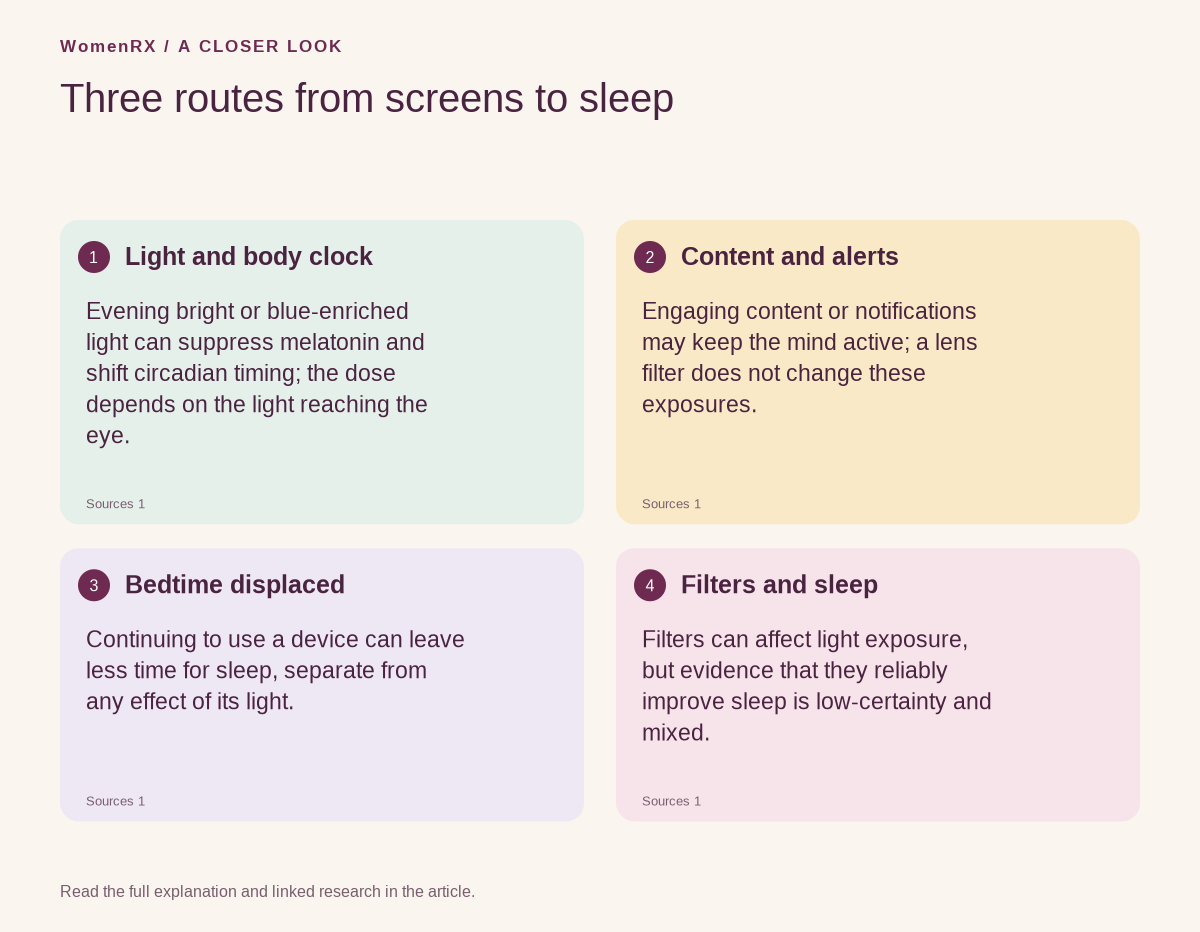
Three routes from screens to sleep
Light and body clock: Evening bright or blue-enriched light can suppress melatonin and shift circadian timing; the dose depends on the light reaching the eye.1
Content and alerts: Engaging content or notifications may keep the mind active; a lens filter does not change these exposures.1
Bedtime displaced: Continuing to use a device can leave less time for sleep, separate from any effect of its light.1
Filters and sleep: Filters can affect light exposure, but evidence that they reliably improve sleep is low-certainty and mixed.1
Read the figure as text
Screen habits can affect sleep through light, mental engagement, or time displaced from sleep. The evidence is strongest for the light mechanism, not for filters as a dependable sleep fix.- Light and body clock: Evening bright or blue-enriched light can suppress melatonin and shift circadian timing; the dose depends on the light reaching the eye.1
- Content and alerts: Engaging content or notifications may keep the mind active; a lens filter does not change these exposures.1
- Bedtime displaced: Continuing to use a device can leave less time for sleep, separate from any effect of its light.1
- Filters and sleep: Filters can affect light exposure, but evidence that they reliably improve sleep is low-certainty and mixed.1
More questions, answered
Is a blue-light filter worth trying?
It’s reasonable to try if it’s easy and comfortable, but evidence that filters reliably improve sleep is low-certainty and mixed. Keep in mind that a filter won’t change stimulating content, alerts, or a bedtime pushed later by scrolling. 1
Does using a screen always make sleep worse?
No. The effect can depend on the amount and timing of light, the person, and what they’re doing on the device. In one controlled study of adolescents, different screen conditions changed alertness slightly but did not significantly change several measured sleep outcomes. 5
Sources you can check
- Evening Light-Emitting Diode Screen Exposure, Melanopsin-Mediated Circadian Disruption, and Optical Filtration for Sleep Hygiene: A Narrative Review in the Indian Context.Dubey SA, Elango N, Blessy Coelho L, Chaudhry M. · Cureus · 2026Return to first citation
- Evening and night exposure to screens of media devices and its association with subjectively perceived sleep: Should "light hygiene" be given more attention?Šmotek M, Fárková E, Manková D, Kopřivová J. · Sleep health · 2020Return to first citation
- Blue blocker glasses as a countermeasure for alerting effects of evening light-emitting diode screen exposure in male teenagers.van der Lely S, Frey S, Garbazza C, Wirz-Justice A, Jenni OG, Steiner R, Wolf S, Cajochen C, Bromundt V, Schmidt C. · The Journal of adolescent health : official publication of the Society for Adolescent Medicine · 2015Return to first citation
- Effects of evening smartphone use on sleep and declarative memory consolidation in male adolescents and young adults.Höhn C, Hahn MA, Gruber G, Pletzer B, Cajochen C, Hoedlmoser K. · Brain communications · 2024Return to first citation
- Does one hour of bright or short-wavelength filtered tablet screenlight have a meaningful effect on adolescents' pre-bedtime alertness, sleep, and daytime functioning?Heath M, Sutherland C, Bartel K, Gradisar M, Williamson P, Lovato N, Micic G. · Chronobiology international · 2014Return to first citation