Sage Safety Starts With the Product You’re Using
Sage in a meal, a brewed tea, an extract, and an essential oil aren’t interchangeable exposures.
If you’re considering sage for a health reason, first check the species and the preparation. Salvia officinalis contains thujone and camphor, which can be neurotoxic at high doses, but this evidence doesn’t establish a safe medicinal amount or show that tea, extracts, and essential oil carry the same exposure. Breastfeeding safety data are lacking, and a menopause benefit shouldn’t be assumed. 3
Start with the form, not the word “sage”
A sprinkle of sage in dinner raises a different question from taking a sage product every day. The name on the front of a package doesn’t tell you how much of any particular compound you’ll consume. Check the botanical name, whether the product contains leaf, an extract, or essential oil, and whether it’s meant to be eaten, brewed, or used another way.
That distinction matters because Salvia officinalis leaves contain several types of compounds, including essential-oil components called thujone and camphor. Related sage species can differ in composition, and sage products may be misidentified or contain other species. Thujone and camphor are neurotoxic at high doses. That is a reason to take concentrated products seriously, not a way to calculate your risk from a cup of tea or a particular bottle. 3
What each preparation tells you, and what it doesn’t
Culinary leaf: Sage used to season food is leaf consumed as part of a meal. The safety information on medicinal sage products doesn’t establish a daily amount of culinary sage to use as a treatment. If your aim is relief from a symptom, adding more seasoning isn’t the same as using a studied remedy.
Tea: Brewing the leaf makes a water-based preparation. Don’t assume that means it contains no thujone or camphor. Researchers detected both in one laboratory-prepared aqueous S. officinalis extract. That analysis cannot tell you how much would be in your tea, because it tested one preparation, not the cup you brew at home. 5
Extracts and capsules: “Sage extract” is not a single formulation. The species, extraction method, ingredients, and amounts on the label matter; testing one product cannot establish the safety or effects of another. An independent quality check may help verify what a supplement contains, but it does not prove that the product is safe or effective. 3
Essential oil: An essential oil is a preparation of volatile compounds, not interchangeable with sage leaf or tea. Thujone was among the main constituents identified in one S. officinalis essential oil studied in a laboratory. That experiment did not test whether people can safely swallow the oil or use it to treat a condition. Don’t use a food or tea comparison to justify taking an essential-oil product internally. 23
Side effects and situations that change the decision
The sage review describes sage as generally well tolerated but lists occasional nausea, vomiting, abdominal pain, dizziness, agitation, and wheezing. It does not give rates by preparation. 3
Pregnant? Don’t treat a botanical product as pregnancy-safe just because it’s sold as a supplement. MedlinePlus advises checking before starting herbs or supplements during pregnancy. The sage information here does not establish pregnancy safety for medicinal tea, extracts, or essential oil. 13
Breastfeeding? Sage has traditionally been used to reduce milk supply, but a review found no scientific studies evaluating that effect and no safety data for nursing mothers or infants. If keeping your milk supply matters to you, that uncertainty is more useful than a claim that sage reliably helps with weaning or oversupply. 3
Taking medication? There isn’t a verified human sage-drug interaction to name from this evidence. One study found changes in drug-metabolizing-enzyme gene expression in male rats given sage extract; it did not measure enzyme activity or establish a drug interaction in people. If you’re considering regular medicinal use, the exact product and your medication list are more useful to discuss with a pharmacist than a broad warning that “sage interacts with medicines.” 4
Considering sage for hot flashes?
A menopause claim on a product doesn’t answer the safety question. Research on an essential oil in cancer cells, an aqueous extract in laboratory cells, and a sage extract in male rats cannot show whether a sage preparation relieves hot flashes in women or what its longer-term effects might be. They also cannot establish that all sage preparations have the same risks. 245
The useful next move is to identify the actual product before weighing its claim: Which Salvia species is it? Is it leaf, tea, extract, or essential oil? What ingredients and amounts does the label give? If those basics are unclear, you cannot make a meaningful comparison with research on a differently prepared sage product. 3
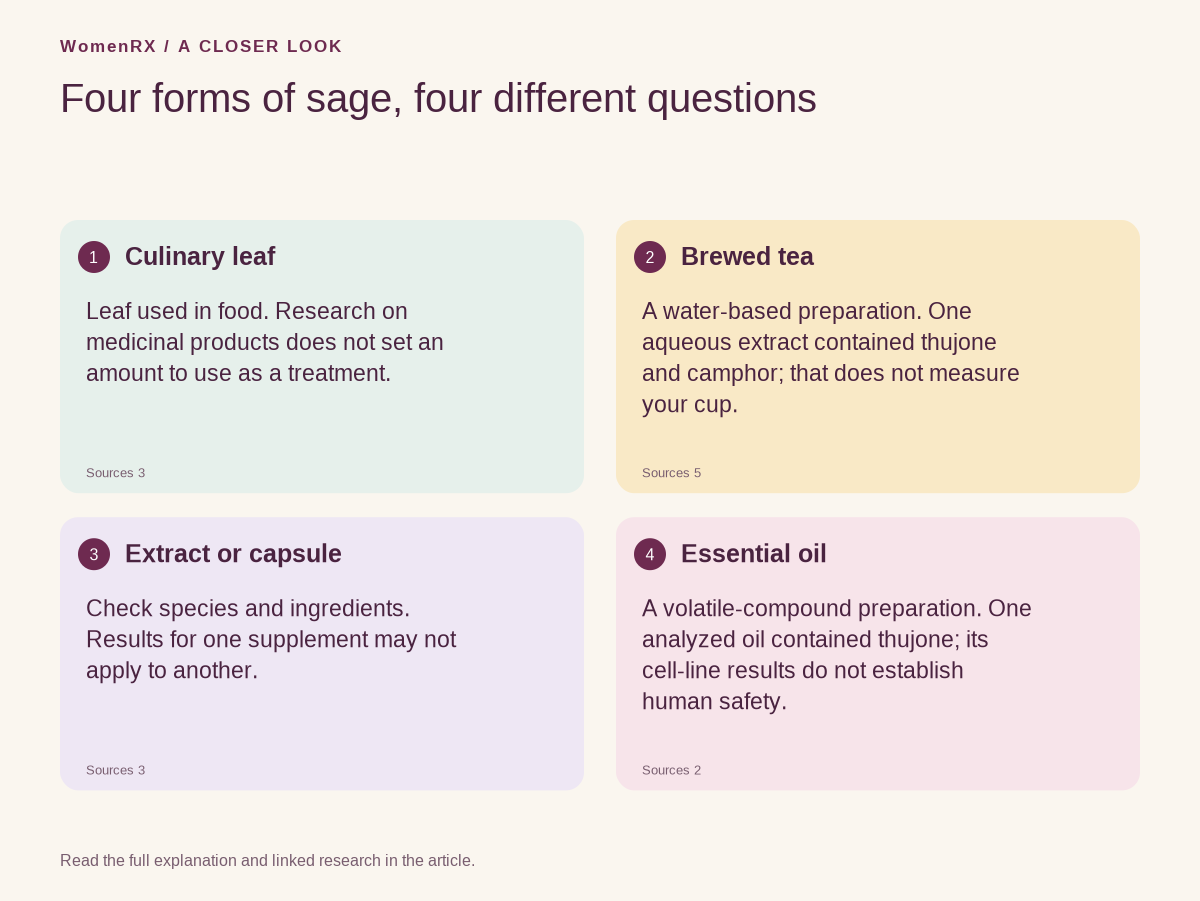
Four forms of sage, four different questions
Culinary leaf: Leaf used in food. Research on medicinal products does not set an amount to use as a treatment.3
Brewed tea: A water-based preparation. One aqueous extract contained thujone and camphor; that does not measure your cup.5
Extract or capsule: Check species and ingredients. Results for one supplement may not apply to another.3
Essential oil: A volatile-compound preparation. One analyzed oil contained thujone; its cell-line results do not establish human safety.2
Read the figure as text
Use the product form to identify what can and cannot be inferred from its label or from research on another preparation.- Culinary leaf: Leaf used in food. Research on medicinal products does not set an amount to use as a treatment.3
- Brewed tea: A water-based preparation. One aqueous extract contained thujone and camphor; that does not measure your cup.5
- Extract or capsule: Check species and ingredients. Results for one supplement may not apply to another.3
- Essential oil: A volatile-compound preparation. One analyzed oil contained thujone; its cell-line results do not establish human safety.2
More questions, answered
Does brewing sage tea remove thujone?
Not necessarily. Thujone was detected in one laboratory-prepared aqueous Salvia officinalis extract. That finding doesn’t measure the thujone in every brewed tea or establish whether a particular cup is safe for medicinal use. 5
Sources you can check
- Pregnancy and Medicines | MedlinePlusAccessed 2026-09-25Return to first citation
- [Anticancer activity of Salvia officinalis essential oil against HNSCC cell line (UMSCC1)].Sertel S, Eichhorn T, Plinkert PK, Efferth T, Efferth T. · HNO · 2011Return to first citation
- Sage2006Return to first citation
- Transcript-Level Modulation of Drug-Metabolizing Enzymes by Echinacea, Salvia, and Thymus in Adult Male Rats: Implications for Herb-Drug Interactions.Ahmed SH, Naguib MM, Seoudi DM, El-Sayed WM. · Current pharmaceutical design · 2026Return to first citation
- Cyto- and Genotoxicity of Selected Plant Extracts and Microbial Metabolites with Confirmed Activity Against Phytopathogens of Potato Seed (Solanum tuberosum L.).Nowak A, Steglińska A, Gutarowska B, Kręgiel D. · Molecules (Basel, Switzerland) · 2025Return to first citation