Can You Take a Sage Supplement Long Term?
Sage in food is different from a daily supplement, and research lasting up to eight weeks doesn’t settle the safety of ongoing use.
Long-term safety isn’t established for sage supplements. Sage is likely safe in amounts commonly used in food, and larger amounts have been used safely for up to eight weeks in research. That doesn’t establish safety beyond eight weeks or for every tea, capsule, or extract. Common sage contains thujone, which can be toxic in large amounts. If you’re taking sage regularly, the exact product matters. 3
The first question isn’t simply how long you’ve taken sage. It’s what kind of sage you’re taking, in what form, and how much. A sprinkle of the herb in dinner and a daily extract shouldn’t be treated as the same exposure. Herbal products are sold as teas, powders, capsules, and extracts, while the evidence for sage’s safety does not establish that these forms are interchangeable. 13
What the eight-week finding tells you
The National Center for Complementary and Integrative Health (NCCIH) says sage is likely safe in amounts commonly found in foods. It also reports that larger amounts have been used safely for up to eight weeks in research studies. Eight weeks is a description of the research, not a proven cutoff after which harm begins or a guarantee that any product is safe until then. NCCIH cautions that sage may be unsafe at high doses or with long-term use because some sage species, including common sage (Salvia officinalis), contain thujone, which can be toxic in large amounts. 3
So if a supplement has become part of your daily routine, a reassuring short-term finding doesn’t answer the question you actually have. Nor can a study of sage applied to the gums fill that gap: one small human trial followed a sage gel used alongside dental treatment for one month, not an oral product taken over time. 2
Food, tea, and extracts are different questions
Sage in food: The safety assessment for amounts commonly found in food applies here. It doesn’t automatically extend to taking sage every day for a health effect. 3
Sage tea: A tea is an herbal preparation, but the amount you drink and how it’s prepared matter when describing your use. Don’t assume that the finding for culinary amounts covers a regular tea habit, or that the eight-week research finding applies to your particular tea. 13
Capsules and extracts: Look for the botanical name on the label, then note the preparation and labeled serving amount. “Sage” can refer to more than one species, and NCCIH’s caution about thujone includes common sage. The name alone doesn’t tell you that two products have the same exposure or long-term safety profile. 3
This distinction is especially useful if you started with occasional tea and later switched to a supplement. Your time using “sage” may sound continuous, but the product you’re evaluating has changed.
If you’re taking it for menopause symptoms
Sage is promoted for menopause symptoms, but NCCIH says research on sage for health conditions is too limited for definitive conclusions about its effects. A possible symptom benefit and the safety of continuing a product for months are separate questions. If you feel it helps, that experience is worth mentioning when you review whether to keep taking it, along with the exact product and how long you’ve used it. 3
If you’re pregnant, don’t carry over the food-safety finding to a sage supplement: NCCIH says sage use during pregnancy may be unsafe because thujone may have harmful effects. If you’re breastfeeding, the question is different. Little is known about the safety of sage use while breastfeeding. Neither statement establishes that your particular product has been studied in pregnancy or lactation. 3
For an ongoing supplement, bring the bottle or a clear photo of its label to a clinician or pharmacist. Include any sage tea you drink, how often you use each product, when you started, and the prescription or over-the-counter medicines you take. Herbal products can interact with medicines, but that general caution does not identify a proven interaction between sage and a particular drug. It gives you a reason to review your actual combination rather than guess from a list. 1
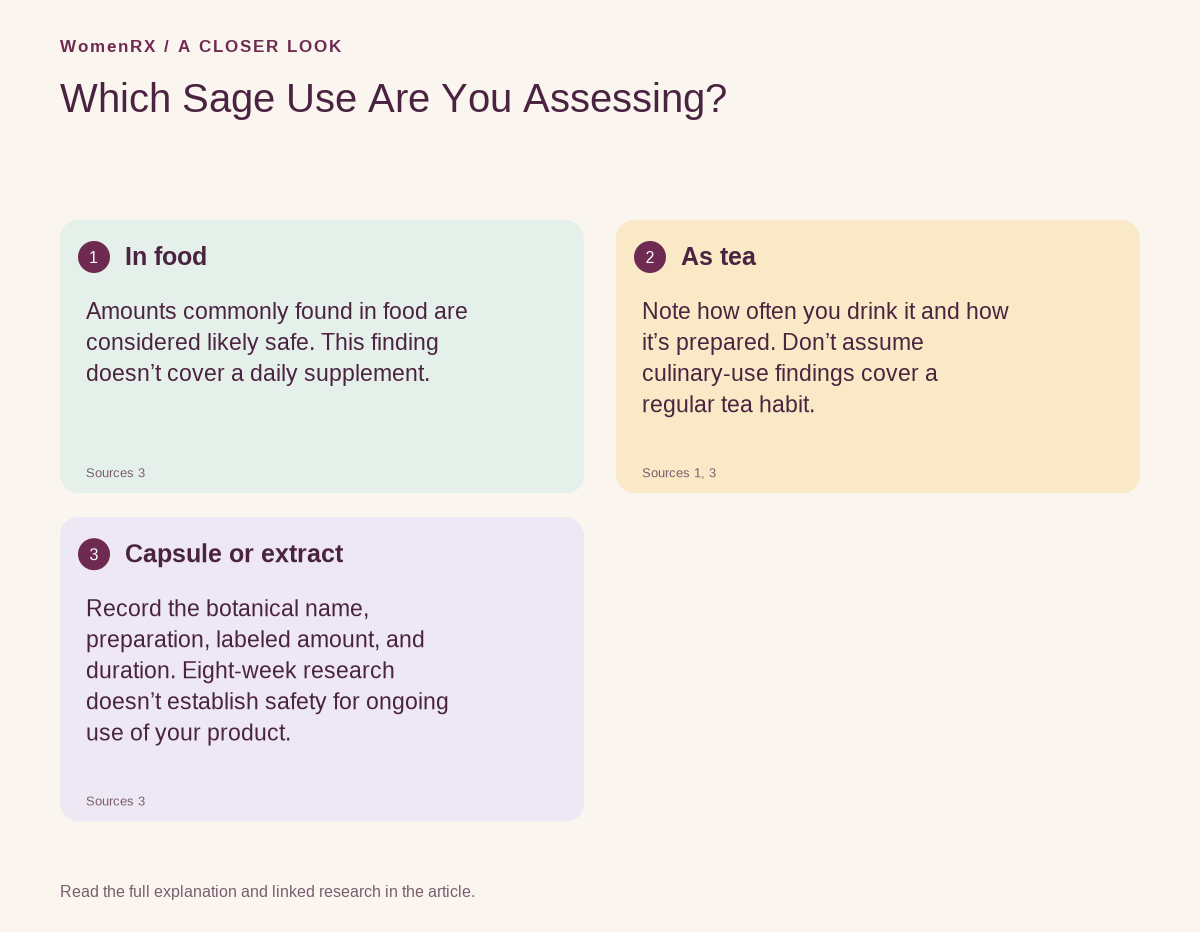
Which Sage Use Are You Assessing?
In food: Amounts commonly found in food are considered likely safe. This finding doesn’t cover a daily supplement.3
As tea: Note how often you drink it and how it’s prepared. Don’t assume culinary-use findings cover a regular tea habit.13
Capsule or extract: Record the botanical name, preparation, labeled amount, and duration. Eight-week research doesn’t establish safety for ongoing use of your product.3
Read the figure as text
The form changes which safety finding is relevant; none of these descriptions proves that another form has the same exposure.- In food: Amounts commonly found in food are considered likely safe. This finding doesn’t cover a daily supplement.3
- As tea: Note how often you drink it and how it’s prepared. Don’t assume culinary-use findings cover a regular tea habit.13
- Capsule or extract: Record the botanical name, preparation, labeled amount, and duration. Eight-week research doesn’t establish safety for ongoing use of your product.3
More questions, answered
Does “used safely for eight weeks” mean I should stop on day 57?
No. Eight weeks describes the research duration NCCIH reports; it isn’t a demonstrated safety limit or a safe-use schedule. It leaves the safety of longer use unresolved. 3
Sources you can check
- Herbal Medicine: MedlinePlusAccessed 2026-09-25Return to first citation
- Clinical Effectiveness of Salvia officinalis in Periodontitis: A Split-Mouth Randomized Controlled Trial.Aljuboori IW, Mahmood MS, Al-Rihaymee SA. · Cureus · 2024Return to first citation
- Sage: Usefulness and Safety | NCCIHAccessed 2026-09-25Return to first citation