Does Sage Need to Be Taken With Food?
For sage tea and supplements, the useful distinction is the preparation, not a proven benefit from taking sage with a meal.
Sage used in cooking is already part of food. For tea or an extract, the cited sage-extract trial doesn’t tell us whether taking it with a meal changes its effects or eases discomfort. 2 Check your product’s directions for any food instruction. If a supplement repeatedly upsets your stomach, ask about the discomfort rather than assuming food will fix it. Higher-dose sage raises different safety questions from culinary use. 3
Start with the form you’re using
If you’re sprinkling sage into dinner, you don’t need a separate timing plan. Sage is likely safe in the amounts commonly found in foods. That finding is a useful starting point for cooking, but it doesn’t tell you how to take a sage capsule or extract. Common sage (Salvia officinalis) contains thujone, which can be toxic in large amounts; high doses or long-term use may be unsafe. 3
Sage tea is a different preparation from both a pinch of culinary sage and an extract. Herbal preparations are sold as teas, tablets, capsules, and extracts. Those different forms are a reason to identify exactly what you have before borrowing advice from another preparation. 1
What does the research say about meals?
A placebo-controlled trial of sage leaf extract in people with elevated blood lipids examined fasting blood markers, not whether taking the extract with food changed its effects or eased discomfort. That trial cannot tell you whether meals affect the extract, much less sage tea. 2
If you have a packaged tea or supplement, read its directions for any food instruction. Don’t turn “take with food” on one product into a rule for all sage, or assume taking it on an empty stomach makes it work better. If a concentrated product repeatedly causes discomfort, ask a health professional about it rather than assuming that changing meal timing will resolve it.
Menopause benefits are a different question
You might be considering sage because of hot flashes or sweating. A meal-timing choice won’t answer whether sage controls those symptoms. The National Center for Complementary and Integrative Health says research on sage for health conditions is limited; its overview does not establish whether sage helps hot flashes or sweating. A food instruction isn’t evidence that a product treats menopause symptoms. 3
If you’re pregnant, the decision is different from choosing when to have tea: sage may be unsafe during pregnancy because thujone may have harmful effects. If you’re breastfeeding, little is known about sage’s safety. The general finding about customary food amounts does not establish what amount of sage is safe during pregnancy or breastfeeding. 3
Sage forms and food timing
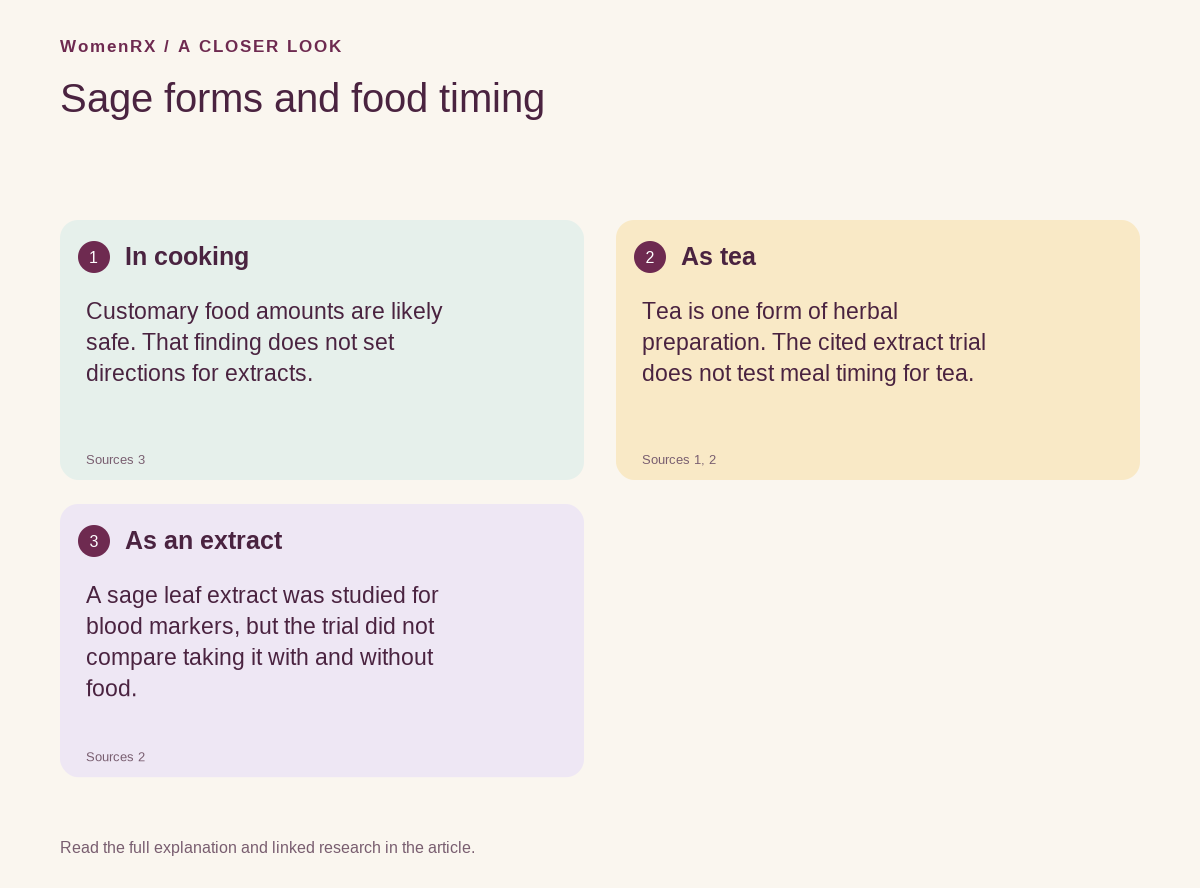
In cooking: Customary food amounts are likely safe. That finding does not set directions for extracts.3
As tea: Tea is one form of herbal preparation. The cited extract trial does not test meal timing for tea.12
As an extract: A sage leaf extract was studied for blood markers, but the trial did not compare taking it with and without food.2
Read the figure as text
The form helps determine which question to ask; a finding about one preparation is not a timing instruction for another.- In cooking: Customary food amounts are likely safe. That finding does not set directions for extracts.3
- As tea: Tea is one form of herbal preparation. The cited extract trial does not test meal timing for tea.12
- As an extract: A sage leaf extract was studied for blood markers, but the trial did not compare taking it with and without food.2
Sources you can check
- Herbal Medicine: MedlinePlusAccessed 2026-09-25Return to first citation
- Antihyperlipidemic effects of Salvia officinalis L. leaf extract in patients with hyperlipidemia: a randomized double-blind placebo-controlled clinical trial.Kianbakht S, Abasi B, Perham M, Hashem Dabaghian F. · Phytotherapy research : PTR · 2011Return to first citation
- Sage: Usefulness and Safety | NCCIHAccessed 2026-09-25Return to first citation