Rhodiola Timing: What Research Says About Morning or Night
Research hasn’t established a best time of day for rhodiola, so your own sleep and symptom pattern is more useful than assuming morning or bedtime is right.
Studies summarized in a recent review do not establish whether rhodiola works better in the morning or evening. A small sleep study used a bedtime blend of rhodiola and another plant extract, so it can’t tell us what rhodiola alone does at bedtime or compare it with morning use. If you’re trying to understand your response, keep a brief, consistent record rather than treating one study as a schedule recommendation. 1 2
No proven clock-time rule
There isn’t a research-backed answer that rhodiola is best in the morning or at night. A 2026 review describes five rhodiola trials among the studies it assessed, but its summary does not establish a direct morning-versus-evening comparison. The trials also varied in their preparations and duration, so a result with one product or routine shouldn’t automatically be applied to another. 1
One study is easy to misread as support for bedtime use. It tested a combination of Rhodiola rosea and lotus extract in adults with sleep disturbance. Participants took the blend at bedtime, but only 13 of 20 participants completed the two-week study. Because the product contained two extracts and wasn’t compared with morning use, it cannot show that rhodiola by itself improves sleep at bedtime or that bedtime is the better schedule. 2
That distinction matters if you’ve heard a product described as energizing or sleep-supporting. Neither label settles what time will suit you. The preparation, other ingredients, and your own response may differ, and the available evidence doesn’t give a universal timing rule.
Use a short record to spot a pattern
If you’re already taking rhodiola and think it may be affecting sleep or symptoms, a simple log can help you see whether a pattern repeats. For several days, note:
- What you took: product name, listed ingredients, and the time you took it.
- How the night went: approximate bedtime and wake time, how often you remember waking, and how rested you felt the next day.
- What you noticed: sleep changes, daytime symptoms, or other changes you’re trying to understand.
- Relevant context: for example, a change in routine or cycle-related or menopause symptoms that may also be affecting sleep.
Keep the notes factual rather than trying to score yourself. If you change several things at once, it becomes harder to tell what might be connected. A brief record is a way to organize your own observations, not a validated test of whether rhodiola is helping.
Don’t use the bedtime study as a dosing instruction
The sleep study tested a specific two-extract blend, not rhodiola alone. It also does not establish that taking rhodiola at bedtime is suitable for you. Follow the directions for your own product rather than borrowing a schedule from a different formulation, and don’t add ingredients or change how much you take based on that study. 2
The studies summarized in the review included healthy people and people with stress-related or functional concerns, but the summary does not report whether timing effects differ for women or across menstrual, perimenopausal, or postmenopausal stages. If cycle-related or menopause symptoms are part of your sleep picture, recording them separately can give you useful context; it does not prove they change the best time to take rhodiola. 1
Bottom line: research hasn’t picked a winning time of day. A small bedtime study of a combination product isn’t enough to recommend bedtime for rhodiola alone. If you use it, pay attention to your own repeated pattern and the directions for the specific product you have.
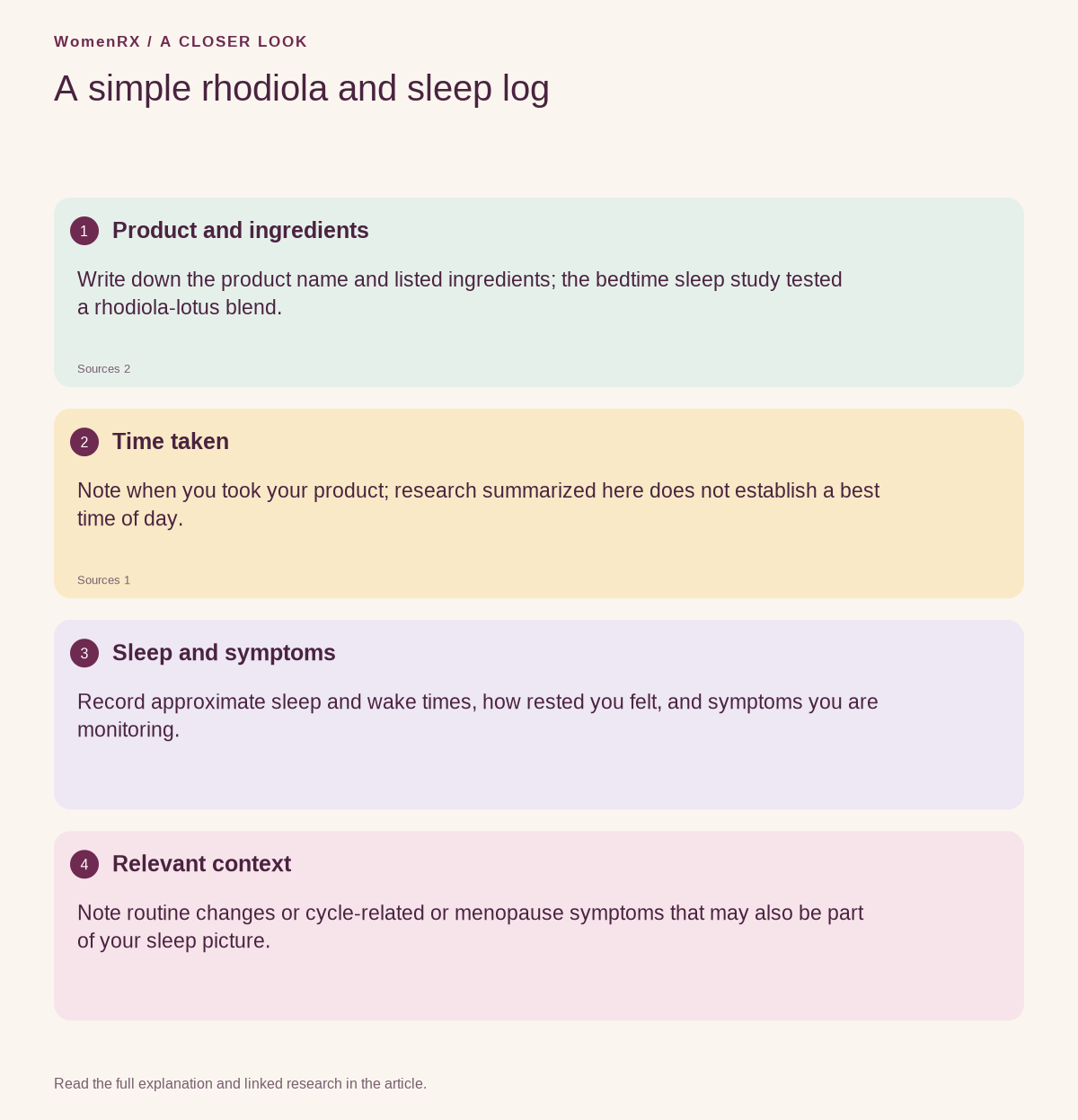
A simple rhodiola and sleep log
Product and ingredients: Write down the product name and listed ingredients; the bedtime sleep study tested a rhodiola-lotus blend.2
Time taken: Note when you took your product; research summarized here does not establish a best time of day.1
Sleep and symptoms: Record approximate sleep and wake times, how rested you felt, and symptoms you are monitoring.
Relevant context: Note routine changes or cycle-related or menopause symptoms that may also be part of your sleep picture.
Read the figure as text
Record a few details consistently to see whether a pattern repeats. This helps organize observations; it cannot establish an ideal schedule.- Product and ingredients: Write down the product name and listed ingredients; the bedtime sleep study tested a rhodiola-lotus blend.2
- Time taken: Note when you took your product; research summarized here does not establish a best time of day.1
- Sleep and symptoms: Record approximate sleep and wake times, how rested you felt, and symptoms you are monitoring.
- Relevant context: Note routine changes or cycle-related or menopause symptoms that may also be part of your sleep picture.
More questions, answered
Does a bedtime study mean rhodiola helps with sleep?
Not by itself. The study tested a bedtime blend of rhodiola and lotus extract, and it did not compare morning with evening use or isolate rhodiola’s effect. 2
Sources you can check
- Clinical evidence for the adaptogenic effects of Withania somnifera and Rhodiola rosea - A systematic review with molecular interpretation of psychometric outcomes.Łuszczak J, Kocki J. · Annals of agricultural and environmental medicine : AAEM · 2026Return to first citation
- Mixture of Rhodiola rosea and Nelumbo nucifera Extracts Ameliorates Sleep Quality of Adults with Sleep Disturbance.Kim Y, Lee WK, Jeong H, Choi HJ, Lee MK, Cho SH. · Nutrients · 2024Return to first citation