Rhodiola Safety: Medicine Checks, Pregnancy, and Product Quality
Rhodiola’s interaction risks aren’t settled in people, and safety information for special populations is limited.
If you take medicine that affects mood or alertness, or you’re pregnant or breastfeeding, discuss rhodiola with your clinician or pharmacist before using it. Earlier studies of rhodiola extracts have reported interaction findings, but their causes and clinical relevance remain unclear. Lab findings about purified salidroside can’t establish whether a whole supplement is safe with your medicine. 5
Rhodiola is sold as a dietary supplement, but “rhodiola” on a label doesn’t tell you exactly what’s in the bottle or how it may interact with a particular medicine. If you take a medicine that affects mood or alertness, or you’re pregnant or breastfeeding, the practical next step is to review the exact product and your full medication list with a clinician or pharmacist before starting it.
What interaction research can, and can’t, tell you
Some laboratory and preclinical research has examined whether rhodiola or salidroside, one of its constituents, affects pathways involved in drug metabolism. An in-vitro study found no interaction potential for a purified, bioengineered form of salidroside across the tested drug-metabolizing enzymes, monoamine oxidases, and transport proteins. That result is about salidroside in lab systems, not a clinical trial of rhodiola supplements taken with medicines. 5
Earlier studies of rhodiola extracts have reported interaction findings in laboratory, animal, and clinical research. The research summary does not establish which constituents caused those findings or how clinically relevant they are. Extracts contain multiple compounds, and their composition varies. So the findings don’t confirm an interaction with a particular mood or alertness medicine, while the reassuring laboratory result for purified salidroside doesn’t show that every rhodiola product is safe to combine with one. 5
Bring the product label or a clear photo of it, along with the names of your prescription medicines, over-the-counter medicines, and other supplements. Ask specifically whether the product’s ingredients could affect your treatment or cause unwanted effects. Don’t stop or change a prescribed medicine to make room for a supplement; during pregnancy, decisions about medicines should weigh the risks of treatment against the risks of leaving a health condition untreated. 3
Why rhodiola products aren’t interchangeable
Herbal supplements can cause unwanted effects or interact with medicines, and they don’t have to go through the same testing as drugs. For rhodiola, limited safety information about one extract cannot establish the side effects or their frequency for every product sold under that name. 256
A small analysis of 10 rhodiola products sold in the United States found substantial variation in measured amounts of the plant markers rosavins and salidroside, including differences from amounts advertised. The researchers also found trace amounts of several metals in the seven capsule products tested. This snapshot doesn’t describe every product on the market, but it shows why safety findings for one extract shouldn’t automatically be applied to another. 6
Check whether the label clearly identifies Rhodiola rosea, lists its other ingredients, and describes the extract. Share the full label, not just the brand name: two products called rhodiola may not have the same composition. A label can help your clinician or pharmacist assess the product, but it can’t prove that it’s safe with your medicines.
Pregnancy and breastfeeding call for a separate check
Comprehensive safety data for special populations are limited. That limitation doesn’t establish whether rhodiola is safe or unsafe during pregnancy or breastfeeding. Pregnancy guidance recommends checking with a clinician before taking herbs or supplements. Don’t stop a prescribed medicine on your own; the risks of untreated illness can also matter. 34
During breastfeeding, some medicines and substances can pass into breast milk, and MedlinePlus advises asking a health care provider about concerns. That general guidance does not assess rhodiola, so discuss this particular supplement rather than assuming traditional use makes it suitable. 1
A focused conversation, not a guess
Before taking rhodiola, bring the product label and a complete list of medicines and supplements to your clinician or pharmacist. Ask whether the exact product raises a concern with your mood or alertness medicine and whether pregnancy or breastfeeding changes the recommendation. If the answer is uncertain, ask what is known about the specific extract and whether there’s a better-supported option for your reason for considering it.
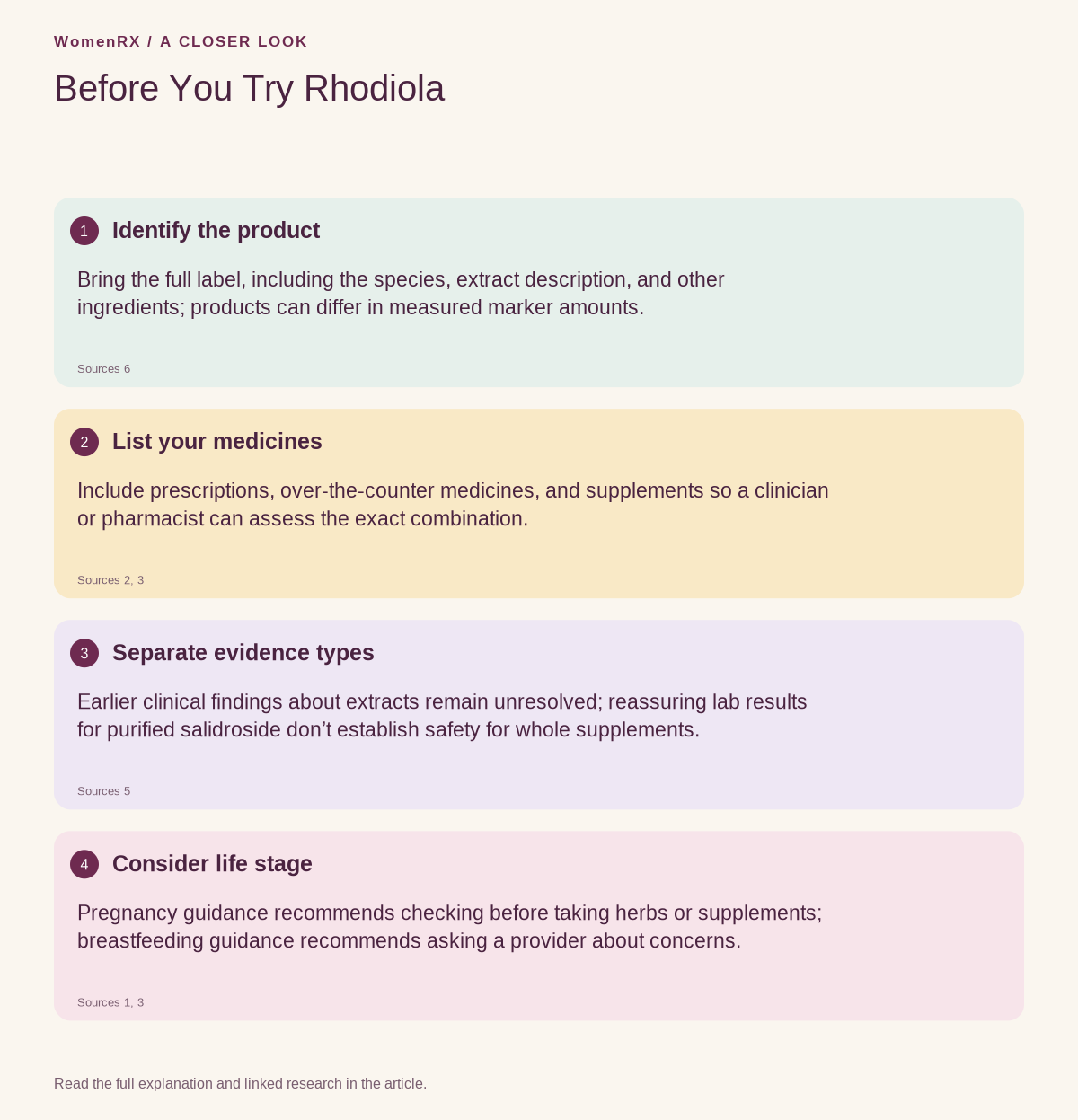
Before You Try Rhodiola
Identify the product: Bring the full label, including the species, extract description, and other ingredients; products can differ in measured marker amounts.6
List your medicines: Include prescriptions, over-the-counter medicines, and supplements so a clinician or pharmacist can assess the exact combination.23
Separate evidence types: Earlier clinical findings about extracts remain unresolved; reassuring lab results for purified salidroside don’t establish safety for whole supplements.5
Consider life stage: Pregnancy guidance recommends checking before taking herbs or supplements; breastfeeding guidance recommends asking a provider about concerns.13
Read the figure as text
Use these checks to make a product-and-medicine review specific, especially if you take medicine affecting mood or alertness or are pregnant or breastfeeding.- Identify the product: Bring the full label, including the species, extract description, and other ingredients; products can differ in measured marker amounts.6
- List your medicines: Include prescriptions, over-the-counter medicines, and supplements so a clinician or pharmacist can assess the exact combination.23
- Separate evidence types: Earlier clinical findings about extracts remain unresolved; reassuring lab results for purified salidroside don’t establish safety for whole supplements.5
- Consider life stage: Pregnancy guidance recommends checking before taking herbs or supplements; breastfeeding guidance recommends asking a provider about concerns.13
More questions, answered
Does rhodiola have a proven interaction with antidepressants or alertness medicines?
Earlier studies of rhodiola extracts have reported interaction findings, including in clinical research, but they don’t establish an interaction with a particular antidepressant or alertness medicine. Laboratory tests of purified salidroside don’t settle the question for whole extracts, either. Ask a clinician or pharmacist to review your exact product and medication list. 5
Should I stop a prescribed medicine if I’m considering rhodiola during pregnancy?
No. Don’t stop or start a medicine on your own. Pregnancy decisions should weigh the risks and benefits of treatment, including the risks of leaving a health condition untreated. Discuss rhodiola and your prescribed medicine with your clinician. 3
Sources you can check
- Breastfeeding | Benefits of Breastfeeding | MedlinePlusAccessed 2026-09-25Return to first citation
- Herbal Medicine: MedlinePlusAccessed 2026-09-25Return to first citation
- Pregnancy and Medicines | MedlinePlusAccessed 2026-09-25Return to first citation
- The effect of salidroside, an active component of Rhodiola rosea, on the metabolic activity of rat and human cytochromes P450 in preclinical studies.Klaskova E, Jurica J, Danek PJ, Mlcuchova N, Eyrilmez SM, Borilova Linhartova P, Bednar D, Kamaraj R, Daniel WA, Zendulka O. · Pharmacological reports : PR · 2026Return to first citation
- In Vitro Evaluation of the Potential for Drug Interactions by Salidroside.Kasprzyk PG, Tremaine L, Fahmi OA, Weng JK. · Nutrients · 2023Return to first citation
- The quality and safety of Rhodiola rosea supplements on the U.S. market: An analysis of biomarkers, heavy metals, and pesticide residues.Porwollik S, Jafari M. · PloS one · 2026Return to first citation