Resveratrol Safety: Interactions, Pregnancy, and Unknowns
Resveratrol may affect platelets and drug metabolism, while its clinical interaction risks remain uncertain.
If you take a blood thinner or another medicine that affects clotting, check with the prescriber or pharmacist before starting concentrated resveratrol. Human and ex vivo findings raise a possible platelet effect, but they don’t prove that a supplement will cause bleeding with your medicine. A pregnancy treatment trial doesn’t establish routine supplement safety, and general breastfeeding guidance doesn’t answer resveratrol-specific questions. 4 5 1
Resveratrol is sold as a concentrated supplement, but “natural” doesn’t tell you how it might affect your medicines or whether a particular product has been studied. The practical takeaway is to treat a resveratrol supplement as a medicine-related decision: check it against your full medication list, and don’t assume that a dose or formulation studied for one purpose is safe for another.
What interaction concerns are supported?
There’s a reason for caution with medicines that affect clotting, but it’s not the same as proof of a harmful interaction. A 2025 review describes antiplatelet effects in human and ex vivo studies, including reduced platelet activation and aggregation. It also says that reported bleeding events attributed to resveratrol are sparse and that clinical confirmation of interaction risks is limited. 4
The details matter. In that review, increased anticoagulant effects with warfarin were described in preclinical research, while clinical confirmation of a warfarin interaction is limited. The review also reports that high-dose resveratrol inhibited CYP3A4 in healthy volunteers and describes a possible interaction with direct oral anticoagulants through drug-metabolism pathways. It characterizes that concern as theoretical, with limited clinical confirmation. 4
So the useful question isn’t simply “Does resveratrol interact with blood thinners?” It’s whether your specific product could add risk to your specific medicines. If you take an anticoagulant, an antiplatelet medicine, or another drug your care team has told you affects bleeding, ask your prescriber or pharmacist to review the product before you start it. Include over-the-counter medicines and other supplements in that conversation. Don’t stop or change a prescribed medicine on your own.
Dose and formulation change what a study can tell you
A study of one resveratrol preparation doesn’t automatically answer questions about a different capsule, dose, or route. Human periodontal trials have tested varied approaches, including oral supplements, gels, sprays, and mouthwashes. Those studies were designed to assess periodontal outcomes, not to establish that every resveratrol product has the same safety profile. 3
For a shopper, that means a result from a mouthwash or a particular oral preparation shouldn’t be treated as a safety finding for a different capsule. A label’s ingredient list and amount can help a pharmacist identify what you’re considering, but neither a familiar ingredient name nor a particular product form proves it is safe with your medicines. 3 4
Pregnancy and breastfeeding call for separate caution
Pregnancy isn’t a setting where general supplement claims can be treated as reassurance. One systematic review of polyphenols in pregnancy included a 349-participant trial in women with preeclampsia comparing resveratrol alongside nifedipine with nifedipine alone. The review reported low-certainty findings about blood-pressure outcomes; that treatment study does not establish the safety of routine resveratrol supplements, other doses, or use at other stages of pregnancy. 5
If you’re pregnant, check before starting a resveratrol supplement. General pregnancy guidance advises reviewing medicines and supplements because some can harm a developing fetus, and warns against starting or stopping medicines without discussing the risks and benefits. 2
For breastfeeding, general guidance says some substances can pass through breast milk, but it does not address whether resveratrol does or what a concentrated supplement might mean for a nursing infant. Bring the exact product label to the clinician or pharmacist advising you about breastfeeding. 1
A useful product-and-medicine check
Before taking a concentrated product, have the bottle or a clear photo of its label ready. Ask the pharmacist or prescriber to check the resveratrol amount and form, the other ingredients, how you plan to take it, and your prescription and nonprescription medicines. If you’re pregnant or breastfeeding, say so; those situations change the question from “Has this ingredient been studied?” to “Does the research apply to me and this product?”
The evidence supports caution, not a blanket claim that resveratrol causes bleeding or that every product is unsafe. When the possible benefit is unclear and the interaction evidence is incomplete, reviewing the exact product before use is a more useful next step than relying on a broad safety claim. 4
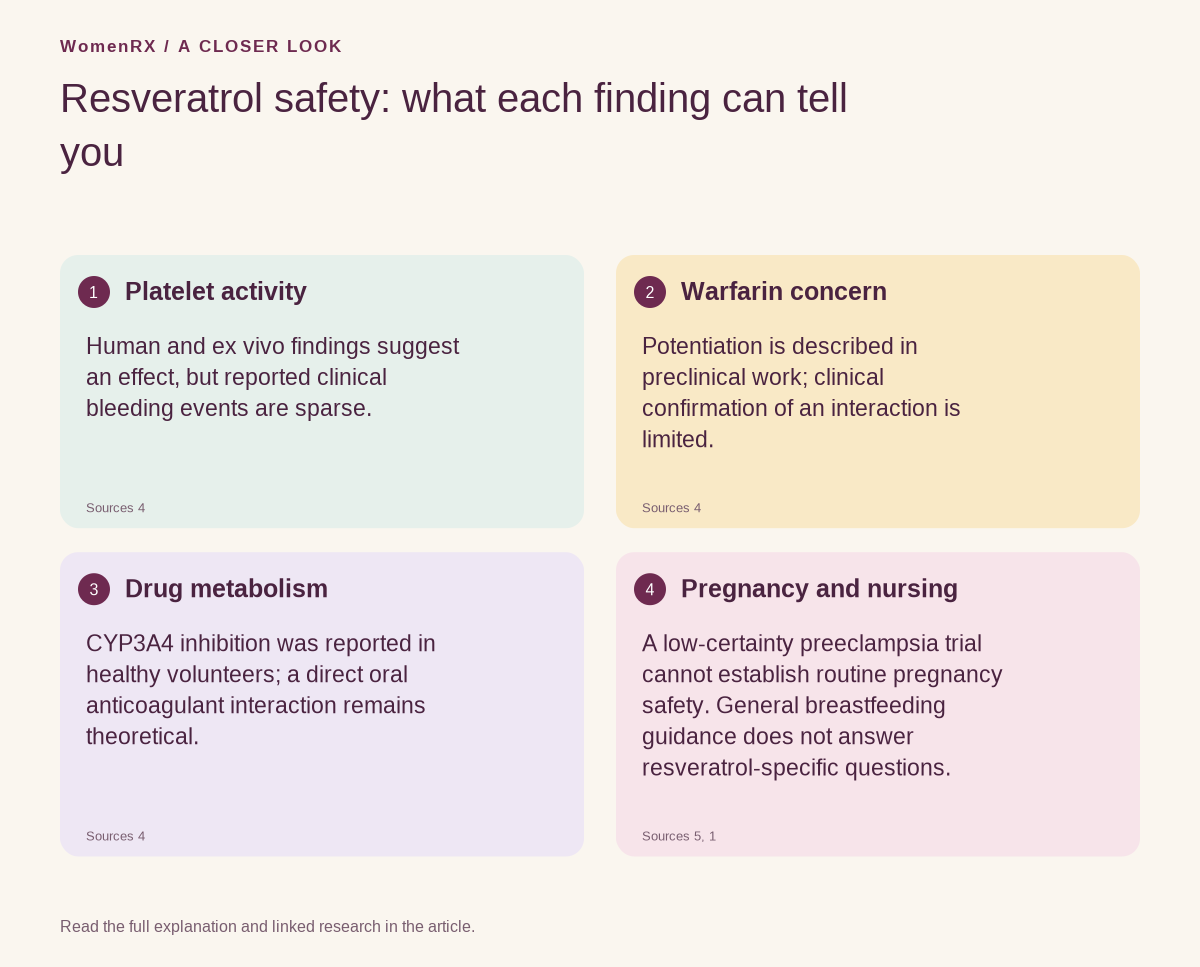
Resveratrol safety: what each finding can tell you
Platelet activity: Human and ex vivo findings suggest an effect, but reported clinical bleeding events are sparse.4
Warfarin concern: Potentiation is described in preclinical work; clinical confirmation of an interaction is limited.4
Drug metabolism: CYP3A4 inhibition was reported in healthy volunteers; a direct oral anticoagulant interaction remains theoretical.4
Pregnancy and nursing: A low-certainty preeclampsia trial cannot establish routine pregnancy safety. General breastfeeding guidance does not answer resveratrol-specific questions.51
Read the figure as text
These evidence categories help distinguish a plausible concern from a proven supplement interaction or a pregnancy safety conclusion.- Platelet activity: Human and ex vivo findings suggest an effect, but reported clinical bleeding events are sparse.4
- Warfarin concern: Potentiation is described in preclinical work; clinical confirmation of an interaction is limited.4
- Drug metabolism: CYP3A4 inhibition was reported in healthy volunteers; a direct oral anticoagulant interaction remains theoretical.4
- Pregnancy and nursing: A low-certainty preeclampsia trial cannot establish routine pregnancy safety. General breastfeeding guidance does not answer resveratrol-specific questions.51
More questions, answered
Does resveratrol definitely cause bleeding with blood thinners?
No. Human and ex vivo findings suggest effects on platelet activity, while the clinical review describes bleeding reports as sparse and clinical interaction confirmation as limited. The concern warrants an individualized medicine review, but it doesn’t prove that a specific combination will cause bleeding. 4
What does general breastfeeding guidance say about resveratrol?
It doesn’t say whether resveratrol passes into milk or affects a nursing infant. The guidance says some substances can pass through milk, but it cannot answer this resveratrol-specific question. Review the exact product with the person advising you about breastfeeding. 1
Sources you can check
- Breastfeeding | Benefits of Breastfeeding | MedlinePlusAccessed 2026-09-25Return to first citation
- Pregnancy and Medicines | MedlinePlusAccessed 2026-09-25Return to first citation
- Resveratrol as an Adjunct Therapy in Periodontal Disease: A Systematic Review and Meta-Analysis.Su SY, Tzeng IS, Huang TH, Fu E. · Nutrients · 2026Return to first citation
- Navigating the Effects of Anti-Atherosclerotic Supplements and Acknowledging Associated Bleeding Risks.Dobre MZ, Virgolici B, Doicin IC, Vîrgolici H, Stanescu-Spinu II. · International journal of molecular sciences · 2025Return to first citation
- Polyphenols for the Prevention or Management of Preeclampsia: A Systematic Review and Meta-Analysis.Nguyen PY, Sanderson B, Makama M, Mills K, Ammerdorffer A, Gülmezoglu AM, Vogel JP, McDougall ARA. · BJOG : an international journal of obstetrics and gynaecology · 2025Return to first citation