Progesterone Sleepiness: What to Check and When
Sleepiness can happen with oral micronized progesterone, but the exact product, timing, and other medicines help put it in context.
Yes. US prescribing information for oral micronized progesterone capsules warns that temporary drowsiness and dizziness can occur, directs bedtime dosing, and advises caution with driving or machinery. 1 Note when the sleepiness starts and how it affects you, check the exact formulation, and review other medicines. Don’t drive or operate machinery while you feel drowsy or dizzy.
Start with when it happens
If drowsiness repeatedly follows your dose of oral micronized progesterone, it may be a medication effect. The US prescribing information for Prometrium capsules warns that temporary drowsiness and dizziness can occur, directs bedtime dosing, and advises caution when driving or operating machinery. 1
As a practical check, jot down when you take the medicine, when sleepiness begins, how long it lasts, and whether you also feel dizzy. This isn’t a diagnostic test, but a pattern can make a conversation with your prescriber or pharmacist more useful. Follow the directions for your own prescription, and don’t stop or change it on your own.
Check the exact product and route
The bedtime direction and drowsiness warning cited above are for oral micronized progesterone capsules. 1 A separate trial studied an oral capsule that combined estradiol and progesterone in postmenopausal women with vasomotor symptoms. Sleep questionnaire scores improved compared with placebo, while sleepiness reported as a treatment-emergent adverse event ranged from 0.2% to 1.2% across the combination-treatment groups and was 0% with placebo. Those results describe that specific combination product and trial, not progesterone alone or every formulation. 3
A medicine can improve some sleep measures and still cause sleepiness for some people. These results also don’t mean that feeling drowsy after a dose is proof your sleep is improving. Don’t assume a warning for oral capsules tells you how often sleepiness occurs with a different product or route. If you’re unsure what you take, check the package or prescription label and ask a pharmacist to identify it.
Consider other contributors
Think about whether you feel sleepy mainly after a dose or feel drained throughout the day. Night waking or menopause-related symptoms may be part of the picture: the combination-product trial enrolled postmenopausal women with vasomotor symptoms and measured sleep outcomes, but it can’t determine the cause of fatigue for an individual. 3
Also review medicines that can cause drowsiness. For example, clonidine, which can be used for menopause-related hot flashes, is listed as a medicine that may cause drowsiness. 2 A pharmacist can review prescription and over-the-counter products with you. There is a specific interaction question for oral micronized progesterone: laboratory findings suggest ketoconazole and other CYP3A4 inhibitors could increase progesterone availability, but the product information says the clinical relevance is unknown. This is not proof that a particular combination will make you sleepy; ask a pharmacist or prescriber to check your exact medicines. 1
Keep alertness-sensitive tasks safe
While you feel drowsy or dizzy, don’t drive, operate machinery, or do another task where reduced alertness could put you or someone else at risk. The Prometrium label specifically advises caution with driving and machinery. 1 If the sleepiness is strong, keeps recurring, lasts into the day, or began after a medication change, contact your prescriber or pharmacist to review the product, timing, and other medicines. Ask before changing your dose schedule, since bedtime directions may be specific to the product you use. 1
A focused question to bring up is: “Could my exact progesterone product be contributing, and could another medicine or disrupted sleep be adding to it?”
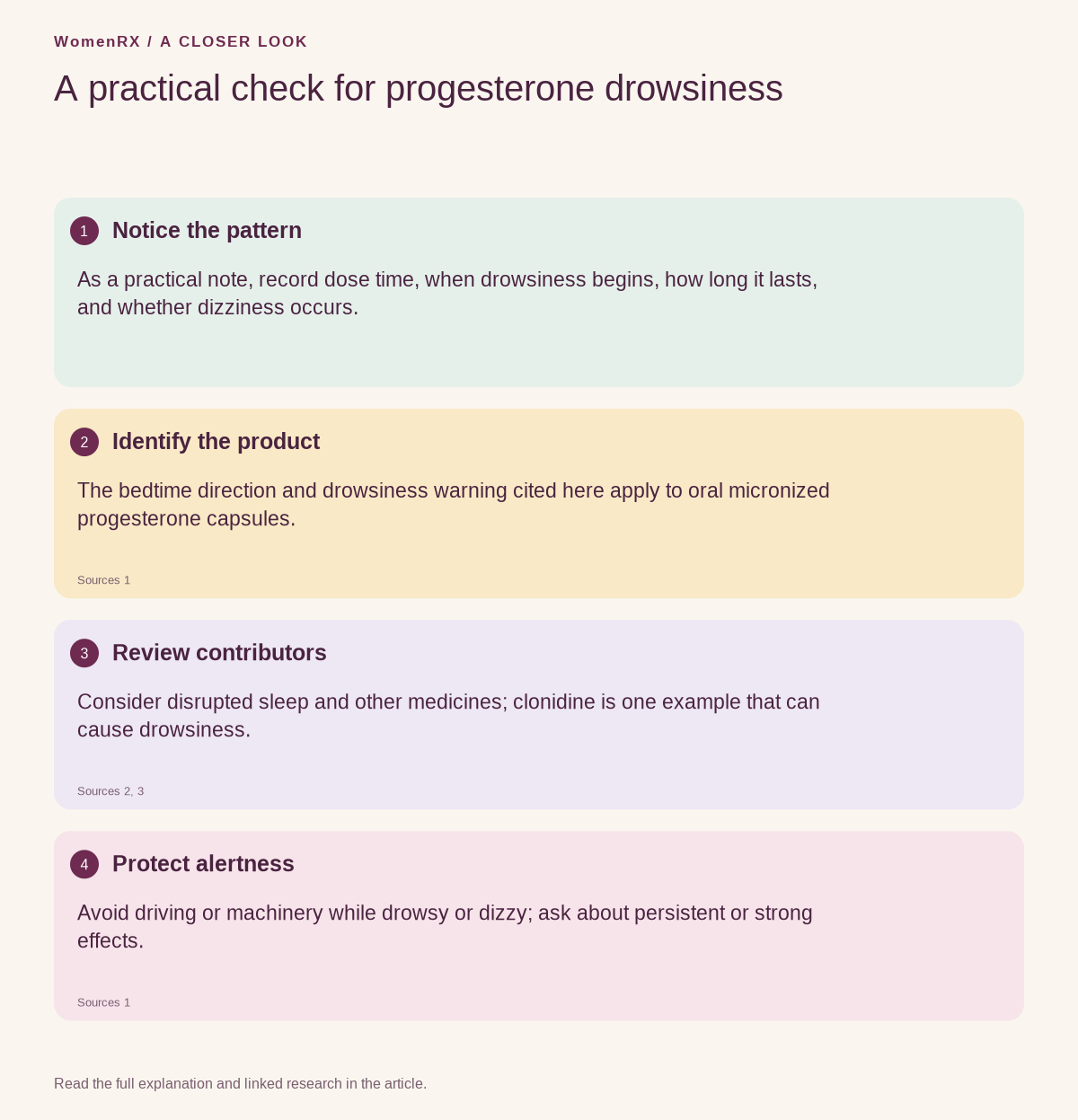
A practical check for progesterone drowsiness
Notice the pattern: As a practical note, record dose time, when drowsiness begins, how long it lasts, and whether dizziness occurs.
Identify the product: The bedtime direction and drowsiness warning cited here apply to oral micronized progesterone capsules.1
Review contributors: Consider disrupted sleep and other medicines; clonidine is one example that can cause drowsiness.23
Protect alertness: Avoid driving or machinery while drowsy or dizzy; ask about persistent or strong effects.1
Read the figure as text
Use the timing, exact product, and safety impact to decide what to review next.- Notice the pattern: As a practical note, record dose time, when drowsiness begins, how long it lasts, and whether dizziness occurs.
- Identify the product: The bedtime direction and drowsiness warning cited here apply to oral micronized progesterone capsules.1
- Review contributors: Consider disrupted sleep and other medicines; clonidine is one example that can cause drowsiness.23
- Protect alertness: Avoid driving or machinery while drowsy or dizzy; ask about persistent or strong effects.1
More questions, answered
Should I take progesterone at bedtime?
The US prescribing information for oral Prometrium capsules directs bedtime dosing. Follow the directions for your own product and check with your prescriber or pharmacist before changing the schedule. 1
Does feeling sleepy mean progesterone is improving my sleep?
No. A trial of an oral estradiol-progesterone combination found improved sleep questionnaire scores, but that doesn’t show that drowsiness after a dose is a sign of better sleep. 3
Sources you can check
- PROMETRIUM (PROGESTERONE) CAPSULE [ACERTIS PHARMACEUTICALS, LLC] | US prescribing information and patient instructionsAccessed 2026-09-25Return to first citation
- Other medicines for menopause symptoms - NHSAccessed 2026-09-25Return to first citation
- Improvement in sleep outcomes with a 17β-estradiol-progesterone oral capsule (TX-001HR) for postmenopausal women.Kagan R, Constantine G, Kaunitz AM, Bernick B, Mirkin S. · Menopause (New York, N.Y.) · 2018Return to first citation