Progesterone Cream: Check the Product Before Following Directions
The right directions depend on the exact cream you have, and a label alone can’t show whether it will do the job you need.
Check the original package and any pharmacy label for the product name, active ingredient, concentration, route, directions, and dispensing source. If you can’t tell whether it was prescribed, compounded, or sold over the counter, ask the pharmacy or seller named on the product. Don’t transfer directions between creams: absorption and evidence of benefit vary, and neither a label nor detected absorption proves a cream has a specific role in menopause hormone therapy. 4 5
Start with the container, not a search result
Find the original package, tube or jar, and any pharmacy label or paperwork that came with it. Write down the product name, active ingredient, concentration, route, directions, and the name of the pharmacy or seller. Keep the package, since directions or identifying details may be on a box or separate label rather than the container itself.
If the product source or type isn’t clear, contact the pharmacy or seller named on the package and ask directly: “Was this prescribed, compounded, or sold over the counter?” If there’s no identifiable pharmacy or seller, or the label is missing or unreadable, don’t try to identify the product by its appearance or by comparing it with a cream you’ve used before. Get the exact product identified before relying on its instructions.
A practical way to make the conversation specific is to have the product in front of you, or share clear images of all label panels. Ask the pharmacist or seller to confirm what the product is, how its directions apply to that exact formulation, and what to do if the label differs from instructions you were given elsewhere.
Directions belong to a particular formulation
“Progesterone cream” isn’t enough information to establish how a particular product is absorbed or what it can do. A review of transdermal progesterone describes complex pharmacokinetics and inconsistent data, which make findings difficult to interpret. 5
For example, one open study examined a specific progesterone cream used alongside transdermal estrogen. Progesterone levels rose, but remained low; the study authors said further research was needed to assess the combination’s effectiveness and safety. That result describes the product and study examined. It doesn’t tell you how another cream behaves or whether a product you have is appropriate for your plan. 4
So don’t borrow an application site, amount, or schedule from another brand, an online post, or an old container. Ask for directions that match the exact product in your hands. If the package and the instructions you remember don’t match, ask the dispensing pharmacist or prescriber to resolve the difference rather than guessing.
A use label is not proof of a benefit
Directions tell you how a product is presented for use; they don’t establish that it works for every menopause-related goal. In a randomized, placebo-controlled study of 223 healthy postmenopausal women with moderate to severe symptoms, the progesterone cream tested was no more effective than placebo for symptom relief over six months. The finding applies to that study and product, not automatically to every formulation. 3
Likewise, evidence that progesterone can be absorbed through skin doesn’t establish that a cream relieves symptoms or is suitable for a specific role in hormone therapy. The review describes clinical use of transdermal progesterone cream in postmenopausal therapy as unsubstantiated, while also noting the difficulty of interpreting its pharmacokinetics. 4 5
That distinction can help you ask a more useful question than “Does this contain progesterone?” Try: “What is this exact product intended to do, and what supports its use for that purpose?”
If you also use estrogen, clarify the plan
Your uterus status and the type and purpose of estrogen treatment matter when you review a menopause therapy plan. The North American Menopause Society says hormone-therapy risks vary with factors including whether a progestogen is used, and recommends individualizing treatment. 2 Estrace vaginal cream’s product labeling advises women with a uterus to discuss whether to add a progestin. That product-specific statement does not establish that a progesterone cream provides the same effect or protection. 1
If you have a uterus and use estrogen, ask the prescriber whether your particular estrogen plan calls for a progestogen and, if so, which product is meant to fill that role. Be especially clear about whether the cream you have is intended for symptom relief or is part of the estrogen plan. Don’t assume an over-the-counter or compounded cream is interchangeable with another prescribed product because both mention progesterone.
Questions that can help pin down the answer:
- What is the exact product, ingredient, concentration, and route?
- Is it prescribed, compounded, or sold over the counter?
- Which directions apply to this exact container?
- What is the cream intended to do in my treatment plan?
- If I use estrogen and have a uterus, is this the progestogen product intended for my plan?
- If the package and pharmacy instructions differ, who can confirm the correct directions?
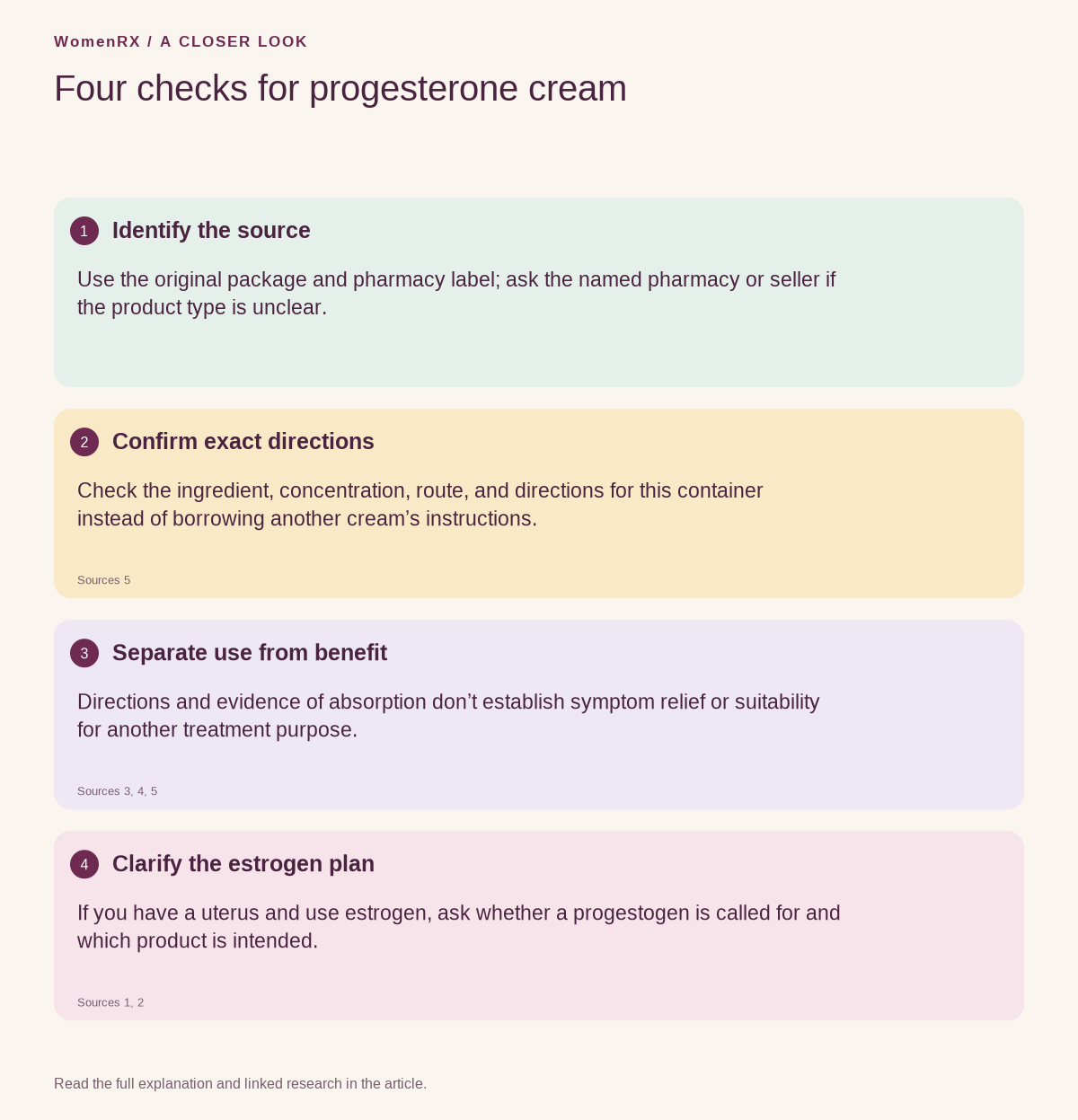
Four checks for progesterone cream
Identify the source: Use the original package and pharmacy label; ask the named pharmacy or seller if the product type is unclear.
Confirm exact directions: Check the ingredient, concentration, route, and directions for this container instead of borrowing another cream’s instructions.5
Separate use from benefit: Directions and evidence of absorption don’t establish symptom relief or suitability for another treatment purpose.345
Clarify the estrogen plan: If you have a uterus and use estrogen, ask whether a progestogen is called for and which product is intended.12
Read the figure as text
Use these checks to identify the exact product, follow product-specific directions, and clarify whether it has a role in an estrogen plan.- Identify the source: Use the original package and pharmacy label; ask the named pharmacy or seller if the product type is unclear.
- Confirm exact directions: Check the ingredient, concentration, route, and directions for this container instead of borrowing another cream’s instructions.5
- Separate use from benefit: Directions and evidence of absorption don’t establish symptom relief or suitability for another treatment purpose.345
- Clarify the estrogen plan: If you have a uterus and use estrogen, ask whether a progestogen is called for and which product is intended.12
More questions, answered
Does progesterone absorption prove a cream is suitable alongside estrogen?
No. One study found that progesterone levels rose during use of a particular cream alongside transdermal estrogen, but levels remained low and the authors called for more research on effectiveness and safety. That finding doesn’t establish that another cream is suitable for your plan. 4
Sources you can check
- ESTRACE (ESTRADIOL) CREAM [ALLERGAN, INC.] | US prescribing information and patient instructionsAccessed 2026-09-25Return to first citation
- The 2022 hormone therapy position statement of The North American Menopause Society.“The 2022 Hormone Therapy Position Statement of The North American Menopause Society” Advisory Panel. · Menopause (New York, N.Y.) · 2022Return to first citation
- A double-blind placebo-controlled study to evaluate the effect of progestelle progesterone cream on postmenopausal women.Benster B, Carey A, Wadsworth F, Vashisht A, Domoney C, Studd J. · Menopause international · 2009Return to first citation
- A study to look at hormonal absorption of progesterone cream used in conjunction with transdermal estrogen.Vashisht A, Wadsworth F, Carey A, Carey B, Studd J. · Gynecological endocrinology : the official journal of the International Society of Gynecological Endocrinology · 2005Return to first citation
- Transdermal natural progesterone cream for postmenopausal women: inconsistent data and complex pharmacokinetics.Elshafie MA, Ewies AA. · Journal of obstetrics and gynaecology : the journal of the Institute of Obstetrics and Gynaecology · 2007Return to first citation