Probiotics and Weight: A Strain-by-Strain Reality Check
Some trials report weight changes, but results belong to specific strains and short study periods, not to probiotics as a category.
Probiotics aren’t a proven, dependable way to lose weight. Overall findings are inconsistent, and a result with one strain can’t be assumed for another. One 12-week trial in overweight adults reported a notable weight difference with a specific strain, while a trial in women with PCOS found no significant weight difference between probiotic and placebo. Neither finding establishes a lasting effect or a benefit for women generally. 2 3 4
What a probiotic could change, and what that proves
Probiotics are live microorganisms. 1 Researchers have proposed that some may affect how gut microbes handle nutrients and energy. That is a possible pathway, not proof that taking a supplement causes weight loss. A proposed effect on the gut microbiome doesn’t automatically mean someone loses a meaningful amount of weight or keeps it off. 2
That distinction matters when a product’s marketing focuses on “gut balance,” appetite, or microbiome results. For weight management, the more useful questions are whether a specific product changed body weight or body fat compared with a placebo, in whom, and for how long.
The overall picture is inconsistent
The NIH Office of Dietary Supplements describes probiotic trial findings for body fat, waist and hip measurements, and body weight as inconsistent. That summary does not support treating “probiotics” as one weight-loss ingredient with a predictable effect. Products can contain different organisms and strains, and many commercial products have not been examined in research studies. 1 2
A label that says Lactobacillus or Bifidobacterium doesn’t, by itself, show that the product matches one studied for weight. The specific strain matters, as does the finished product. A higher CFU count isn’t evidence of greater effectiveness, either. 1
A positive trial is a signal, not a general promise
One recent randomized, double-blind, placebo-controlled trial tested Weissella confusa WIKIM51 in overweight adults aged 19 to 64. At 12 weeks, the probiotic group’s body weight had fallen by an average of 3.38 kg while the placebo group’s had risen by 1.14 kg. The reported adjusted difference between groups was 4.40 kg. The study also reported changes in body-fat and abdominal-fat measures. 3
That is a measurable result for that strain and trial. It doesn’t show that other probiotic strains work the same way, or that the difference lasts after supplementation ends. The report doesn’t establish whether the effect differs for women. Statistical significance also doesn’t settle whether the change is meaningful for a particular person’s health goals.
A women-specific result points to the same caution
In a randomized, double-blind trial of 84 women aged 18 to 45 with polycystic ovary syndrome (PCOS), participants took Saccharomyces boulardii or a placebo for 12 weeks. BMI decreased from baseline in the probiotic group, but the difference between the probiotic and placebo groups was not statistically significant. In other words, the within-group change did not demonstrate that the probiotic caused more weight change than the placebo. 4
This study concerns women with PCOS, not women generally. It also doesn’t answer whether effects differ across cycling years, perimenopause, or postmenopause. Its weight finding is a reason to be careful about broad claims, not a reason to expect a weight effect in other groups.
How to judge a product’s weight claim
Before spending money, look for a trial that matches the product’s exact strain, not just a familiar genus name or a blend. Check whether the study compared the product with placebo and reported weight or body-fat outcomes, rather than only appetite, hormone, or microbiome changes. Then check the duration: a result measured during a short trial doesn’t show that weight changes persist afterward.
Probiotic supplements vary widely, and the effects of many commercial products haven’t been studied. Labels may list CFUs, but that number alone doesn’t establish a weight benefit. If you choose to use a probiotic for another reason, gas and other gastrointestinal symptoms are possible; that doesn’t make it a weight-management treatment. 1 2
The practical takeaway is simple: don’t treat a probiotic’s general “microbiome” claim as evidence it will change your weight. Consider a weight result credible only as evidence about the particular strain, population, and study period that produced it. These studies offer a specific short-term signal, but not a dependable or established long-term approach.
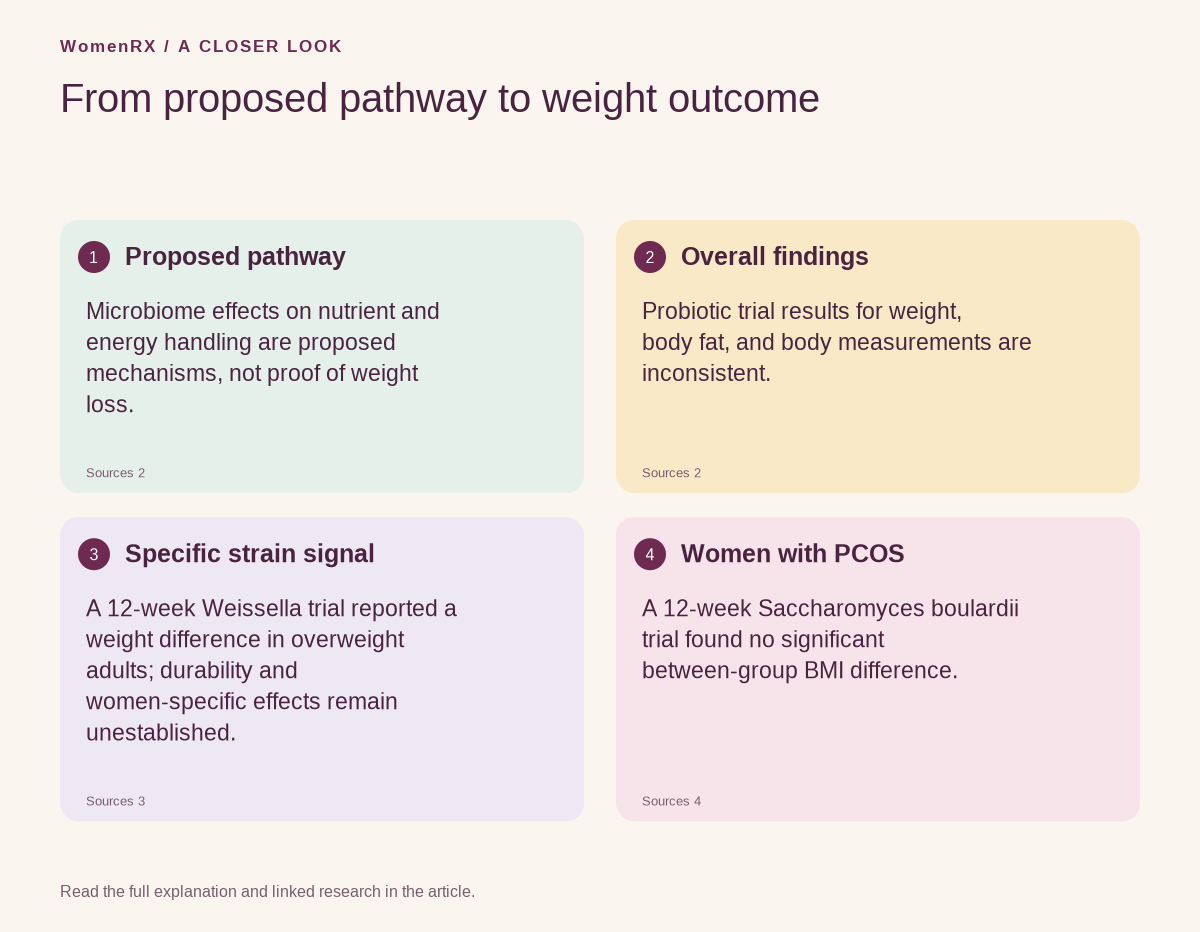
From proposed pathway to weight outcome
Proposed pathway: Microbiome effects on nutrient and energy handling are proposed mechanisms, not proof of weight loss.2
Overall findings: Probiotic trial results for weight, body fat, and body measurements are inconsistent.2
Specific strain signal: A 12-week Weissella trial reported a weight difference in overweight adults; durability and women-specific effects remain unestablished.3
Women with PCOS: A 12-week Saccharomyces boulardii trial found no significant between-group BMI difference.4
Read the figure as text
These distinctions separate a biological explanation from evidence that a particular product changed weight in a particular group.- Proposed pathway: Microbiome effects on nutrient and energy handling are proposed mechanisms, not proof of weight loss.2
- Overall findings: Probiotic trial results for weight, body fat, and body measurements are inconsistent.2
- Specific strain signal: A 12-week Weissella trial reported a weight difference in overweight adults; durability and women-specific effects remain unestablished.3
- Women with PCOS: A 12-week Saccharomyces boulardii trial found no significant between-group BMI difference.4
More questions, answered
Does a proposed microbiome effect mean a probiotic will help with weight loss?
No. A proposed mechanism is not the same as a demonstrated difference in body weight compared with placebo. For a weight claim, look for a trial that measured weight or body fat directly. 2
Can I assume a product will work if it contains the same probiotic species?
No. Probiotic effects can depend on the specific strain, and products with the same broad species name aren’t automatically equivalent. Many commercial probiotic products haven’t been tested for weight outcomes. 1
Sources you can check
- Probiotics - Health Professional Fact SheetAccessed 2026-09-25Return to first citation
- Dietary Supplements for Weight Loss - Health Professional Fact SheetAccessed 2026-09-25Return to first citation
- Effects of Wilac D001 (Weissella confusa WIKIM51) Supplementation on Metabolic Parameters and Central Adiposity in Overweight Adults: A 12-Week Randomized, Double-Blind, Placebo-Controlled Trial.Park S, Lee B, Sun H, Shin W, Mok JY, Seo J, Choi HJ, Choi GH, Son JY, Yoo B. · Journal of microbiology and biotechnology · 2026Return to first citation
- The Effect of Supplementation with Saccharomyces boulardii in Women with Polycystic Ovary Syndrome: A Double-blind, Randomized Controlled Trial.Pourkarim F, Khani E, Hamdi K, Soroush-Oskoui N, Sarbakhsh P, Mastaneh H, Shaseb E. · Journal of research in pharmacy practice · 2026Return to first citation