PCOS Supplements: What the Evidence Means for Your Goal
A promising change in a lab result doesn’t necessarily mean a supplement will help with the PCOS outcome you care about.
Start with your goal, whether that’s improving a metabolic measure, managing symptoms, or getting pregnant. Then check whether studies measured that outcome in women with PCOS, using the same ingredient or formulation you’re considering. Inositol, vitamin D, and chromium have different evidence gaps; none is a proven all-purpose PCOS treatment. Check medication interactions and the full ingredient list before buying. 246
Match the claim to the outcome you want
“Helps PCOS” is too broad to be useful. PCOS can involve irregular ovulation, androgen-related symptoms, and metabolic concerns, but a supplement that changes an insulin-resistance measure hasn’t necessarily been shown to improve periods, pregnancy rates, or how you feel. Treatments also differ depending on whether you’re trying to conceive. 12
For example, if a product promises fertility benefits, look for pregnancy or live-birth results in women with PCOS. A study of fasting insulin answers a different question. If your concern is a nutrient deficiency, ask whether the product addresses that deficiency rather than assuming it treats PCOS itself.
What studies have actually measured
| Supplement | Studied PCOS outcomes | What you can reasonably conclude | What to check on a product |
|---|---|---|---|
| Inositol | Metabolic measures, ovulation, weight, and fertility outcomes have been studied, but trials vary and many are small. A review of trials in Indian women found limited evidence for improvements in hirsutism, ovulation, and weight. A review of PCOS infertility care found no good-quality evidence that myo-inositol improves live birth or clinical pregnancy in the fertility-treatment studies it discussed. 56 | Don’t read a metabolic finding as proof of a fertility benefit. A 2026 commentary concluded that evidence for myo-inositol in PCOS-related infertility remains inconclusive, particularly alongside current fertility protocols. 4 | Look for the specific form, such as myo-inositol or D-chiro-inositol, and any other active ingredients. Evidence about one form or combination doesn’t automatically apply to another. 5 |
| Vitamin D | Vitamin D status has been studied in relation to PCOS-related fertility, but a review concluded that controlled prospective trials were needed to establish whether supplementation improves reproductive outcomes. 6 | Meeting a vitamin D need is a different goal from treating ovulation problems. Don’t take a rise in blood vitamin D as proof of a PCOS fertility benefit. Both D2 and D3 raise vitamin D levels, though D3 generally raises them more and maintains them longer. 36 | Check whether another supplement you use also contains vitamin D. Excessive supplemental intake can cause high calcium levels and other harms. 3 |
| Chromium | Reviews of randomized PCOS trials have found mixed results. One analysis found an improvement in an insulin-resistance measure but no significant difference in fasting insulin or another insulin-sensitivity measure; the clinical relevance was uncertain. 27 | A change in a calculated metabolic measure isn’t proof that chromium improves symptoms or fertility. 27 | Check the named chromium form and the amount of elemental chromium on the Supplement Facts label. Chromium may add to the glucose-lowering effects of insulin or diabetes medicines, and chromium picolinate taken at the same time as levothyroxine reduced that medicine’s absorption in a small study. 2 |
You may also see N-acetylcysteine (NAC) in PCOS products. Before accepting a benefit claim, ask which outcome was measured in a controlled study of women with PCOS and whether the product matches what was studied. Don’t borrow evidence from a different ingredient or from research in people without PCOS.
Use the label to test the claim
A product name isn’t enough to identify what you’re buying. Compare the Supplement Facts panel with the research claim: the ingredient’s form, the amount per serving, and everything else in the blend. A study of chromium picolinate, for example, doesn’t establish that a multi-ingredient “hormone balance” blend works. Nor does a study of myo-inositol establish the effect of every inositol combination. 25
This check matters for safety as well as evidence. Vitamin D can appear in more than one product, and excessive amounts have caused toxicity, including cases involving manufacturing errors. A label tells you what a product declares; it doesn’t demonstrate that the finished product produces the outcome in a clinical trial. 3
When your circumstances change the decision
If you take metformin, insulin, another diabetes medicine, or levothyroxine, check the exact ingredients before adding chromium. The potential concerns are different: added glucose-lowering effects with diabetes medicines, versus reduced levothyroxine absorption when chromium picolinate was taken at the same time in a small study. Don’t change a prescription schedule based on a supplement label. 2
If you’re planning pregnancy, receiving fertility treatment, or pregnant, bring the full product label to the clinician overseeing that care. This is a cautious way to review an individual product, not a claim that these supplements have all been shown to cause pregnancy harm. Fertility-treatment evidence for inositol remains inconclusive, and evidence about an outcome before conception doesn’t establish safety or benefit during pregnancy. 45 Vitamin D needs also apply during pregnancy, but a product marketed for PCOS should not be assumed to be a better choice than one selected for a specific nutritional need. 3
A useful buying question is: What result am I paying for, and did a study in women with PCOS actually measure it? If the best answer is a lab marker, weigh that limited finding against the product’s ingredients and your medications rather than treating the front-label promise as the result.
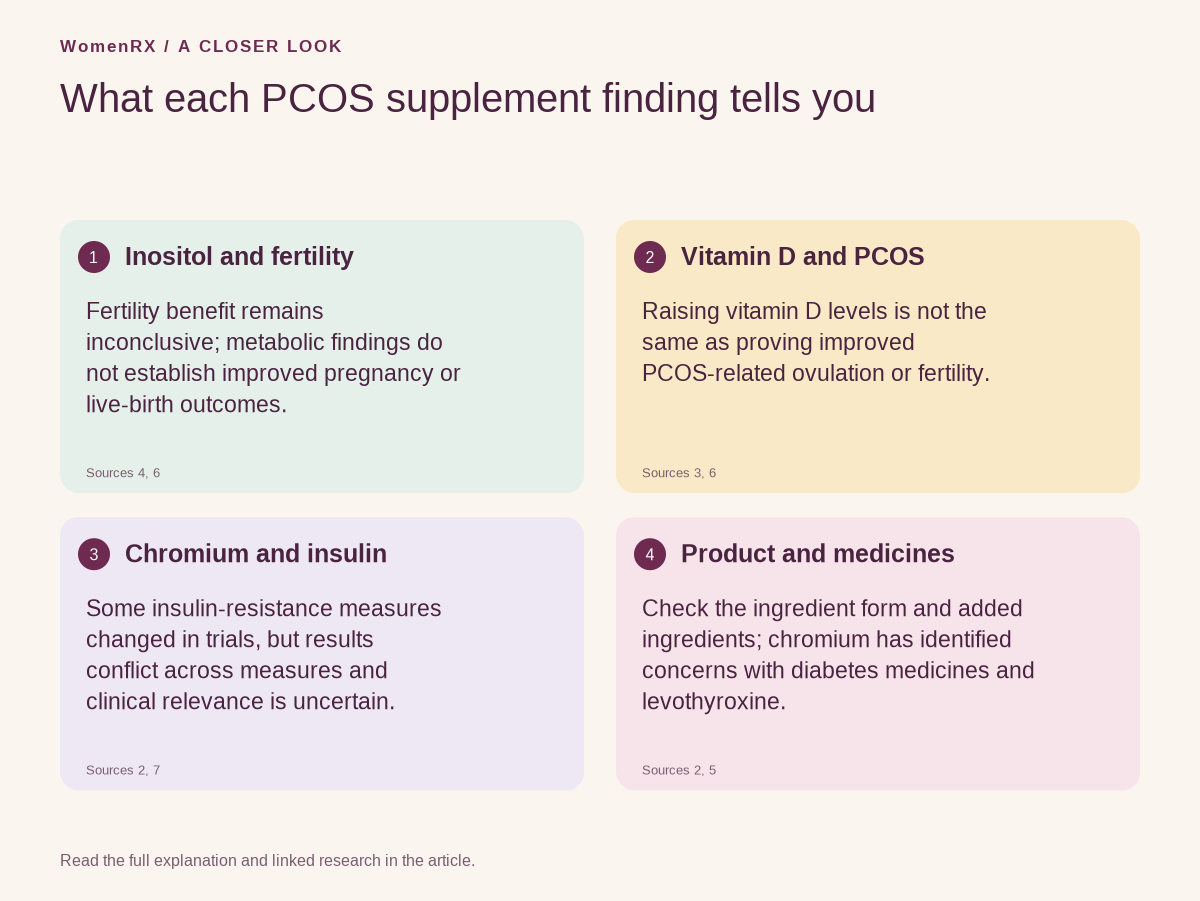
What each PCOS supplement finding tells you
Inositol and fertility: Fertility benefit remains inconclusive; metabolic findings do not establish improved pregnancy or live-birth outcomes.46
Vitamin D and PCOS: Raising vitamin D levels is not the same as proving improved PCOS-related ovulation or fertility.36
Chromium and insulin: Some insulin-resistance measures changed in trials, but results conflict across measures and clinical relevance is uncertain.27
Product and medicines: Check the ingredient form and added ingredients; chromium has identified concerns with diabetes medicines and levothyroxine.25
Read the figure as text
Read the studied outcome before deciding what a product claim means.- Inositol and fertility: Fertility benefit remains inconclusive; metabolic findings do not establish improved pregnancy or live-birth outcomes.46
- Vitamin D and PCOS: Raising vitamin D levels is not the same as proving improved PCOS-related ovulation or fertility.36
- Chromium and insulin: Some insulin-resistance measures changed in trials, but results conflict across measures and clinical relevance is uncertain.27
- Product and medicines: Check the ingredient form and added ingredients; chromium has identified concerns with diabetes medicines and levothyroxine.25
More questions, answered
Can I use inositol instead of fertility treatment for PCOS?
Inositol hasn’t been established as a replacement. Evidence that myo-inositol improves fertility outcomes is inconclusive, and a review of PCOS infertility management describes established ovulation-induction options separately from supplements that still need further research. 46
Does a better insulin-resistance score mean a supplement is working?
It means that particular measure changed in the people studied. Chromium reviews illustrate the gap: results differ across metabolic measures, and researchers have questioned whether the observed changes matter clinically. A score alone doesn’t establish better symptoms or fertility outcomes. 27
Sources you can check
- PCOS | Polycystic Ovary Syndrome | MedlinePlusAccessed 2026-09-25Return to first citation
- Chromium - Health Professional Fact SheetAccessed 2026-09-25Return to first citation
- Vitamin D - Health Professional Fact SheetAccessed 2026-09-25Return to first citation
- Myo-inositol in reproductive management of women with PCOS: holy grail for medical practice or demon for scientific evidence?Palomba S, Seminara G, Aversa A. · Reproductive biomedicine online · 2026Return to first citation
- Pharmacological and Non-Pharmacological Interventions for Polycystic Ovary Syndrome (PCOS) in Indian Women: A Systematic Review and Meta-Analysis.Maan P, Gautam R, Vasudevan S, Menon GR, Arora A, Nair A, Jabbar PK, Arora T. · Pharmaceuticals (Basel, Switzerland) · 2025Return to first citation
- Infertility management in women with polycystic ovary syndrome: a review.Cunha A, Póvoa AM. · Porto biomedical journal · 2021Return to first citation
- The Effects of Supplementation with Chromium on Insulin Resistance Indices in Women with Polycystic Ovarian Syndrome: A Systematic Review and Meta-Analysis of Randomized Clinical Trials.Heshmati J, Omani-Samani R, Vesali S, Maroufizadeh S, Rezaeinejad M, Razavi M, Sepidarkish M. · Hormone and metabolic research = Hormon- und Stoffwechselforschung = Hormones et metabolisme · 2018Return to first citation