Nipple Discharge: Which Features Need Medical Assessment?
Nipple discharge is worth getting checked; how it happens and what comes with it help guide the assessment.
Make an appointment to have nipple discharge assessed, whether it comes from one breast or both. Note whether it appeared on its own or only after pressure, its color, and any breast lump. Pregnancy and breastfeeding can explain leakage, while discharge outside those contexts may have other causes. Mention any bloody discharge or breast lump when arranging assessment; neither diagnoses cancer. 1 5 6
Start with how it happens
Nipple discharge is fluid that comes from the nipple, either on its own or after the nipple is squeezed. It can be clear, white, yellow, green, or bloody. Color is one detail to report, not a diagnosis: several colors can occur, and the pattern and context matter too. 1
A useful distinction is whether the fluid appears spontaneously or only when the nipple is pressed. Spontaneous discharge unrelated to pregnancy or breastfeeding is a pattern clinicians assess. Discharge that occurs only when expressed may have a different explanation, but it should still be assessed. These patterns guide evaluation; they don’t prove what is causing the discharge. 1 5
What one breast or both can suggest
Discharge from both breasts can occur with lactation or with galactorrhea, which may be linked to elevated prolactin. Medicines and other health conditions can contribute to elevated prolactin, so a clinician may consider those possibilities when galactorrhea is suspected. 2 5
Note whether the discharge came from one breast or both, but don’t use that detail alone to decide whether to seek care: discharge from either nipple should be checked. In a retrospective study of women evaluated for breast complaints, spontaneous discharge and discharge that occurred only when provoked were examined as separate groups. Because this was a selected clinical population, its results shouldn’t be used to estimate an individual reader’s risk. The useful takeaway is that clinicians consider the pattern along with examination and other findings, rather than judging by color alone. 1 3
Pregnancy, breastfeeding, and after menopause
Leaking can happen during pregnancy and breastfeeding. If you’re pregnant or breastfeeding, mention that context and whether the fluid is from one or both breasts, appears on its own, or has changed. 1
If you notice new discharge after menopause, arrange an assessment rather than assuming it’s simply part of aging. Age-related, noncancerous changes in the breast ducts are one possible cause, but discharge can also have other causes. 1
When to arrange an assessment
Contact a healthcare provider about nipple discharge from either breast. Be sure to mention if it appears spontaneously, is bloody, or occurs with a breast lump. Bloody discharge and a breast lump were associated with malignancy in a small, selected cross-sectional study of 100 patients in Bangladesh; that finding does not mean either feature confirms cancer, and it cannot establish an individual’s risk. 1 5 6
A clinician may ask about the discharge and examine your breasts. Depending on the findings, evaluation may include imaging such as mammography or ultrasound, and sometimes a needle sample. Which tests are appropriate depends on your situation and examination. 1 4
Make the pattern easier to describe
Write down what you’ve already noticed: which breast, whether the fluid appeared on its own or only after pressure, its color, when you first noticed it, and whether there’s a lump or another breast change. Include whether you’re pregnant or breastfeeding, and mention relevant medicines. You don’t need to produce discharge to complete these notes; simply record what has happened. Medication can be one contributor to galactorrhea, so a medication review may be relevant. 1 2
These details help explain why a clinician asks about pattern and context. They can guide the next steps, but they can’t replace an examination or determine the cause on their own.
What to do about nipple discharge
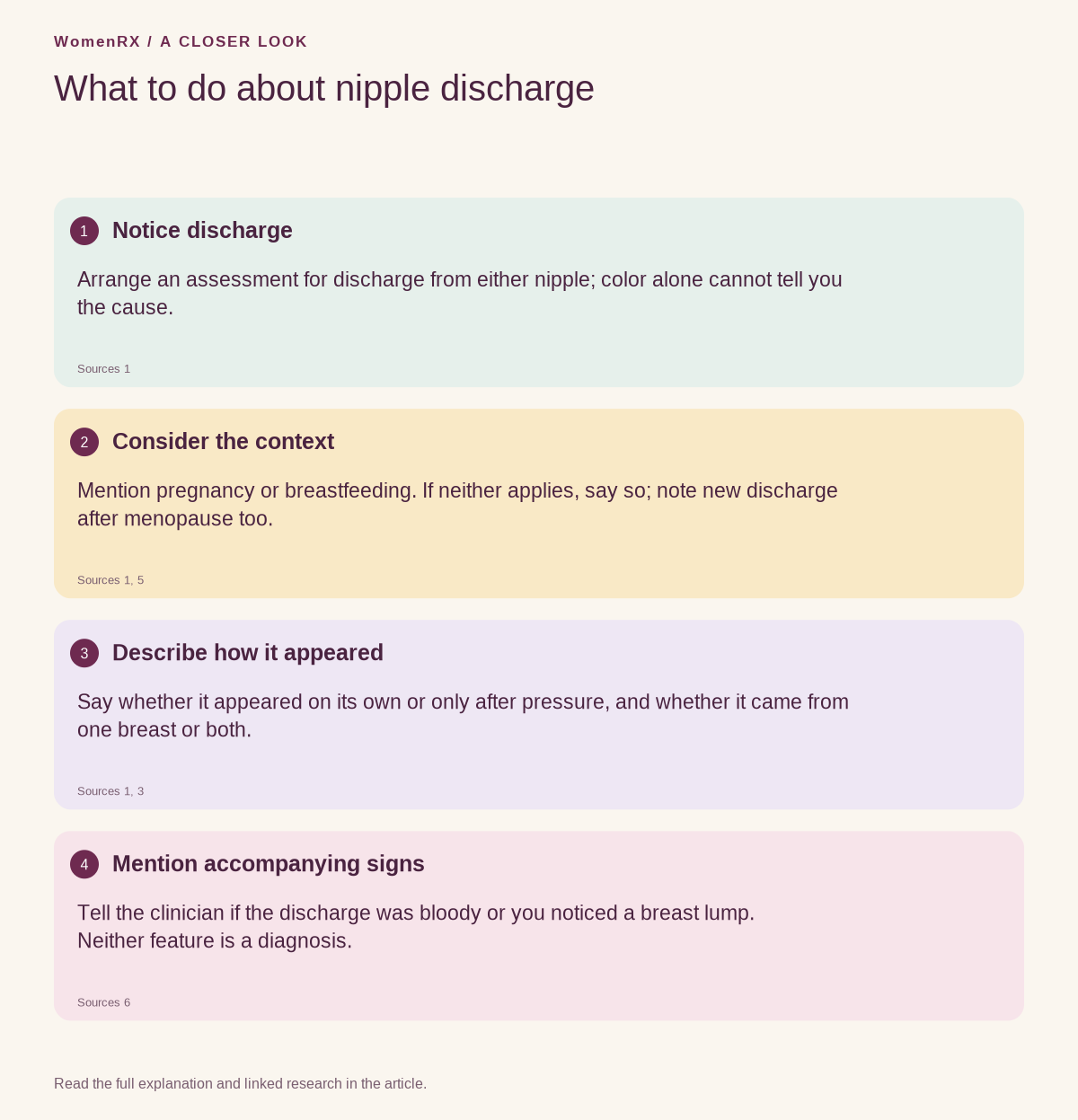
Notice discharge: Arrange an assessment for discharge from either nipple; color alone cannot tell you the cause.1
Consider the context: Mention pregnancy or breastfeeding. If neither applies, say so; note new discharge after menopause too.15
Describe how it appeared: Say whether it appeared on its own or only after pressure, and whether it came from one breast or both.13
Mention accompanying signs: Tell the clinician if the discharge was bloody or you noticed a breast lump. Neither feature is a diagnosis.6
Read the figure as text
Start with the same next step regardless of color or which breast is affected. Then note the details that can guide the assessment.- Notice discharge: Arrange an assessment for discharge from either nipple; color alone cannot tell you the cause.1
- Consider the context: Mention pregnancy or breastfeeding. If neither applies, say so; note new discharge after menopause too.15
- Describe how it appeared: Say whether it appeared on its own or only after pressure, and whether it came from one breast or both.13
- Mention accompanying signs: Tell the clinician if the discharge was bloody or you noticed a breast lump. Neither feature is a diagnosis.6
More questions, answered
Does bloody discharge always mean cancer?
No. Arrange an assessment for nipple discharge and mention if it is bloody; blood alone is not a diagnosis. A study of a selected group of patients found an association between bloody discharge and malignancy, but the finding cannot tell an individual what is causing their discharge. 6
Can a medicine contribute to galactorrhea?
Some medicines can contribute to elevated prolactin, which is one possible cause of galactorrhea. Mention your medicines during an assessment so you can discuss whether any might be relevant. 2
Sources you can check
- Nipple discharge - NHSAccessed 2026-09-25Return to first citation
- Evaluation and management of galactorrhea.Huang W, Molitch ME. · American family physician · 2012Return to first citation
- Management strategies for patients with nipple discharge.Goksel HA, Yagmurdur MC, Demirhan B, Isiklar I, Karakayali H, Bilgin N, Haberal M. · Langenbeck's archives of surgery · 2005Return to first citation
- Imaging evaluation of nipple discharge: Review of literature and management considerations.Woodard S, Ahuja K, Allen E. · Breast disease · 2025Return to first citation
- New method for cytological evaluation using direct nipple discharge without aspiration.Zhu J, Cong H, Zhang X, Dong X, Zhao S, Hu C, Maimo JR, Wang Y, Zhang K, Wang J, Li P, Ma R. · Scientific reports · 2025Return to first citation
- Triple Assessment in the Clinical Evaluation of Ductal Breast Disease.Sultana F, Aziz SR, Ara I, Farruk MM, Nusrat F. · Mymensingh medical journal : MMJ · 2026Return to first citation