Nausea on Mounjaro: What to Do Next
Nausea is a known Mounjaro side effect, especially during dose increases, but how long it lasts and whether you can keep fluids down help shape your next step.
Mounjaro-related nausea often shows up during dose increases, and trial reports of nausea, vomiting, or diarrhea generally declined over time, though that isn’t a promise about your symptoms. Track when nausea starts, how it relates to your dose, whether you vomit, and whether you can drink. If symptoms are persistent or worsening, or you can’t keep fluids down, contact your prescriber before the next dose or increase. 12
Why nausea can happen
Tirzepatide affects signals involved in appetite and digestion, and it can slow stomach emptying. Nausea, vomiting, diarrhea, and other stomach symptoms are recognized side effects. In Mounjaro’s adult placebo-controlled trials, gastrointestinal side effects were more common with the medicine than with placebo. 13
Symptoms often occur during dose escalation. The prescribing information says most reports of nausea, vomiting, and diarrhea occurred while doses were being increased and decreased over time. That’s a pattern across trial participants, not a guarantee that your nausea will pass on a particular schedule. 1
Dose escalation matters because the body may tolerate nausea and vomiting differently with more gradual increases. A meta-analysis comparing trial phases found greater modeled tolerance to these symptoms in Phase 3 than Phase 1 trials of tirzepatide; its authors also found an association between greater tolerance and longer escalation periods or more dose steps across the medicines studied. This supports discussing tolerability with your prescriber, not changing your dose on your own. 4
Make a short, useful symptom log
For a few days, note:
- When nausea begins and how long it lasts.
- When your last injection was, and whether the dose was recently started or increased.
- Whether you vomit, and how often.
- Whether you can drink and keep fluids down.
- Any other new symptoms, and whether nausea is getting better, staying the same, or worsening.
This is not a diagnostic test. It gives your prescriber concrete details to weigh when deciding whether your current dose and escalation plan are tolerable. If nausea began after an increase, say so directly. Don’t take an extra dose, skip one, or change the schedule without instructions; the medication guide says to use Mounjaro as your healthcare provider tells you to. 1
Match your next step to what’s happening
If nausea is mild, you can drink, and it is improving, keep the log and raise it with your prescriber before a planned increase if you’re still concerned. If it is persistent, getting worse, or interfering with drinking or eating, contact the prescriber to discuss the symptoms and the next dose. Ask whether the planned increase should wait and what to do about your next injection. 12
Repeated vomiting or being unable to keep fluids down deserves prompt attention. Nausea, vomiting, and diarrhea can lead to dehydration; the prescribing information notes reports of acute kidney injury in people whose gastrointestinal symptoms caused volume depletion. 2
If pregnancy is possible
Mention that possibility when discussing nausea and treatment. The Mounjaro medication guide says it is not known whether the medicine will harm an unborn baby and advises telling your provider if you become pregnant. It also says oral birth-control pills may work less well after starting Mounjaro and for four weeks after each dose increase; ask your prescriber whether another method is appropriate for you. 1
What the evidence says about women
A subgroup analysis of a randomized trial in adults with type 2 diabetes included women and men. Nausea and diarrhea were among the most frequently reported side effects in each subgroup, and the authors described the safety profile as similar across the subgroups they assessed. The report does not establish that women are more likely than men to experience nausea, or provide detailed sex-specific nausea rates. 5
So your own timing and symptom severity are more useful for deciding what to discuss than assuming nausea is worse because you’re a woman. If pregnancy is possible, that is a separate, relevant part of the conversation.
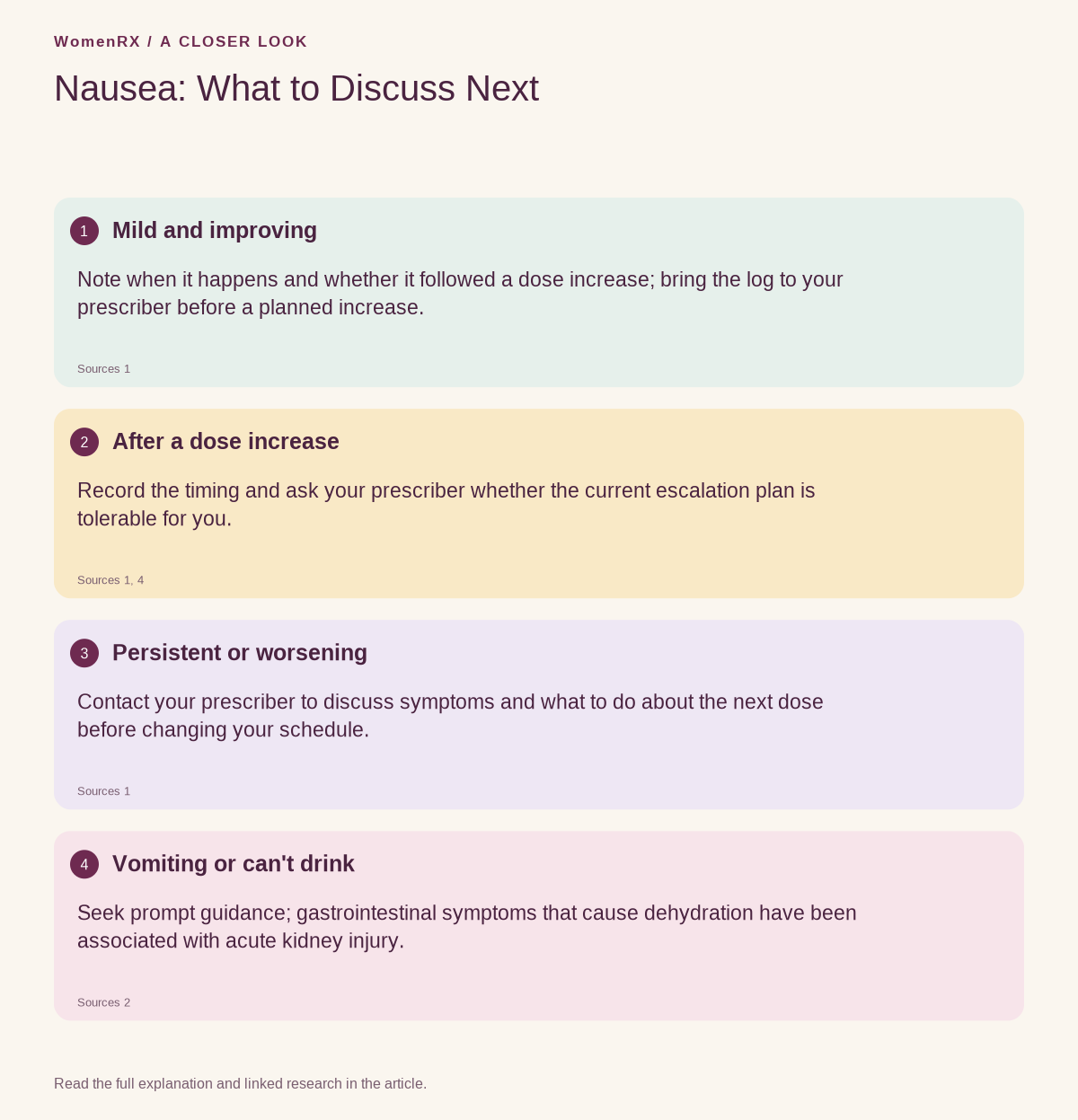
Nausea: What to Discuss Next
Mild and improving: Note when it happens and whether it followed a dose increase; bring the log to your prescriber before a planned increase.1
After a dose increase: Record the timing and ask your prescriber whether the current escalation plan is tolerable for you.14
Persistent or worsening: Contact your prescriber to discuss symptoms and what to do about the next dose before changing your schedule.1
Vomiting or can't drink: Seek prompt guidance; gastrointestinal symptoms that cause dehydration have been associated with acute kidney injury.2
Read the figure as text
Use symptom trend, vomiting, fluid intake, and dose timing to organize a conversation with your prescriber. This is a guide to discussion, not a diagnostic tool.- Mild and improving: Note when it happens and whether it followed a dose increase; bring the log to your prescriber before a planned increase.1
- After a dose increase: Record the timing and ask your prescriber whether the current escalation plan is tolerable for you.14
- Persistent or worsening: Contact your prescriber to discuss symptoms and what to do about the next dose before changing your schedule.1
- Vomiting or can't drink: Seek prompt guidance; gastrointestinal symptoms that cause dehydration have been associated with acute kidney injury.2
More questions, answered
Should I increase my dose if I still feel nauseated?
Don’t decide on your own. Tell your prescriber how long the nausea has lasted, whether it followed a dose increase, and whether you can keep fluids down. Ask whether to proceed with the planned increase or what to do about the next dose. Nausea and related symptoms commonly occur during escalation, but individual tolerability varies. 14
Can Mounjaro affect birth-control pills?
The medication guide says oral birth-control pills may work less well while using Mounjaro. It says your provider may recommend another type of birth control for four weeks after starting the medicine and for four weeks after each dose increase. Ask what applies to you. 1
Sources you can check
- MOUNJARO (TIRZEPATIDE) INJECTION, SOLUTION MOUNJARO KWIKPEN (TIRZEPATIDE) INJECTION, SOLUTION [ELI LILLY AND COMPANY] | US prescribing information and patient instructionsAccessed 2026-09-25Return to first citation
- MOUNJARO (TIRZEPATIDE) INJECTION, SOLUTION [A-S MEDICATION SOLUTIONS] | US prescribing information and patient instructionsAccessed 2026-09-25Return to first citation
- Gastrointestinal adverse events associated with tirzepatide: A bibliometric and pharmacovigilance analysis.Shen P, Peng MS, Kim SJ, Joung KI, Kim KJ. · PloS one · 2026Return to first citation
- Dose-Escalation Regimens for Incretin Mimetics in Type 2 Diabetes Are Associated With Tolerance for Nausea and Vomiting.Nauck MA, Punov V, Kang YM, Lim S. · Diabetes, obesity & metabolism · 2026Return to first citation
- Safety and efficacy of switching from dulaglutide to tirzepatide across clinically relevant baseline characteristics in participants with T2D: subgroup analysis of SURPASS-SWITCH.Violante-Ortiz R, Rose L, Sharma P, Gomez Valderas E, Chivukula KK, Kwan AY. · BMJ open diabetes research & care · 2026Return to first citation