NAC vs. Glutathione: What Human Evidence Can Tell You
NAC can supply a building block for your body’s glutathione, but that relationship doesn’t make the supplements interchangeable or establish a general winner.
NAC and glutathione are connected, but they’re different supplements: NAC supplies cysteine, which the body can use to make glutathione. Human studies have examined each for different outcomes, and the limited comparisons don’t establish that one works better overall. For women, there’s some NAC research in PCOS-related infertility, but it doesn’t compare NAC with glutathione. 12
NAC and glutathione are often discussed together because NAC can provide cysteine, one of the building blocks your body uses to make glutathione. That biochemical link is real. It doesn’t show that taking NAC produces the same effect as taking glutathione, or that either supplement is better for every goal. 2
The more useful question is what human studies have measured, in whom, and with which form of each supplement.
Related compounds, different routes
Glutathione is a molecule your body makes. NAC is a cysteine donor: it can contribute a building block to the body’s own glutathione production. NAC may also have effects that aren’t limited to glutathione. So the two supplements differ both in what they are and in how they’re proposed to work. 2
That distinction matters when comparing studies. A change in a glutathione measurement doesn’t automatically mean a person feels or functions better. And results from a particular route, such as intranasal glutathione, don’t necessarily tell you what an oral product will do.
What studies have found, by outcome
Parkinson’s disease: A systematic review covering nine studies and 196 participants reported that NAC was associated with improvements in Parkinson’s motor and non-motor measures and some oxidative-stress markers. In contrast, intranasal glutathione was associated with modest increases in brain glutathione, without significant symptom or oxidative-stress-marker improvements. The review describes preliminary evidence, with small studies, short durations, and varied methods. This is a comparison across studies, not proof from a direct NAC-versus-glutathione trial. 2
Cognition in other settings: In a 24-week randomized trial of 59 people with mild cognitive impairment taking part in cardiac rehabilitation, NAC did not improve cognition more than placebo. The group was 69.5% male, and the study tested NAC alongside a specific rehabilitation program, not glutathione or general cognitive support. 3 A separate preliminary trial in 23 people with alcohol use disorder, 70% of them male, found no significant NAC-versus-placebo differences in the measured brain metabolites or cognitive tests. 4
These findings don’t cancel out the Parkinson’s results. They show why a broad claim such as “NAC boosts glutathione, so it improves cognition” goes beyond the evidence: results depend on the condition, outcome, and study design.
What the evidence says for women
There is some research on NAC in women with PCOS-related infertility. A structured narrative review of clinical studies concluded that NAC may help with pregnancy rates and some metabolic measures, but it also described heterogeneity and a need for better-designed trials. This is evidence about NAC as an adjunct in a specific reproductive-health context, not evidence that NAC is better than glutathione. 1
The review does not establish a head-to-head comparison with glutathione or show that results apply to women without PCOS-related infertility. The Parkinson’s review likewise does not provide a sex-specific comparison that would show whether its findings differ for women. So there isn’t a women-specific basis here for choosing one supplement as generally superior.
A practical way to compare them
Start with the outcome you care about, rather than the shared antioxidant language on a label. Ask whether a human study tested that outcome, the same compound and route, and people in a situation like yours. A study of NAC for a specific condition cannot establish the effect of glutathione for that condition, or vice versa.
If your interest is fertility or PCOS, the NAC evidence is at least relevant to that context, but it remains uncertain and does not make NAC a proven substitute for established care. If your goal is general wellness, the available findings don’t establish a universal benefit or winner. The biochemical relationship is a reason to study NAC; it isn’t, by itself, a reason to assume equivalence.
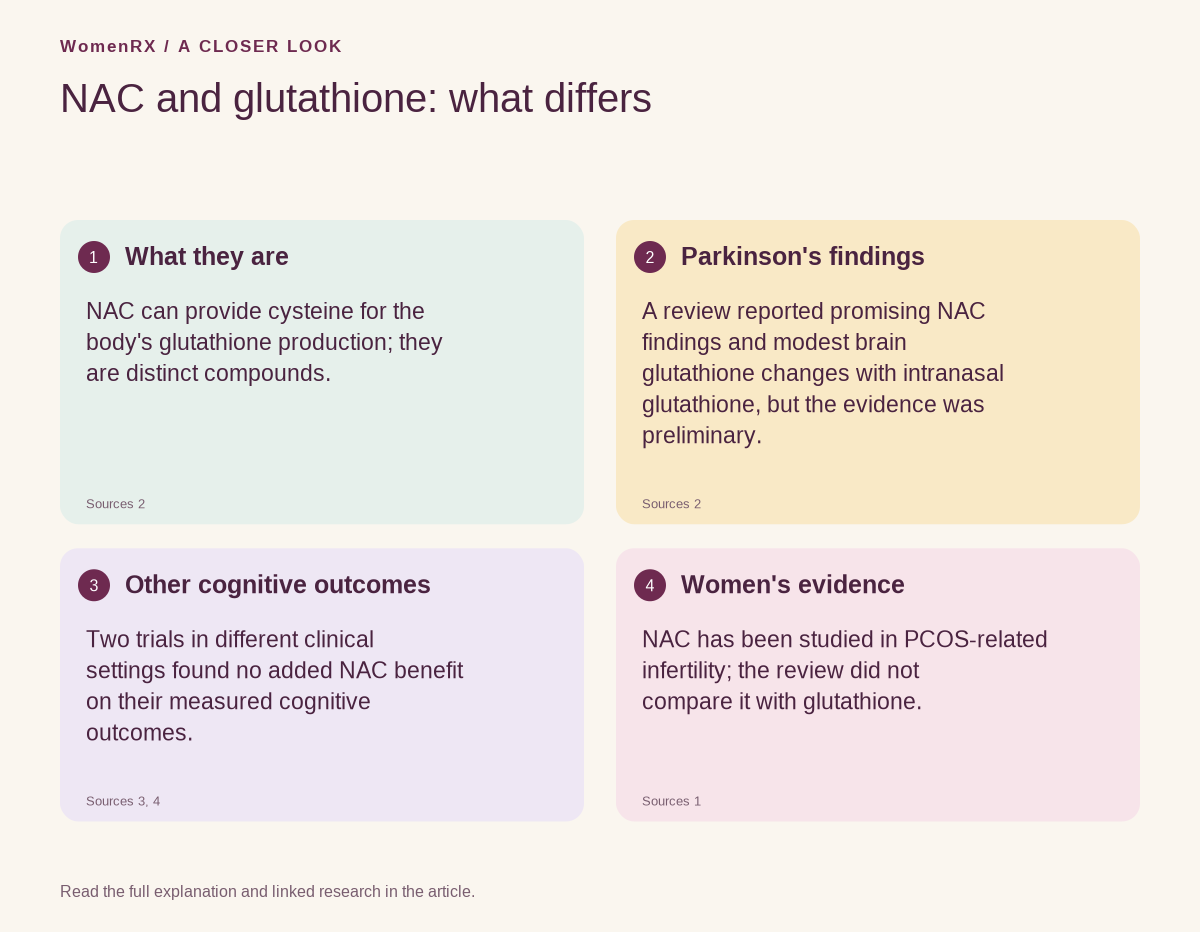
NAC and glutathione: what differs
What they are: NAC can provide cysteine for the body's glutathione production; they are distinct compounds.2
Parkinson's findings: A review reported promising NAC findings and modest brain glutathione changes with intranasal glutathione, but the evidence was preliminary.2
Other cognitive outcomes: Two trials in different clinical settings found no added NAC benefit on their measured cognitive outcomes.34
Women's evidence: NAC has been studied in PCOS-related infertility; the review did not compare it with glutathione.1
Read the figure as text
The relationship between these compounds is biochemical; the human evidence tests different outcomes and does not establish a universal winner.- What they are: NAC can provide cysteine for the body's glutathione production; they are distinct compounds.2
- Parkinson's findings: A review reported promising NAC findings and modest brain glutathione changes with intranasal glutathione, but the evidence was preliminary.2
- Other cognitive outcomes: Two trials in different clinical settings found no added NAC benefit on their measured cognitive outcomes.34
- Women's evidence: NAC has been studied in PCOS-related infertility; the review did not compare it with glutathione.1
More questions, answered
Does taking NAC mean my body makes more glutathione?
NAC can provide cysteine, a building block used to make glutathione. That mechanism does not guarantee a particular increase in glutathione or a meaningful improvement in symptoms for every person or purpose. 2
Is there a direct clinical trial showing NAC is better than glutathione?
The Parkinson’s review compares findings across studies, including different interventions and routes; it does not establish a direct head-to-head winner. The evidence it summarizes is preliminary. 2
Sources you can check
- Evaluating the Therapeutic Potential of Antioxidants in Polyendocrine Metabolic Ovarian Syndrome (PMOS)-Associated Infertility.Mahapatra PD, Bhat VV, Vyas NA, Dharmadhikari S, Puppalwar G, Khandhedia C, Mane A, Mehta S. · International journal of women's health · 2026Return to first citation
- The role of N-acetylcysteine and glutathione in the management of Parkinson's disease: a systematic review of oxidative biomarkers and clinical outcomes.Mohammed I, Nankya Y, Hong UT, Kan A, Abdelhafid AM, Latunde-Dada GO. · Amino acids · 2026Return to first citation
- Efficacy and safety of N-acetylcysteine in patients with mild cognitive impairment undergoing exercise-based cardiac rehabilitation program: a randomized controlled trial.Gallagher D, Kang Y, Herrmann N, Kiss A, Black SE, Oh P, Marzolini S, Rabin JS, Andreazza A, Ramirez J, Gao F, Rapoport M, Chen JJ, Survilla K, Vieira D, Mah E, Swardfager W, Lanct... · Alzheimer's research & therapy · 2026Return to first citation
- The Effect of N-Acetylcysteine (NAC) on Neurometabolites and Cognitive Function in Adults With Alcohol Use Disorder: A Preliminary Randomized Controlled Trial.Dunbar KY, Dali G, DeMayo MM, Logge W, Hurzeler T, Kelly C, Watt J, Squeglia LM, Kirkland AE, Haber PS, Morley KC. · Neuropsychopharmacology reports · 2025Return to first citation