Multiple Sclerosis: From First Symptoms to Treatment Decisions
An MS diagnosis draws on your symptoms, neurological exam, MRI, and sometimes other tests, while treatment planning depends on your goals and circumstances.
There’s no single test that diagnoses multiple sclerosis (MS). A neurologist puts your symptom history and examination together with MRI findings and, when useful, a spinal fluid test. Treatment conversations then separate three needs: managing a current symptom or relapse, reducing future disease activity, and supporting daily life. If pregnancy is possible or menopause is raising new symptom questions, bring those into the plan early. 12
Symptoms are a reason to investigate, not a diagnosis
MS affects the brain and spinal cord. Damage to myelin, the protective coating around nerve cells, can disrupt messages between your brain and body. Symptoms vary with the nerves affected and may include blurry or double vision or eye pain. These symptoms can also have other causes, so experiencing one of them doesn’t establish MS. 12
The first useful distinction is how a symptom began and changed. For example, a neurologist will want to know whether a vision problem appeared suddenly, whether it improved, and whether you’ve had a separate episode of weakness or altered sensation. Your account matters alongside what the examination shows. If weakness or numbness in one arm comes on suddenly, seek emergency care rather than waiting for an MS appointment; that pattern needs urgent assessment for other possible causes. 12
What the diagnostic workup can tell you
A neurologist reviews your health history and symptoms, then checks functions such as vision, strength, sensation, coordination, balance, and reflexes. An MRI looks for areas of damage in the brain or spinal cord. A lumbar puncture may be used to examine the fluid surrounding them for signs that help with the diagnosis. No one result replaces the whole assessment. 12
An MRI finding is particularly easy to misread without that context. Changes that look like MS can appear on an MRI in someone who has no symptoms; some people with these findings later develop MS symptoms and some do not. If you’ve been told your scan is “suggestive,” a useful question is: How do the scan, my history, and the examination fit together, and what remains uncertain? 1
Vision symptoms offer another reason not to jump to a conclusion. Optic neuritis, an inflammatory optic nerve condition, can occur with MS but also with other disorders. The diagnosis behind it affects longer-term treatment decisions. 14
Keep the treatment goals separate
Once there’s a diagnosis, “treatment” can mean different things. Disease-modifying treatment aims to reduce future relapses and their severity; treatment for a troublesome symptom aims to improve how you feel and function now. Steroids may be used for an acute relapse, but treating that episode is a separate decision from choosing longer-term disease-modifying treatment. Your MS type and symptoms help shape the plan, and the plan may change over time. 23
You could start that discussion with three questions:
- What are we trying to prevent? Ask how a proposed disease-modifying treatment fits your MS type and the activity seen so far. 2
- What needs help today? Pain, stiffness, vision problems, and other symptoms may call for their own treatment or support rather than a change in disease-modifying treatment alone. 2
- What would make us revisit the plan? Ask which new symptoms, examination findings, or scan changes should prompt a conversation. A worsening symptom is not automatically a new relapse; infection, for example, can cause a pseudo-relapse without new MS activity. 3
If the type of MS is not yet clear, a neurologist may monitor symptoms and test results over time before determining it. You can still ask what the current findings mean for decisions you face now. 2
Make room for pregnancy and menopause questions
If you might want to become pregnant, say so when discussing treatment, not only once you’re ready to try. Ask how each treatment option fits your plans, who will coordinate care during pregnancy, and what decisions you would need to revisit after birth. Those are planning questions, not a reason to assume you must stop or avoid a particular treatment. Ask your neurologist what pregnancy and breastfeeding guidance applies to each medicine you’re considering.
Around perimenopause or after menopause, a new or worsening symptom deserves the same careful description you’d give at any other time: what changed, when, and how it affects you. Rather than assuming it’s MS activity or attributing it to menopause, ask how your clinician would distinguish a possible relapse from another cause. MS symptoms vary widely, and symptoms that resemble MS can have other explanations. 123
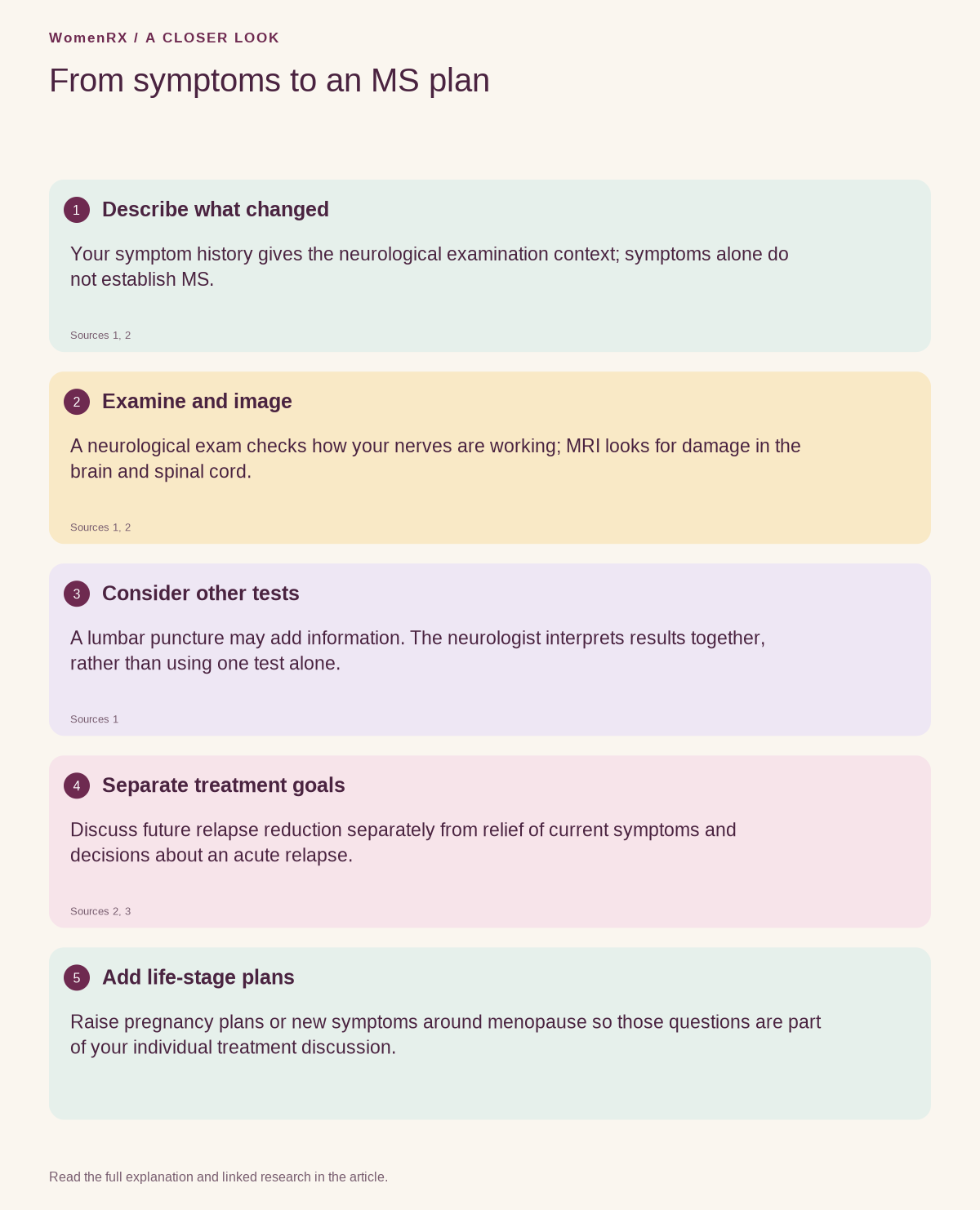
From symptoms to an MS plan
Describe what changed: Your symptom history gives the neurological examination context; symptoms alone do not establish MS.12
Examine and image: A neurological exam checks how your nerves are working; MRI looks for damage in the brain and spinal cord.12
Consider other tests: A lumbar puncture may add information. The neurologist interprets results together, rather than using one test alone.1
Separate treatment goals: Discuss future relapse reduction separately from relief of current symptoms and decisions about an acute relapse.23
Add life-stage plans: Raise pregnancy plans or new symptoms around menopause so those questions are part of your individual treatment discussion.
Read the figure as text
The workup gathers several kinds of evidence. Treatment and life-stage decisions come after, and draw on more than a scan result.- Describe what changed: Your symptom history gives the neurological examination context; symptoms alone do not establish MS.12
- Examine and image: A neurological exam checks how your nerves are working; MRI looks for damage in the brain and spinal cord.12
- Consider other tests: A lumbar puncture may add information. The neurologist interprets results together, rather than using one test alone.1
- Separate treatment goals: Discuss future relapse reduction separately from relief of current symptoms and decisions about an acute relapse.23
- Add life-stage plans: Raise pregnancy plans or new symptoms around menopause so those questions are part of your individual treatment discussion.
More questions, answered
Does an abnormal MRI mean I have MS?
Not by itself. A neurologist interprets MRI findings with your symptoms and examination and may use other tests. MS-like MRI changes can also be found in someone without symptoms, and not everyone in that situation goes on to develop MS symptoms. 1
Is every worsening symptom a relapse?
No. A review of MS relapse assessment describes pseudo-relapses, in which a factor such as infection worsens symptoms without representing new MS disease activity. Tell your MS team what changed and whether you’ve been ill so they can assess the cause. 3
Sources you can check
- Multiple Sclerosis | MS | MedlinePlusAccessed 2026-09-25Return to first citation
- Multiple sclerosis - NHSAccessed 2026-09-25Return to first citation
- Innate immunity and biomarkers of multiple sclerosis relapse versus remission.Karadeniz M, Wesselingh R, Jayakrishnan PC, Sequeira RP, Van Der Walt A, Butzkueven H, Monif M. · Autoimmunity reviews · 2026Return to first citation
- Updates on the Acute and Maintenance Management of Optic Neuritis Including Multiple Sclerosis, Neuromyelitis Optica Spectrum Disorder, and Myelin Oligodendrocyte Glycoprotein Antibody Disease.Alchaki AR. · Neurologic clinics · 2026Return to first citation