Libido Creams: What to Check Before You Buy
A cream studied for menopausal dryness isn’t automatically a treatment for low sexual desire.
Start with the active ingredient, the body site and route it’s meant for, and the specific outcome studied. Vaginal estradiol has evidence for some menopause-related vaginal symptoms, but that does not establish that it boosts desire. A study of vaginal estradiol for dryness cannot establish a libido benefit for topical testosterone or creams sold broadly as libido products, so look for research on the exact product and claim. 5
A cream can be marketed for “libido” while containing an ingredient studied for a different purpose. Before buying, check whether the label names an active ingredient, says exactly where and how the product is used, and makes a claim that matches the outcome researchers actually measured. The word “hormone” or “arousal” isn’t proof that a cream increases sexual desire.
First, separate desire from discomfort
Low desire and painful or uncomfortable sex aren’t the same problem. Menopause-related changes in vulvar and vaginal tissue can include dryness and discomfort. Prescription vaginal estradiol is one example of a medicine used for moderate to severe vulvar and vaginal atrophy symptoms due to menopause. Its approved purpose is not the same as a general promise to increase libido. 2
In a randomized, placebo-controlled trial of 576 postmenopausal women whose most bothersome symptom was vaginal dryness, estradiol cream improved dryness compared with placebo. The trial did not establish an increase in sexual desire. Results also differed by symptom: irritation and itching improved similarly in the estradiol and placebo groups, while dyspareunia was better with estradiol at one study assessment, Week 8. That’s evidence about a particular medicine, group, symptom, and timeframe, not a result that can be applied to every “libido cream.” 5
The North American Menopause Society’s position statement discusses low-dose vaginal estrogen as an option for bothersome genitourinary symptoms of menopause that aren’t relieved by over-the-counter therapies. That recommendation concerns those symptoms; it does not make vaginal estrogen a general treatment for low desire. 6
A label check that helps sort the claims
1. Find the active ingredient. Check whether the label identifies a hormone or another active ingredient, or mainly describes moisturizers, fragrance, or sensations. A named ingredient alone doesn’t show that the product works for desire. Don’t assume two creams are interchangeable because both use words such as “hormone,” “arousal,” or “libido.”
2. Match the claim to the outcome. Does the seller promise more desire, easier arousal, less dryness, or less pain? Those are different outcomes. Ask whether research on the exact ingredient and route measured the result being advertised. A study of vaginal dryness cannot, by itself, prove increased desire.
3. Check the route and application site. “Topical” can be vague. A product intended for skin, the vulva, or inside the vagina may not be used in the same way. For example, the US prescribing information for Estrace identifies it as estradiol vaginal cream and gives its indication as moderate to severe vulvar and vaginal atrophy due to menopause. Don’t treat that product information as support for a different cream or application site. 2
4. Look for a clear ingredient amount and warnings. A label that names an ingredient but leaves its amount unclear makes it harder to compare the product with research. Prescription product information can identify both its concentration and its intended use; Estrace’s label, for example, states that each gram contains 0.1 mg estradiol. That detail is specific to Estrace, not a suggested amount for another product. 2 If you already have vulvar irritation, check the warnings for the particular product rather than assuming a cream will feel soothing. Vaginal pain can occur early with vaginal estrogen; that information doesn’t tell you how a different cream will feel. 3
5. Ask who was studied. Menopause-related vaginal symptoms and postpartum or breastfeeding changes are different situations. A review describes possible vulvovaginal and sexual symptoms during lactation but also notes that more than one cause may contribute. 4 If you’re pregnant or breastfeeding, check information for the exact ingredient and route. Guidance on vaginal estrogen says to stop using it and talk with a doctor if you think you might be pregnant, and notes that information about its use during breastfeeding is limited. It does not establish the safety of an unrelated libido cream. 1
What a testosterone claim needs to show
A claim that topical testosterone improves women’s sexual desire needs evidence for the actual product, route, and outcome. A study of vaginal estradiol for dryness cannot establish that benefit. 5 That isn’t proof that no research exists; it means the ingredient name alone can’t settle the question. For compounded products in particular, don’t infer that a product is proven or interchangeable with a studied medicine simply because it contains a familiar hormone. Look for evidence that matches the formulation and the promised result.
If a cream’s main promise is more desire, but the evidence it points to concerns dryness, tissue changes, or sensation, the evidence and the sales claim don’t match. If your concern is discomfort, a product studied for that specific symptom may be more relevant than one marketed broadly for libido. The useful question isn’t just “What’s in the cream?” It’s “Was this ingredient, in this form and route, shown to help the outcome I want?”
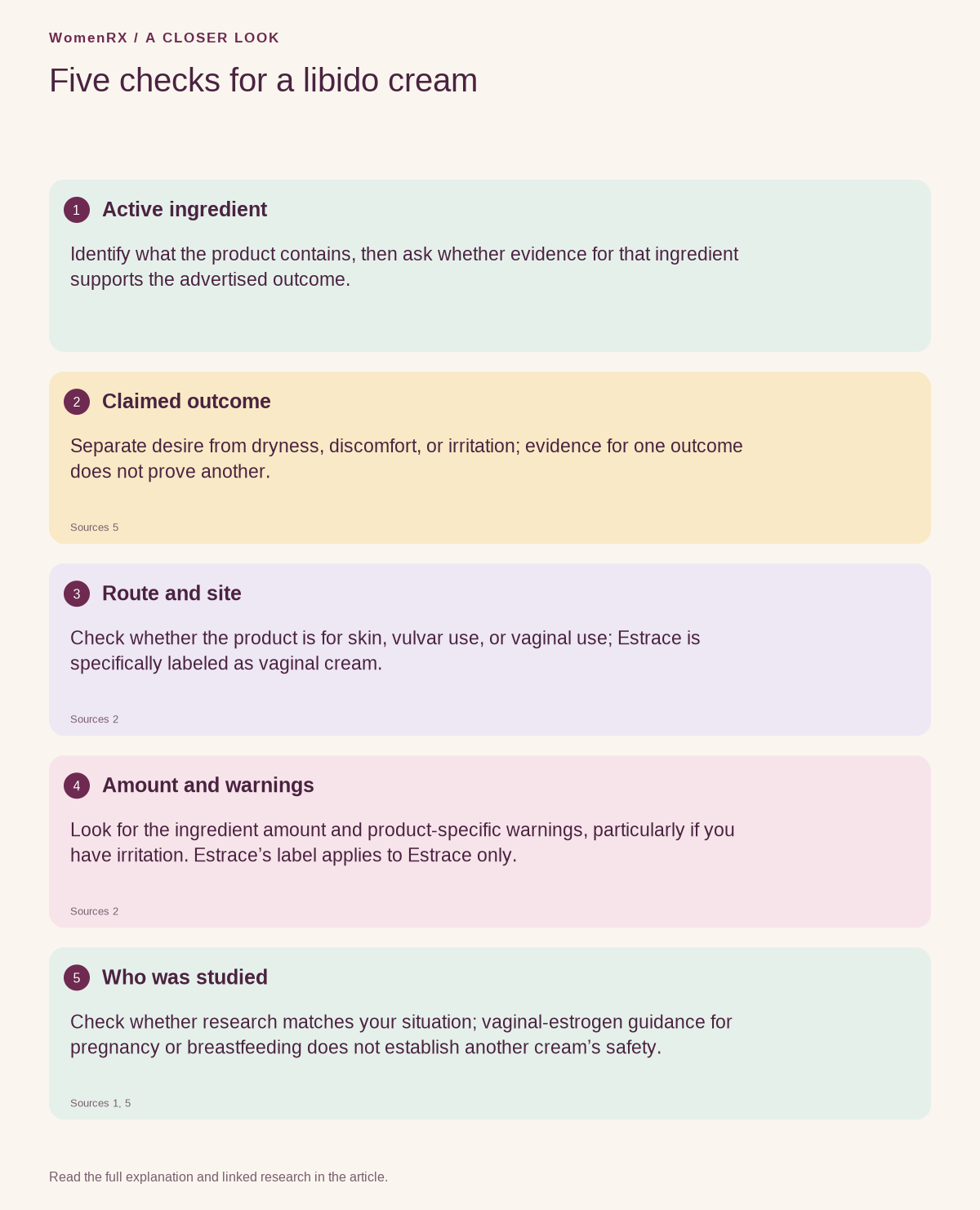
Five checks for a libido cream
Active ingredient: Identify what the product contains, then ask whether evidence for that ingredient supports the advertised outcome.
Claimed outcome: Separate desire from dryness, discomfort, or irritation; evidence for one outcome does not prove another.5
Route and site: Check whether the product is for skin, vulvar use, or vaginal use; Estrace is specifically labeled as vaginal cream.2
Amount and warnings: Look for the ingredient amount and product-specific warnings, particularly if you have irritation. Estrace’s label applies to Estrace only.2
Who was studied: Check whether research matches your situation; vaginal-estrogen guidance for pregnancy or breastfeeding does not establish another cream’s safety.15
Read the figure as text
Use these checks to compare the product’s label and claims with the evidence that actually applies.- Active ingredient: Identify what the product contains, then ask whether evidence for that ingredient supports the advertised outcome.
- Claimed outcome: Separate desire from dryness, discomfort, or irritation; evidence for one outcome does not prove another.5
- Route and site: Check whether the product is for skin, vulvar use, or vaginal use; Estrace is specifically labeled as vaginal cream.2
- Amount and warnings: Look for the ingredient amount and product-specific warnings, particularly if you have irritation. Estrace’s label applies to Estrace only.2
- Who was studied: Check whether research matches your situation; vaginal-estrogen guidance for pregnancy or breastfeeding does not establish another cream’s safety.15
More questions, answered
Does evidence for vaginal estrogen mean it increases libido?
No. The cited trial studied postmenopausal women whose main concern was vaginal dryness and measured dryness and other vulvovaginal symptoms, not sexual desire. 5
What should I check if I’m pregnant or breastfeeding?
Check information for the exact ingredient and route. Guidance on vaginal estrogen says to stop using it and talk with a doctor if you think you might be pregnant; information about its use during breastfeeding is limited. Neither point establishes the safety of other creams marketed for libido. 1
Sources you can check
- Pregnancy, breastfeeding and fertility while using vaginal oestrogen - NHSAccessed 2026-09-25Return to first citation
- ESTRACE (ESTRADIOL) CREAM [ALLERGAN, INC.] | US prescribing information and patient instructionsAccessed 2026-09-25Return to first citation
- About vaginal oestrogen - NHSAccessed 2026-09-25Return to first citation
- Genitourinary syndrome of lactation: An underrecognized postpartum condition affecting women's vulvovaginal, urinary and sexual health.Orozco Fernández R, Gil-Antuñano SP. · Women's health (London, England) · 2026Return to first citation
- A Randomized, Multicenter, Double-Blind, Study to Evaluate the Safety and Efficacy of Estradiol Vaginal Cream 0.003% in Postmenopausal Women with Vaginal Dryness as the Most Bothersome Symptom.Archer DF, Kimble TD, Lin FDY, Battucci S, Sniukiene V, Liu JH. · Journal of women's health (2002) · 2018Return to first citation
- The 2022 hormone therapy position statement of The North American Menopause Society.“The 2022 Hormone Therapy Position Statement of The North American Menopause Society” Advisory Panel. · Menopause (New York, N.Y.) · 2022Return to first citation