Arousal Creams: Match the Product to Your Goal
Lubrication, genital sensation, and sexual desire are different things, so start by checking what a topical product is actually meant to do.
A lubricant can help with dryness during sex, and a vaginal moisturizer is intended for vaginal dryness. A warming or tingling product aims to change sensation, but that isn’t proof it increases desire or orgasm. A small study of a different topical drug measured genital temperature, not desire or orgasm. 1 3
First, name what you want to change
“More arousal” can mean a few different things: less friction, more genital sensation, or a stronger wish to have sex. Those aren’t interchangeable. Lubrication and physical sensation are body responses; desire is about wanting sex. A product aimed at one doesn’t automatically address the others.
That distinction can make a label easier to read. Ask: Is this for dryness, for a change in sensation, or is it a medicine for a diagnosed condition? Then check whether it’s meant for external vulvar use, internal vaginal use, or both.
What the product categories are for
Lubricants are used around sex to ease dryness. Guidance on vaginal dryness recommends water-based lubricant before sex, including on the vulva or on a partner’s fingers, penis, or a sex toy. 1
Vaginal moisturizers are products intended for vaginal dryness; guidance distinguishes these from lubricants and describes using them inside the vagina. Don’t assume a moisturizer meant for the body or face is suitable for vaginal use. Products not made for vaginal use can cause more irritation or an infection. 1
Warming, cooling, or tingling products are marketed to change sensation. Read the label for the intended site and directions. The research described below does not establish whether over-the-counter sensation products reliably increase desire or orgasm, or whether one ingredient works better than another.
Medicines are different from sensation products. For example, US prescribing information for vaginal estradiol cream lists treatment of moderate to severe vulvar and vaginal atrophy symptoms due to menopause. That is a menopause-related treatment, not evidence that a cream generally increases sexual desire. 2
What the arousal research actually tested
A small proof-of-principle study compared topical alprostadil with an over-the-counter lubricant in 10 healthy premenopausal women without sexual dysfunction. Alprostadil was associated with increased measured temperature in the vulva, vestibule, and clitoris; six of the 10 women reported being aware of genital sensations with it. The study measured genital temperature and sensation, not whether participants wanted sex more or had more orgasms. It also doesn’t establish the effect of over-the-counter warming or tingling products. 3
Menopause-related dryness is another distinct issue. A systematic review of nonestrogen treatments for genitourinary syndrome of menopause found that some treatments improved sexual-function measures, alongside symptoms or signs of atrophy. Those findings concern specific treatments studied for menopause-related symptoms; they don’t prove that a retail “arousal cream” increases desire. 4
The small alprostadil study involved premenopausal participants, while the menopause evidence concerns a different set of symptoms and treatments. Neither tells us how an arousal product works during postpartum recovery. If you’re postpartum, check that the product is intended for the exact body site and follow its own directions rather than assuming evidence from another group applies.
A quick label-reading check
Before using a product, look for its intended purpose, application site (external, internal, or both), ingredients, and directions or warnings. Check the package for whether it can be used with condoms or other products; compatibility can depend on the specific product, so don’t guess from the category name. If the label doesn’t clearly say it’s intended for vaginal use, don’t put it inside the vagina. Products not made for vaginal use can cause irritation or infection. 1
If the main problem is dryness, choose a product labeled for dryness rather than expecting a sensation product to create desire. If you’re looking at a medicine, check its actual indication: treatment for menopause-related vaginal symptoms is not the same as a general-purpose arousal cream. And if your concern is desire rather than comfort or sensation, a topical product may not match the problem you’re trying to solve.
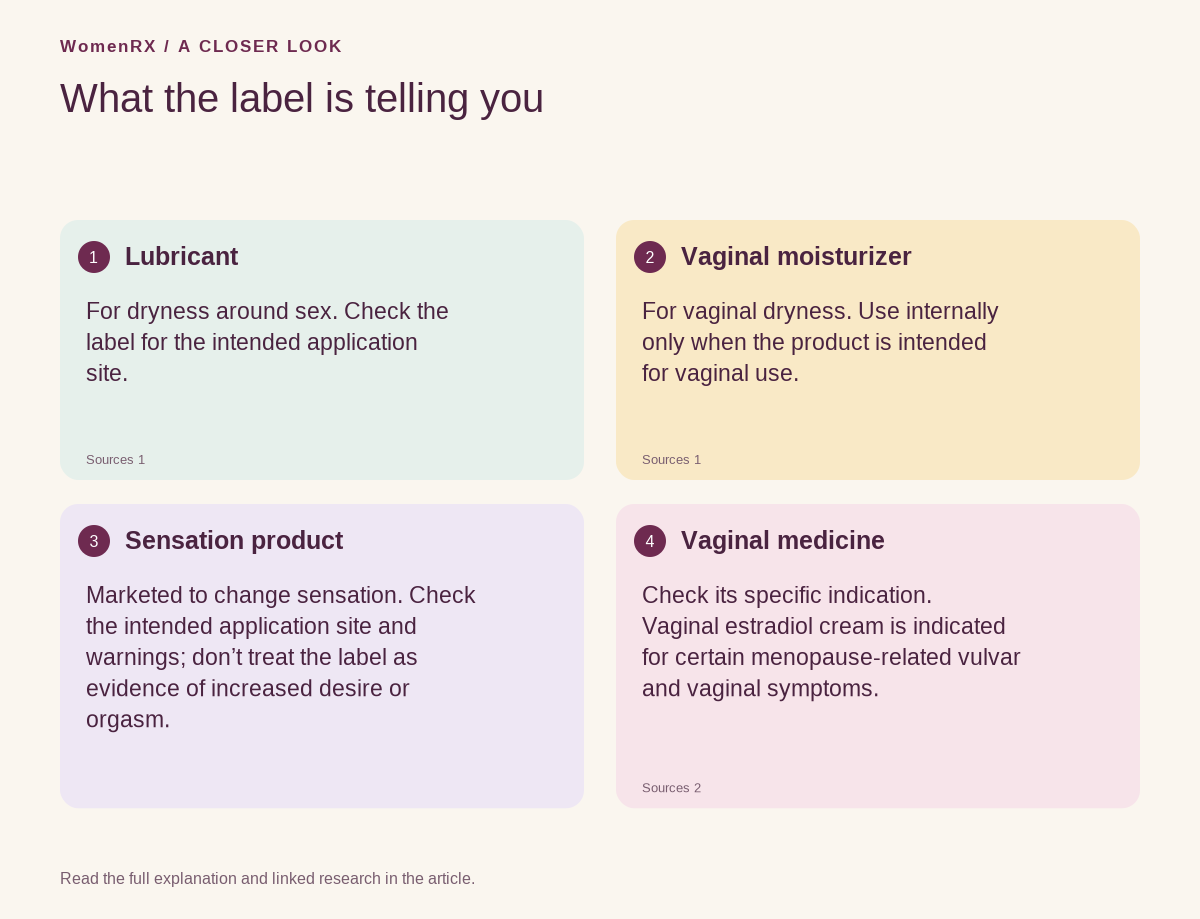
What the label is telling you
Lubricant: For dryness around sex. Check the label for the intended application site.1
Vaginal moisturizer: For vaginal dryness. Use internally only when the product is intended for vaginal use.1
Sensation product: Marketed to change sensation. Check the intended application site and warnings; don’t treat the label as evidence of increased desire or orgasm.
Vaginal medicine: Check its specific indication. Vaginal estradiol cream is indicated for certain menopause-related vulvar and vaginal symptoms.2
Read the figure as text
Compare each category by its intended goal and check the application site before use. The name on the front of a package does not establish that a product treats desire.- Lubricant: For dryness around sex. Check the label for the intended application site.1
- Vaginal moisturizer: For vaginal dryness. Use internally only when the product is intended for vaginal use.1
- Sensation product: Marketed to change sensation. Check the intended application site and warnings; don’t treat the label as evidence of increased desire or orgasm.
- Vaginal medicine: Check its specific indication. Vaginal estradiol cream is indicated for certain menopause-related vulvar and vaginal symptoms.2
Sources you can check
- Vaginal dryness - NHSAccessed 2026-09-25Return to first citation
- ESTRACE (ESTRADIOL) CREAM [ALLERGAN, INC.] | US prescribing information and patient instructionsAccessed 2026-09-25Return to first citation
- Peripheral Female Genital Arousal as Assessed by Thermography Following Topical Genital Application of Alprostadil vs Placebo Arousal Gel: A Proof-of-Principle Study Without Visual Sexual Stimulation.Goldstein SW, Gonzalez JR, Gagnon C, Goldstein I. · Sexual medicine · 2016Return to first citation
- Nonestrogen Therapies for Treatment of Genitourinary Syndrome of Menopause: A Systematic Review.Casiano Evans EA, Hobson DTG, Aschkenazi SO, Alas AN, Balgobin S, Balk EM, Dieter AA, Kanter G, Orejuela FJ, Sanses TVD, Rahn DD. · Obstetrics and gynecology · 2023Return to first citation