Is Olive Oil a Good Fit for Weight Management?
Olive oil can fit into meals when you’re managing weight; the useful question is whether it replaces another fat or adds to what you already use.
Yes, you can keep olive oil in meals while managing weight, but don’t count on it to cause weight loss. A three-month feeding trial in middle-aged and older women found no significant difference in weight change among groups assigned olive, soybean, or camellia oil. For portions, distinguish a swap from an extra pour. That’s a way to account for a meal, not a proven weight-loss strategy. 1
Keep the focus on what the oil replaces
Start with a meal-planning question: is olive oil replacing something else, or is it being added to what you already use?
For example, you might use olive oil instead of butter to cook vegetables. That’s a substitution. If you use your usual cooking oil, then add olive oil as a finishing drizzle and keep the same dressing, that’s an addition. In that example, more oil is being used, but the trials discussed here don’t tell us what weight outcome that specific change would produce.
A practical way to keep track is to measure the oil you pour for cooking or dressing, rather than pouring freely. Count the oil used in the pan and the oil added at the table or in a dressing. Then consider what, if anything, that amount replaces. This is a portion-awareness tool, not a prescribed amount.
What the studies can tell you
One randomized controlled-feeding trial looked directly at weight in 90 middle-aged and older Chinese women at high cardiovascular risk. For three months, the groups ate meals prepared with soybean oil, olive oil, or camellia seed oil. The researchers found no significant difference in weight change among the three groups. That doesn’t prove the oils have identical effects in every setting, but it doesn’t support olive oil as a distinct weight-loss aid either. 1
Other trials help show why it matters to separate an oil from the broader eating pattern. In a randomized trial involving adults with severe obesity, participants were assigned to olive oil alone, a traditional Brazilian diet, or that diet plus olive oil. The diet groups had reductions in body fat; the diet-only group also had a significant reduction in body weight, and weight change differed between each diet group and the oil-only group. Because the trial compared dietary interventions with oil alone, it doesn’t establish what adding olive oil to usual meals would do. 3
A separate 24-week trial in 116 adults with type 2 diabetes compared a high-phenolic extra-virgin olive oil intervention with advice to minimize extra-virgin olive oil. Both groups had modest reductions in weight and BMI. Because the reductions occurred in both groups, this result doesn’t show that olive oil itself produced weight loss. 2
What that means for women
The most directly relevant oil-comparison trial included only middle-aged and older women, but it compared different cooking oils in provided meals, not olive oil against adding no oil to a person’s usual diet. It found no significant difference in weight change between the oil groups. 1
The severe-obesity trial tested a dietary pattern with and without olive oil as well as an oil-only group. Its overall findings don’t provide a basis for claiming a special weight benefit for midlife women or a difference in olive oil’s effects by sex. 3
A simple way to account for oil at meals
When you cook, note what fat the olive oil replaces. When you dress a salad or finish a dish, count that pour along with any oil already used in cooking or in another sauce. For instance, using olive oil in a vinaigrette instead of a creamy dressing is a swap; keeping the dressing and adding an extra drizzle is not.
That distinction helps you see what’s going into a meal. Weight changes seen with a whole dietary pattern shouldn’t automatically be credited to the olive oil in it. 3
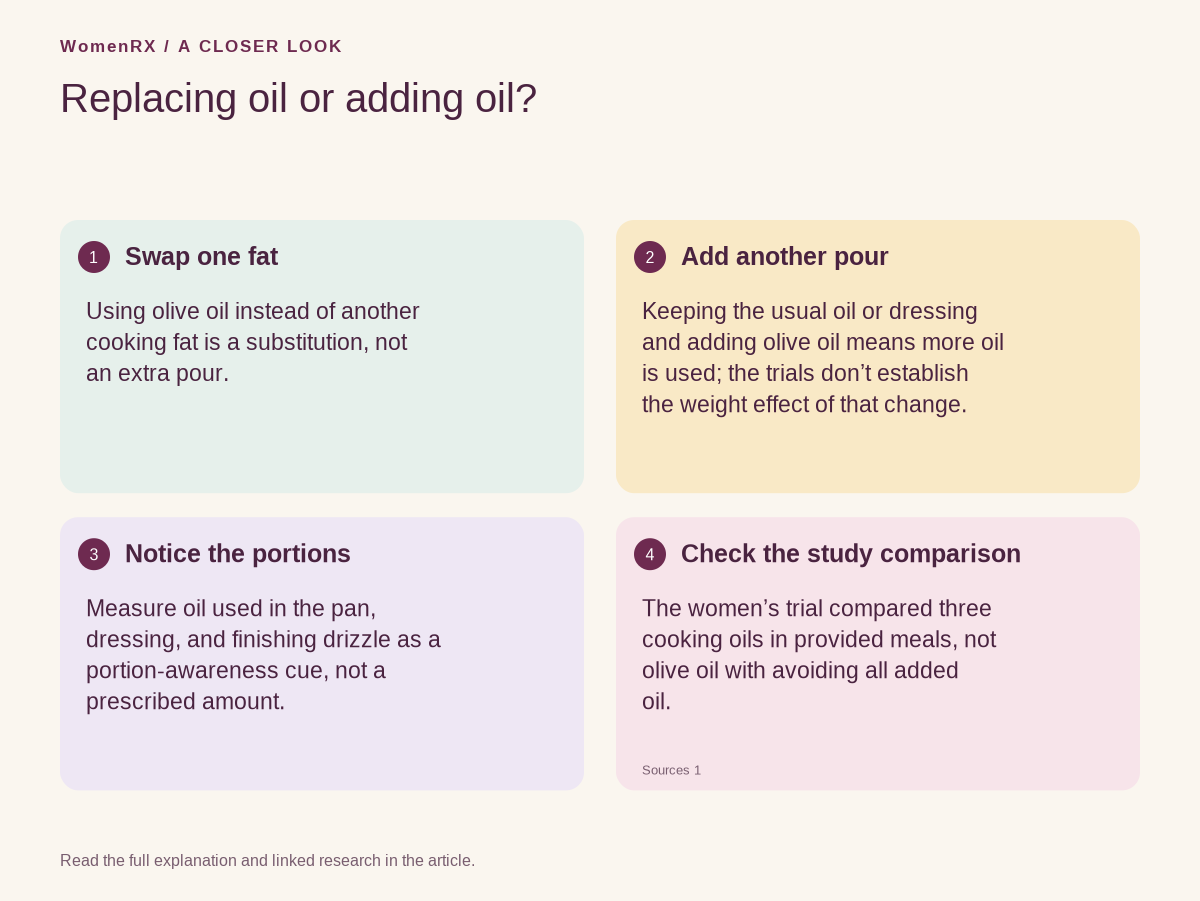
Replacing oil or adding oil?
Swap one fat: Using olive oil instead of another cooking fat is a substitution, not an extra pour.
Add another pour: Keeping the usual oil or dressing and adding olive oil means more oil is used; the trials don’t establish the weight effect of that change.
Notice the portions: Measure oil used in the pan, dressing, and finishing drizzle as a portion-awareness cue, not a prescribed amount.
Check the study comparison: The women’s trial compared three cooking oils in provided meals, not olive oil with avoiding all added oil.1
Read the figure as text
Separate the practical question of what goes into a meal from what the weight studies actually tested.- Swap one fat: Using olive oil instead of another cooking fat is a substitution, not an extra pour.
- Add another pour: Keeping the usual oil or dressing and adding olive oil means more oil is used; the trials don’t establish the weight effect of that change.
- Notice the portions: Measure oil used in the pan, dressing, and finishing drizzle as a portion-awareness cue, not a prescribed amount.
- Check the study comparison: The women’s trial compared three cooking oils in provided meals, not olive oil with avoiding all added oil.1
Sources you can check
- Effects of n-6 PUFA-rich soybean oil, MUFA-rich olive oil and camellia seed oil on weight and cardiometabolic profiles among Chinese women: a 3-month double-blind randomized controlled-feeding trial.Wu MY, Du MH, Wen H, Wang WQ, Tang J, Shen LR. · Food & function · 2022Return to first citation
- Exploring Galician phenolic-rich olive oil as a glycemic control strategy: the OILDIABET randomized trial.Figueiredo-González M, Seoane-Cruz I, Reboredo-Rodríguez P, Fernández-Rodríguez E, Marcos-García M, Menor-Rodríguez MJ, Calderón-Cruz B, González-Barreiro C, Mato-Mato JA, Cancho-G... · Food & function · 2025Return to first citation
- Effects of Extra Virgin Olive Oil (EVOO) and the Traditional Brazilian Diet on Sarcopenia in Severe Obesity: A Randomized Clinical Trial.Aparecida Silveira E, Danésio de Souza J, Dos Santos Rodrigues AP, Lima RM, de Souza Cardoso CK, de Oliveira C. · Nutrients · 2020Return to first citation