Olive Oil in Everyday Cooking: What Extra Virgin Means
Olive oil is a cooking fat, not a protein source. Here, extra virgin describes production without refining; dietary evidence looks at meals and eating patterns rather than a spoonful of oil on its own.
Olive oil brings fat and flavor to a meal. A USDA reference tablespoon supplies about 119 calories, 13.5 g fat and no protein. 11 “Extra virgin,” “refined,” and “olive oil” describe different categories, including how the oil was processed or blended. 16 Choose for the dish and the flavor you enjoy; diet studies do not turn one bottle into a treatment. 14
Start with what olive oil does in a meal
Olive oil is an ingredient, not a complete nutrition strategy. It can carry the flavor of a dressing, coat vegetables before cooking, or finish a bowl of beans. USDA food-composition data list zero grams of protein in olive oil, so it contributes none to that last example. One tablespoon supplies about 119 calories and 13.5 grams of fat. Those figures are reference estimates, not a target serving or a measurement of every bottle. 11
That portion context is useful if you're deciding whether to drizzle oil onto a finished dish or pour freely from the bottle. You don't need to avoid it because it contains calories. But adding more oil to an otherwise unchanged meal is different from choosing it as the fat you use instead of another ingredient. Neither choice, by itself, recreates a Mediterranean-style eating pattern.
What the evidence can and can't credit to olive oil
Olive oil is often discussed alongside a Mediterranean-style diet, which also includes foods such as vegetables, legumes, fruit, nuts, and whole grains. That makes the diet a useful way to think about meals, but a study of the whole pattern can't tell you how much of an outcome came from the oil. 7
A 2024 review pooled 18 randomized trials of Mediterranean diets enriched with olive oil. Compared with control diets, the pooled result showed a small reduction in triglycerides, about 2.4 mg/dL, with substantial differences between studies. The reviewers found no consistent effects across the other cardiometabolic measures they assessed. That's a more measured finding than saying olive oil reliably improves every heart-health marker. 14
A smaller trial in people who already had coronary heart disease offers another useful distinction. Its intervention group added both olive oil and flaxseed to heart-healthy dietary advice for three months; the control group received the dietary advice. Some measures of blood-vessel function, inflammation, and blood lipids improved relative to the control group. Because the two foods were given together, the trial cannot show which changes were due to olive oil. 12
What about a benefit specifically for women? The trial descriptions above do not report a separate result for women. A trial of high-phenolic extra-virgin olive oil in people with high blood lipids noted that its sample may have been too small to detect differences by sex. It would be a stretch to promise a distinct effect for women from those findings. 13
Read the category before the marketing
Three common descriptions are easier to compare side by side:
| Description | What the category tells you | What to do with that information |
|---|---|---|
| Extra virgin olive oil | A virgin oil meeting defined quality and flavor criteria, including no measured flavor defects | Choose a flavor you enjoy in dressings or a finishing drizzle |
| Olive oil | A blend of refined olive oil and virgin olive oil | Check the actual ingredient description instead of assuming it is all extra virgin |
| Refined olive oil | Virgin oil that has been refined; the U.S. grade describes it as flavorless and odorless | Consider it when you want the oil to have less influence on a dish's flavor |
These are USDA category definitions, with cooking uses offered as practical suggestions. Olive-pomace oil is a separate category containing refined olive-pomace oil and virgin olive oil. None of these names promises a particular medical outcome. 16
A high-polyphenol description concerns compounds that can vary between oils. Laboratory antioxidant measurements and studies of individual products do not establish a clinical ranking for every bottle on the shelf. For everyday buying, start with the category, the flavor you want and how much you will use. 413
Using it and keeping it in good condition
The choice between cooking with olive oil and adding it afterward needn't become a rule about one perfect method. Use it where its flavor works for the dish. Evidence that olive oil's minor compounds can be affected by heat doesn't establish a single cooking-temperature cutoff or mean that a cooked meal loses all value. 8
Storage is a more practical place to pay attention. Light, heat, and oxygen can affect compounds in extra-virgin olive oil, and a study of 14 commercial samples found that most had deteriorated on measured quality indicators after three years of storage. That study doesn't set an expiration date for your bottle. It does give you a reason to close it after use, keep it away from a sunny or hot spot, and buy an amount you'll realistically use. 810
The simplest decision is about the meal in front of you: choose an oil you like, use an amount that suits the dish, and consider what else is on the plate. Olive oil brings fat and flavor. A varied eating pattern offers more than any one ingredient can. 117
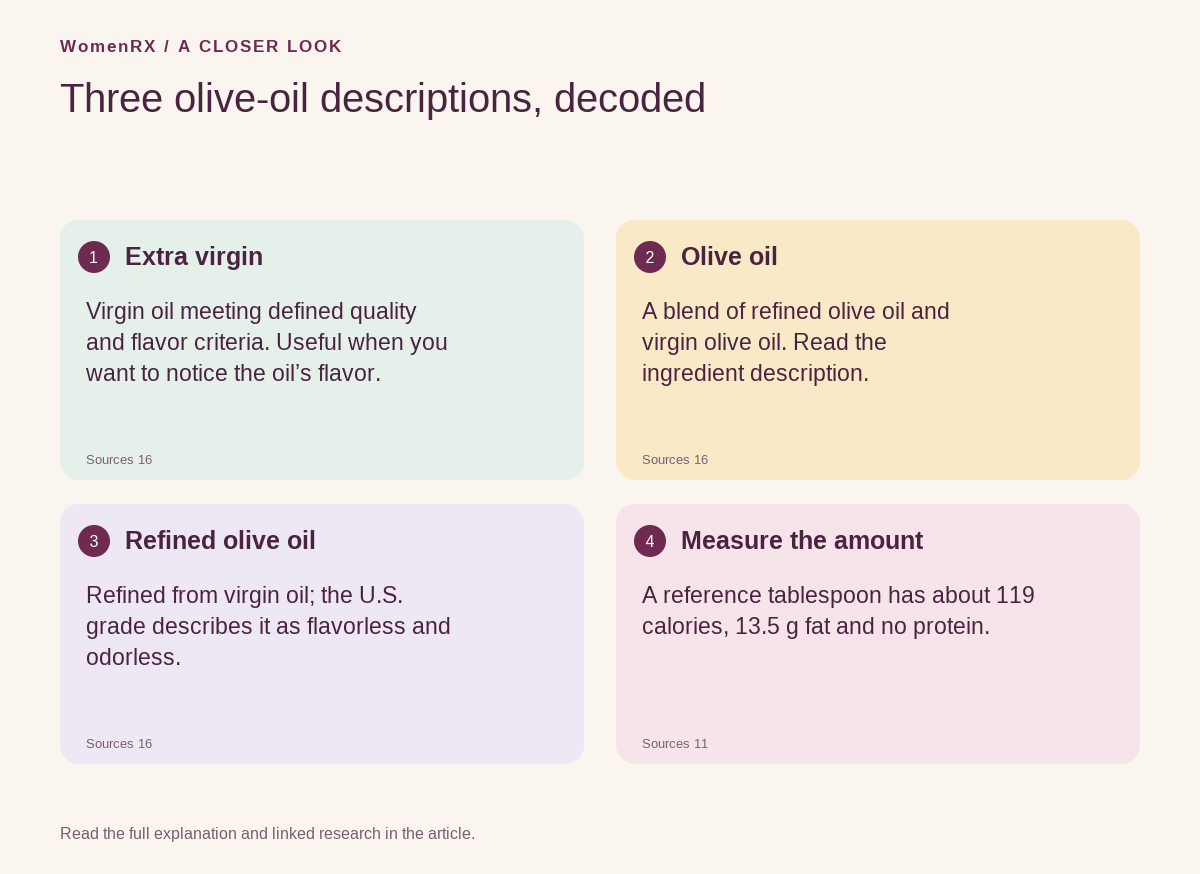
Three olive-oil descriptions, decoded
Extra virgin: Virgin oil meeting defined quality and flavor criteria. Useful when you want to notice the oil’s flavor.16
Olive oil: A blend of refined olive oil and virgin olive oil. Read the ingredient description.16
Refined olive oil: Refined from virgin oil; the U.S. grade describes it as flavorless and odorless.16
Measure the amount: A reference tablespoon has about 119 calories, 13.5 g fat and no protein.11
Read the figure as text
Category and flavor help you choose for a meal.- Extra virgin: Virgin oil meeting defined quality and flavor criteria. Useful when you want to notice the oil’s flavor.16
- Olive oil: A blend of refined olive oil and virgin olive oil. Read the ingredient description.16
- Refined olive oil: Refined from virgin oil; the U.S. grade describes it as flavorless and odorless.16
- Measure the amount: A reference tablespoon has about 119 calories, 13.5 g fat and no protein.11
Does extra-virgin olive oil have more protein than other olive oil?
No. The USDA reference entry for olive oil lists zero grams of protein per tablespoon. “Extra virgin” describes how the oil is produced, not a protein advantage. 1110
Does a high-polyphenol label guarantee a heart benefit?
No. “Extra virgin” describes production without refining; a high-polyphenol description concerns compounds measured in an oil. Even extra-virgin oils differ in measured polyphenols, and those measurements don't establish what a particular bottle will do for your heart. A clinical trial of high-phenolic extra-virgin olive oil cautioned against extending its findings to other olive varieties without further study. 10413
Sources you can check
- Exploring the Nutraceutical Potential of Extra Virgin Olive Oils From Sicilian Well-Known and Lesser-Known Cultivars.Yetisgin AM, Bartolomeo G, Cicero N, Micale N, Costa R, Cristani M. · Chemistry & biodiversity · 2026Return to first citation
- Impact of Olive Oil Fatty Acids and Bioactive Compounds on Cognitive Function in Adults: A Systematic Review.Kanaan A, Papaneophytou C, Andreou EP. · Foods (Basel, Switzerland) · 2026Return to first citation
- Advances in Nanotechnological Strategies for Preserving and Authenticating Bioactive Compounds in Extra Virgin Olive Oil: Nano-Enabled Stabilization, Sensing, and Circular Valorization.Vega Baudrit JR, Corrales-Ureña Y, Jaimes Merazzo K, Chinchilla Orrego JS, Lopretti M. · Foods (Basel, Switzerland) · 2026Return to first citation
- Statistical and Multivariate Evaluation of Olive Oil Degradation During Long-Term Storage.Almeida ES, Silva DF, de Oliveira NS, Fernandes JS, Oliveira BCS, Monteiro S, Almeida FV, Braga JWB, Dias ACB. · Foods (Basel, Switzerland) · 2025Return to first citation
- USDA SR Legacy: Oil, olive, salad or cooking (FDC 171413)Accessed 2026-09-25Return to first citation
- Effects of olive oil and flaxseed consumption in a healthy diet on endothelial function, plasma lipids and inflammatory factors of patients with coronary heart disease: a randomized clinical trial.Khandouzi N, Zahedmehr A, Asadian S, Nasrollahzadeh J. · Coronary artery disease · 2023Return to first citation
- Effects of High-Phenolic Extra Virgin Olive Oil (EVOO) on the Lipid Profile of Patients with Hyperlipidemia: A Randomized Clinical Trial.Kourek C, Makaris E, Magiatis P, Zouganeli V, Benetou V, Briasoulis A, Xanthopoulos A, Paraskevaidis I, Melliou E, Koudounis G, Orfanos P. · Nutrients · 2025Return to first citation
- Mediterranean diet enriched with olive oil shows no consistent benefits on cardiometabolic and anthropometric parameters: a systematic review with meta-analysis of randomized controlled trials.Keshani M, Sadeghi N, Tehrani SD, Ahmadi AR, Sharma M. · European journal of nutrition · 2024Return to first citation
- USDA: Olive Oil and Olive-Pomace Oil GradesAccessed 2026-09-26Return to first citation