IBS Treatment Choices Depend on Your Symptoms
IBS care starts with checking the cause of your symptoms, then choosing options for the bowel pattern and discomfort affecting you most.
IBS can involve abdominal pain, bloating, diarrhea, constipation, or a mix that changes over time. A clinician can assess the pattern and consider tests for other causes before calling it IBS. Treatment then depends on what’s most disruptive: diarrhea, constipation, pain, or several symptoms together. No single diet or medicine fits everyone. 124
First, make sure IBS fits
IBS often involves stomach pain or cramps along with a change in bowel habits. Pain may be worse after eating and ease after a bowel movement. Bloating, sudden urges to go, straining, and a feeling that you haven’t fully emptied can also be part of the picture. Symptoms may settle and flare again, so one unusually bad day doesn’t tell the whole story. 234
There isn’t one test that confirms IBS. A clinician will ask what your symptoms are, when they happen, how often they return, and how long they’ve been going on. Depending on the situation, blood or stool tests may help check for other explanations, including celiac disease, infection, or inflammatory bowel disease. That’s why it’s worth getting a new or persistent pattern assessed rather than diagnosing yourself from a symptom list. 12
Some changes deserve more prompt attention instead of being put down to an IBS flare: unexplained substantial weight loss, bleeding from the rectum or bloody diarrhea, a hard lump or swelling in the abdomen, or shortness of breath with palpitations and unusually pale skin. Seek prompt medical assessment if these occur. 4
Match the option to the problem it needs to solve
A useful starting question is: What would make the biggest difference in my day? Fewer urgent trips to the bathroom? Less straining? Less pain even on days when bowel movements seem manageable? IBS treatments don’t all target the same thing, and bowel habits can shift over time. 45
When diarrhea or urgency leads: Loperamide is one medication option in the American Gastroenterological Association’s IBS-with-diarrhea guideline, but its recommendation is conditional and the certainty of evidence is very low. Other medicines the guideline conditionally recommends include rifaximin, eluxadoline, alosetron, certain tricyclic antidepressants, and antispasmodics. They aren’t interchangeable: the choice calls for a discussion of the symptoms you want to improve and the potential downsides of a particular medicine. 6
For example, eluxadoline was studied in placebo-controlled IBS-diarrhea trials using improvement in both abdominal pain and stool consistency as an outcome. A review found benefits for several IBS-diarrhea symptoms but also identified constipation, vomiting, and abdominal pain among its adverse effects. That makes it a different conversation from simply trying to slow a loose stool. 57
When constipation leads: If constipation comes with troublesome abdominal pain, ask about treatments studied for both problems rather than assuming that making a bowel movement easier will address everything. A systematic review of nine randomized trials involving 5,718 people with IBS and constipation found that linaclotide and plecanatide improved combined pain-and-constipation outcomes compared with placebo. Diarrhea occurred more often with these medicines, a meaningful tradeoff if your bowel pattern sometimes swings the other way. The review did not establish which of the two is better in a direct comparison. 8
When bowel habits alternate: A fixed “diarrhea plan” or “constipation plan” may be a poor fit if either extreme regularly follows the other. Describe the pattern, including what happens to your pain and bloating when stools change, so treatment can focus on your current burden without losing sight of the swings. This is a way to organize the conversation, not a diagnosis you have to make yourself. 245
When pain and bloating are the hardest part: Say so plainly. IBS has been linked to increased sensitivity in the gut as well as changes in how quickly food passes through it; a painful day isn’t always explained by the number of bowel movements you’ve had. Diet changes, stress management, and medicines are among approaches used to manage IBS, but that doesn’t mean you need to start every approach at once. Ask which option is meant to help the symptom that troubles you most and how you’ll tell whether it’s helping. 236
If symptoms change around your period
If you notice a possible pattern, record abdominal pain, bloating, and stool changes alongside the dates of your period for a while. For example, note whether loose stools occur only around bleeding or remain a problem throughout the month. That comparison can make your description more precise; it can’t, by itself, prove that a symptom is caused by your cycle or confirm IBS. 14
Women are not a single treatment-response group. A planned subgroup analysis of placebo-controlled eluxadoline trials included women and men and found higher rates of its combined pain-and-stool response than placebo across the reported sex subgroups. That finding doesn’t establish that this medicine is the right choice for an individual woman, or that IBS treatments in general work differently by sex. Choose based on your symptoms and the evidence and tradeoffs for the particular option under discussion. 56
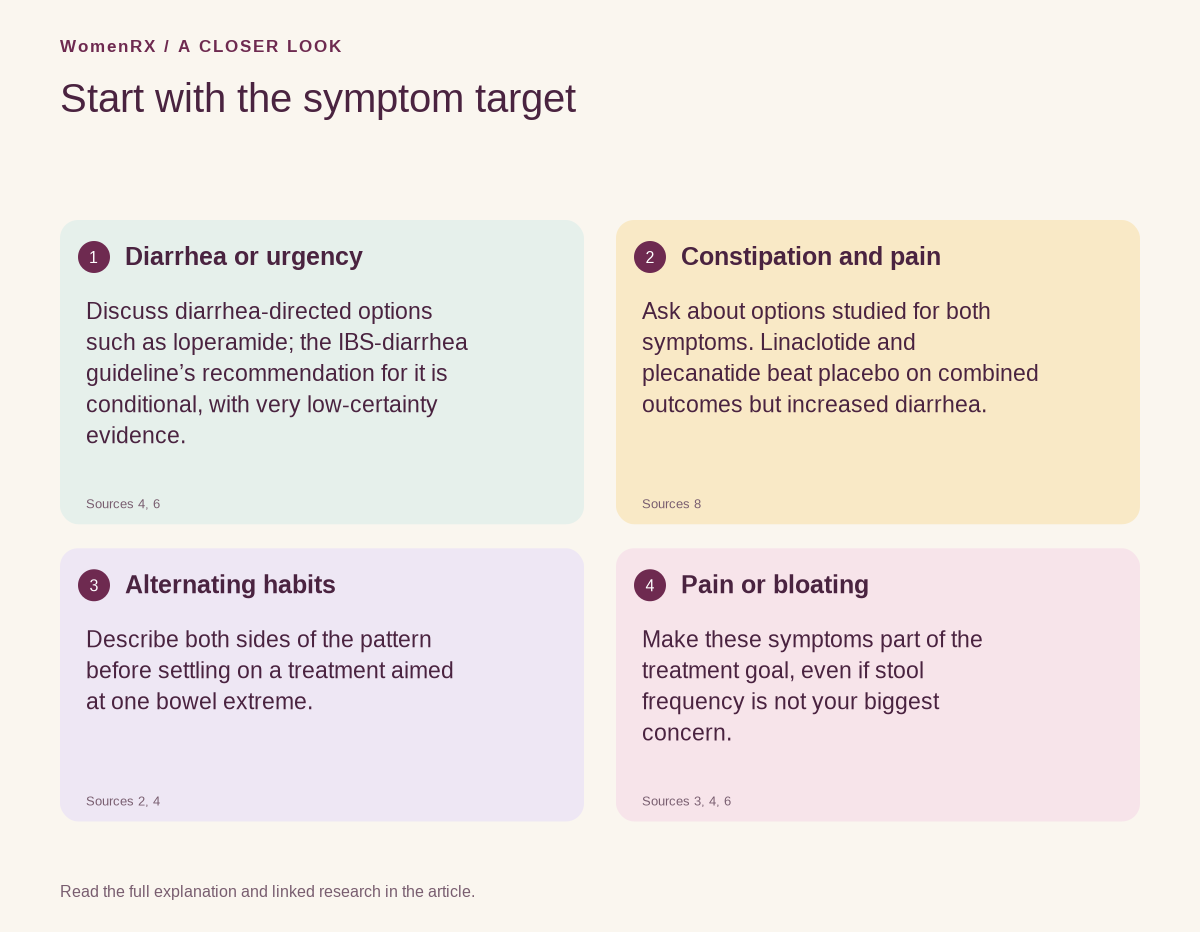
Start with the symptom target
Diarrhea or urgency: Discuss diarrhea-directed options such as loperamide; the IBS-diarrhea guideline’s recommendation for it is conditional, with very low-certainty evidence.46
Constipation and pain: Ask about options studied for both symptoms. Linaclotide and plecanatide beat placebo on combined outcomes but increased diarrhea.8
Alternating habits: Describe both sides of the pattern before settling on a treatment aimed at one bowel extreme.24
Pain or bloating: Make these symptoms part of the treatment goal, even if stool frequency is not your biggest concern.346
Read the figure as text
The comparison separates bowel pattern from the symptom a treatment discussion needs to address.- Diarrhea or urgency: Discuss diarrhea-directed options such as loperamide; the IBS-diarrhea guideline’s recommendation for it is conditional, with very low-certainty evidence.46
- Constipation and pain: Ask about options studied for both symptoms. Linaclotide and plecanatide beat placebo on combined outcomes but increased diarrhea.8
- Alternating habits: Describe both sides of the pattern before settling on a treatment aimed at one bowel extreme.24
- Pain or bloating: Make these symptoms part of the treatment goal, even if stool frequency is not your biggest concern.346
More questions, answered
Does an IBS diagnosis always mean more tests?
No. There’s no single confirmatory IBS test. A clinician may use blood or stool tests to check for another cause, while further testing depends on how clear the diagnosis is from your symptoms and assessment. 12
Should I change my whole diet as soon as IBS is suspected?
Not necessarily. Diet changes can help some people manage IBS, but symptoms and treatment needs vary. First clarify the bowel pattern and what you’re trying to improve, especially if the diagnosis hasn’t yet been assessed. 123
Sources you can check
- Getting diagnosed with IBS (irritable bowel syndrome) - NHSAccessed 2026-09-25Return to first citation
- Irritable Bowel Syndrome | IBS | MedlinePlusAccessed 2026-09-25Return to first citation
- What is IBS (irritable bowel syndrome) - NHSAccessed 2026-09-25Return to first citation
- Symptoms of IBS (irritable bowel syndrome) - NHSAccessed 2026-09-25Return to first citation
- Impact of patient and disease characteristics on the efficacy and safety of eluxadoline for IBS-D: a subgroup analysis of phase III trials.Lacy BE, Harris LA, Chang L, Lucak S, Gutman C, Dove LS, Covington PS, Lembo A. · Therapeutic advances in gastroenterology · 2019Return to first citation
- AGA Clinical Practice Guideline on the Pharmacological Management of Irritable Bowel Syndrome With Diarrhea.Lembo A, Sultan S, Chang L, Heidelbaugh JJ, Smalley W, Verne GN. · Gastroenterology · 2022Return to first citation
- Spotlight on eluxadoline for the treatment of patients with irritable bowel syndrome with diarrhea.Fragkos KC. · Clinical and experimental gastroenterology · 2017Return to first citation
- Efficacy and safety of Guanylyl cyclase C agonists (linaclotide and plecanatide) in patients with irritable bowel syndrome with constipation: a systematic review and meta-analysis of randomized controlled trials.Zhou Z, Li Y, Tu Y, He M, Liao D, He Z, Liu Z, Li B, Zhou Z, Ai S. · Frontiers in pharmacology · 2026Return to first citation