How to Vet a Telehealth Weight-Management Program
A thoughtful program should explain who evaluates you, how follow-up works, what care costs, and what happens if the plan needs to change.
Before enrolling, check that a qualified prescriber reviews your health history and current medicines, that follow-up is scheduled rather than left to you, and that fees and cancellation terms are clear. Ask how the program handles side effects, lack of progress, pregnancy plans, breastfeeding, and needs beyond remote care. Telehealth studies are encouraging but don’t establish that every program or medication approach works equally well. 4 5
Look for care, not just a prescription
A weight-management program should start by understanding your health, not by treating a number on a screen. Ask what the initial evaluation includes: your weight history, previous approaches, other health conditions, medicines, and whether the clinician considers possible medical contributors to weight changes. A sound plan may include medication, nutrition or behavioral support, a referral, or a combination, depending on your situation. 2
Find out who makes treatment decisions and what their professional credentials are. Ask whether the clinician is licensed to provide care where you live, who answers medical questions between visits, and how you’ll reach that person if your symptoms or circumstances change. A platform’s staff, coaches, and prescribers may have different roles, so ask who is responsible for which part of your care.
A prescription should follow an individual assessment. Ask what options are being considered, why one might fit your health needs, what tradeoffs to expect, and what alternatives exist if it doesn’t suit you. If a program offers a medicine, ask for a conversation about your current medicines and relevant health conditions, not just a list of checkboxes. For example, US orlistat prescribing information describes interactions with several medicines, including cyclosporine, warfarin, levothyroxine, and some antiepileptic drugs. 3
Make follow-up part of the offer
Ask how often you’ll have clinical follow-up, what information the team will review, and what happens if you report side effects or aren’t seeing the expected benefit. Find out whether you can speak with a clinician, whether appointments are video or messaging-based, and when the program would arrange an in-person evaluation or referral. Telehealth can make it easier to receive care from home, but technology problems and gaps in the clinician’s access to your full medical history can complicate remote visits. 1
The research doesn’t support treating “telehealth” as one uniform intervention. In a retrospective study of 139 patients referred for intensive behavioral therapy, observed weight outcomes and loss to follow-up were similar for the in-person and telemedicine groups; the study was not a randomized test proving the approaches equivalent. 5 A separate study of a direct-to-consumer platform looked at liraglutide outcomes only 50 days after prescription, and relied on patient-reported follow-up. Neither result tells you what an individual program will deliver over time. 4
That’s why it’s reasonable to ask the program what it will do if treatment isn’t helping, causes problems, or no longer fits. Look for a specific answer about reassessment and alternatives, not a promise of a particular amount of weight loss. Medication and behavioral support may be part of care, but the right plan depends on your health and treatment goals. 2
Ask about fees, privacy, and practical details
Request the total cost in writing before you enroll. Ask what the program fee includes, whether medication and laboratory tests are separate, whether insurance is billed, and what you may owe if you stop or miss an appointment. Don’t assume a quoted monthly price covers every part of treatment.
Ask what personal and health information the program collects, who can access it, how it is stored, and whether you can review its privacy policy before signing up. Also check how you’ll get your records if you leave and whether the program can coordinate with your usual clinician, with your permission, if that’s what you want. These are practical questions to ask; the answers will depend on the service.
Bring your life stage into the conversation
If you’re pregnant, breastfeeding, planning a pregnancy, or could become pregnant, tell the prescriber before treatment decisions are made. Ask how those circumstances affect the specific plan and who you should contact if they change. For orlistat specifically, US prescribing information says weight loss during pregnancy offers no benefit and may cause fetal harm. Don’t assume one medicine’s guidance applies to another. 3
If contraception is relevant to a treatment being discussed, ask the prescriber what the current guidance is for that specific medicine. If you’re in perimenopause, ask whether the program will consider your broader health concerns and whether it can coordinate with your usual care team or refer you when remote weight-management care isn’t enough. Neither cited study reports outcomes specifically for women in perimenopause. 4 5
A useful comparison before you sign up
Compare programs on the care they actually provide, not only convenience or advertised outcomes. A strong fit is one that can describe its evaluation, follow-up, costs, privacy practices, and next steps if the first plan isn’t suitable. If the answers are vague, you can pause and ask for details before committing.
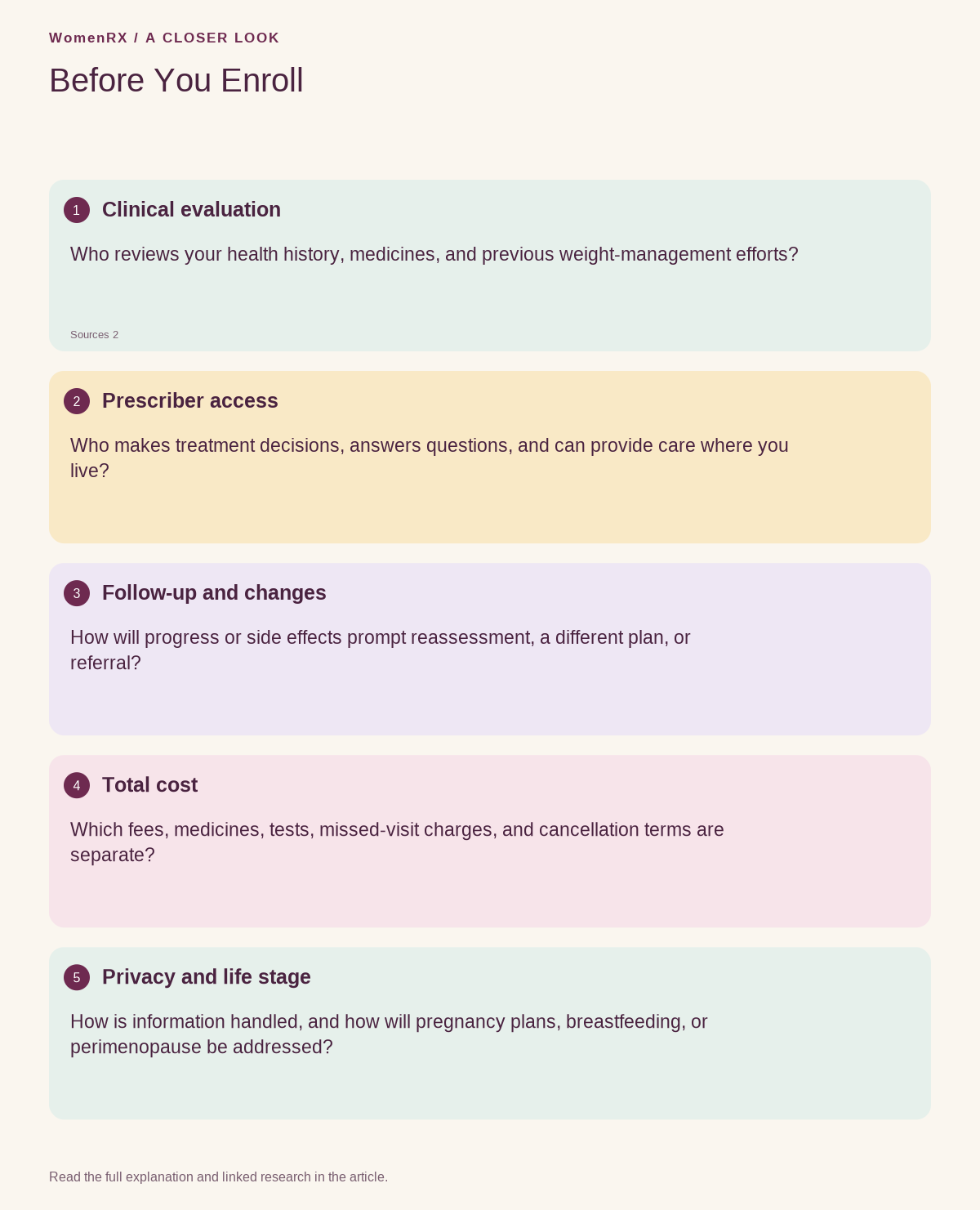
Before You Enroll
Clinical evaluation: Who reviews your health history, medicines, and previous weight-management efforts?2
Prescriber access: Who makes treatment decisions, answers questions, and can provide care where you live?
Follow-up and changes: How will progress or side effects prompt reassessment, a different plan, or referral?
Total cost: Which fees, medicines, tests, missed-visit charges, and cancellation terms are separate?
Privacy and life stage: How is information handled, and how will pregnancy plans, breastfeeding, or perimenopause be addressed?
Read the figure as text
Compare the program’s clinical process and practical terms. Ask for clear answers before committing.- Clinical evaluation: Who reviews your health history, medicines, and previous weight-management efforts?2
- Prescriber access: Who makes treatment decisions, answers questions, and can provide care where you live?
- Follow-up and changes: How will progress or side effects prompt reassessment, a different plan, or referral?
- Total cost: Which fees, medicines, tests, missed-visit charges, and cancellation terms are separate?
- Privacy and life stage: How is information handled, and how will pregnancy plans, breastfeeding, or perimenopause be addressed?
More questions, answered
Does telehealth work as well as in-person weight care?
Some studies report encouraging outcomes, but they examine particular programs and groups. One retrospective comparison of patients receiving intensive behavioral treatment found similar observed outcomes for telemedicine and in-person care, but it did not prove the approaches equivalent or predict results for every service. 5
What if a program offers orlistat?
Ask the prescriber to review your medicines and explain relevant tradeoffs. US prescribing information identifies interactions with medicines including cyclosporine, warfarin, levothyroxine, and some antiepileptic drugs; it also says orlistat should not be used for weight loss during pregnancy. 3
Sources you can check
- Telehealth: MedlinePlusAccessed 2026-09-25Return to first citation
- Obesity: MedlinePlusAccessed 2026-09-25Return to first citation
- XENICAL (ORLISTAT) CAPSULE [H2-PHARMA LLC] | US prescribing information and patient instructionsAccessed 2026-09-25Return to first citation
- GLP-1 receptor agonist therapy for obesity via direct-to-consumer telemedicine: Clinical characteristics and treatment outcomes.Gratzke M, von Bueren J, Garrahy E, Calewaert B, Abeck F, Wuelfing C. · Digital health · 2025Return to first citation
- Adoption of telemedicine for obesity treatment during the COVID-19 pandemic achieved comparable outcomes to in-person visits.Latorre-Rodríguez AR, Shah RH, Munir S, Mittal SK. · Obesity pillars · 2024Return to first citation