How to Choose an Online Weight-Management Program
Compare the care, follow-up, medication costs, and cancellation terms you’ll actually receive, not just the monthly price.
Before enrolling, ask for a written breakdown of the full cost and who provides each part of care: medical visits, behavioral coaching, medication, lab work, and follow-up. A virtual format can work for weight management, but online programs differ; look for ongoing support and clear access to a clinician, and check that the program can address your health context and life stage. 3 4
Start with what the monthly price includes
An advertised monthly fee may not cover every part of treatment. Before signing up, ask for the total expected cost and a written list of what is included, what costs extra, and what you may owe if your needs change. Don’t assume medication, clinician visits, lab work, or coaching are bundled just because they appear on the same website.
Ask for specifics: Is the first medical assessment included? Are follow-up visits included, and how often do they happen? Is behavioral support one-to-one, in a group, or through an app? Could prescriptions, lab work, or other services be billed separately? What happens to the fee if a medication is unavailable, unsuitable, or no longer part of your plan?
Also read the cancellation terms before paying. Check whether there is a minimum commitment, how to cancel, when cancellation takes effect, and whether any payment is refundable. These are questions to verify directly with the program; don’t rely on a promotional summary to answer them.
Medical care and coaching do different jobs
A coach or app may help you build routines and stay engaged. Medical care is a separate service: it means you can reach a qualified clinician who can assess your health, discuss treatment options, and follow up when your plan needs adjusting. Ask who you’ll meet, what their role is, how to contact them between visits, and what happens if you report a concern.
Behavioral support can be part of meaningful care, rather than an optional extra. A review of technology-based obesity treatment describes connection with healthcare professionals to support self-management and behavioral adherence as promising, while apps can help with self-monitoring. That doesn’t mean an app alone is equivalent to a clinician-supported program. 4
Virtual care itself isn’t a guarantee of better results, either. In a retrospective study of 1,313 participants in a structured, two-year behavioral program, switching to virtual visits was associated with higher retention; retention, rather than the delivery format, was associated with weight reduction at two years. The study examined one program during the COVID-19 period, so it can’t tell you which current online service is best. 3
If medication is part of the offer, ask what care surrounds it
Ask whether medication is optional or central to the program, who determines whether it’s appropriate for you, and what follow-up is included after treatment begins. Confirm whether the quoted fee covers the medication itself or only the care around it, and ask how the program handles side effects or a change in treatment. A prescription offer is not the same as a full plan for ongoing care.
One small study illustrates why the details matter but shouldn’t be treated as a promise. In a 24-week, single-arm study, 180 participants in a telehealth program received medication, a behavioral program tailored to long-acting obesity medications, and monitoring tools. The study reported an average weight loss of 12.3% at 24 weeks, but without a comparison group it cannot show how much of the change was due to the program or predict your result. 2
If you’re considering semaglutide and may become pregnant, raise that timing with the prescriber before starting. The Wegovy prescribing information says to discontinue it at least two months before a planned pregnancy. 1
Check whether the program fits your life
A program doesn’t need to specialize in every condition or life stage. It should be able to tell you whether it can address yours or coordinate care when it can’t. Ask directly about pregnancy planning, postpartum needs, menopause, or PCOS if any apply to you. Find out whether your medical history and current medications are part of the assessment, and whether you can continue care with your usual clinicians.
Think about the format you can realistically use, too. For example, if regular video visits are hard to fit around work or caregiving, ask whether the program offers another way to check in and how quickly a clinician responds. Evidence from virtual programs suggests that access and continued participation matter; the format alone doesn’t tell you whether a particular service will fit your schedule or needs. 3 5
A scorecard to use before you enroll
Rate each area as clear, unclear, or not offered. A lot of “unclear” answers are a reason to pause and get details in writing.
- Total cost: Do you know which visits, coaching, medication, tests, and follow-ups are included or billed separately?
- Medical access: Do you know who assesses you, who can prescribe, and how to reach the clinical team between appointments?
- Behavioral support: Is there a defined support option, and can you tell how and when you’ll use it?
- Medication follow-up: If medication is offered, is the clinical review and ongoing follow-up explained separately from its cost?
- Life-stage fit: Can the team discuss your relevant health context, including pregnancy planning, postpartum needs, menopause, or PCOS?
- Exit terms: Are the commitment, cancellation process, effective date, and refund rules easy to find?
Choose the program whose care and costs are clear enough for you to make an informed decision, not the one with the most persuasive promise.
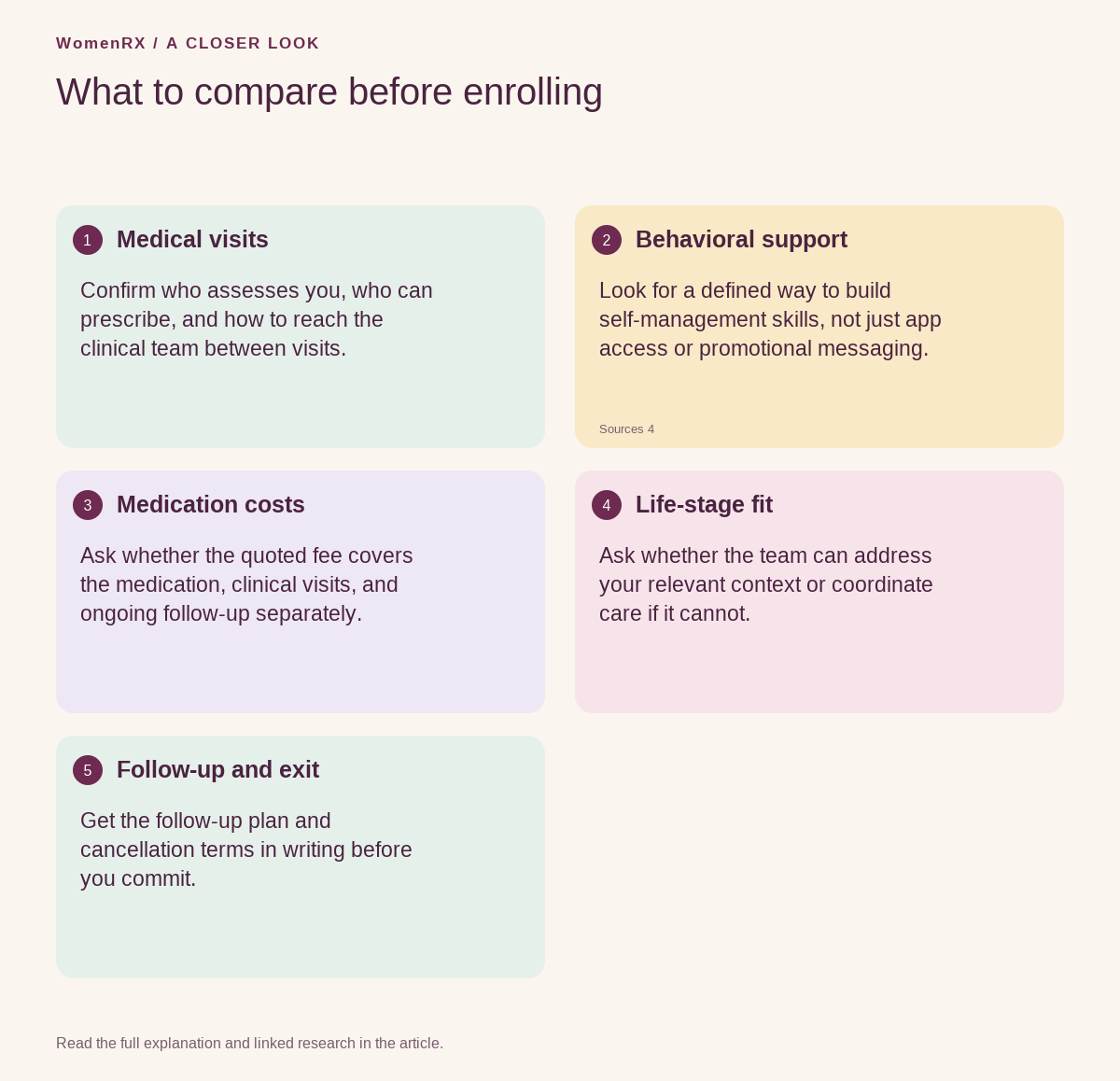
What to compare before enrolling
Medical visits: Confirm who assesses you, who can prescribe, and how to reach the clinical team between visits.
Behavioral support: Look for a defined way to build self-management skills, not just app access or promotional messaging.4
Medication costs: Ask whether the quoted fee covers the medication, clinical visits, and ongoing follow-up separately.
Life-stage fit: Ask whether the team can address your relevant context or coordinate care if it cannot.
Follow-up and exit: Get the follow-up plan and cancellation terms in writing before you commit.
Read the figure as text
Separate the practical components of a program so you can check what is included, who provides it, and what still needs an answer.- Medical visits: Confirm who assesses you, who can prescribe, and how to reach the clinical team between visits.
- Behavioral support: Look for a defined way to build self-management skills, not just app access or promotional messaging.4
- Medication costs: Ask whether the quoted fee covers the medication, clinical visits, and ongoing follow-up separately.
- Life-stage fit: Ask whether the team can address your relevant context or coordinate care if it cannot.
- Follow-up and exit: Get the follow-up plan and cancellation terms in writing before you commit.
More questions, answered
How can I tell whether medication is included in the price?
Ask the program to separate the cost of the medication from the cost of visits and follow-up, and to explain what happens if your treatment plan changes. Don’t assume a medication mentioned in an advertisement is included in the membership fee.
Should an online program be able to support every condition or life stage?
Not necessarily. Ask whether it can address the health context that matters to you or coordinate with your existing care team. If you may become pregnant and are considering Wegovy, discuss timing with the prescriber; its prescribing information says to discontinue it at least two months before a planned pregnancy. 1
Sources you can check
- WEGOVY (SEMAGLUTIDE) INJECTION, SOLUTION WEGOVY (SEMAGLUTIDE) TABLET [NOVO NORDISK PHARMACEUTICAL INDUSTRIES, LP] | US prescribing information and patient instructionsAccessed 2026-09-25Return to first citation
- Effectiveness of Telemedicine Prescribing and a Long-Acting Obesity Medication Behavioral Program: A 24-Week Single-Arm Study.Heinberg LJ, Lee AM, Foster GD, DiVita A, Allman M, Rotroff D, Dargham CB, Cardel MI. · Obesity (Silver Spring, Md.) · 2026Return to first citation
- Retention and weight outcomes after transitioning an intensive behavioral weight management program from an in-person to a virtual format.Rothberg AE, Marriott DJ, Miller NM, Herman WH. · Obesity science & practice · 2023Return to first citation
- Can Mobile Health Applications, Social Media, and Telemedicine Assist with Obesity Treatment?Ames GE, Koball AM, Grothe K. · Current obesity reports · 2025Return to first citation
- Adoption of telemedicine for obesity treatment during the COVID-19 pandemic achieved comparable outcomes to in-person visits.Latorre-Rodríguez AR, Shah RH, Munir S, Mittal SK. · Obesity pillars · 2024Return to first citation