How to Read the Obesity-Drug Pipeline
A promising trial result is a research milestone, not a promise that a medicine will become a routine treatment.
Start by separating medicines approved for weight management from those still being studied. A 2026 clinical trial report identifies tirzepatide as an approved non-semaglutide option for eligible adults. Retatrutide was described as a phase 3 candidate in a 2025 review; TERN-601 reached phase 2, but its development was discontinued after liver-safety findings. Trial stages are dated research updates, not prescribing recommendations. 3 4

Start with the distinction that matters
If you’re looking beyond semaglutide, think of the obesity-medicine pipeline as a research tracker, not a list of what you can ask to be prescribed next. A clinical trial can show that a candidate deserves further study. It does not by itself establish that the medicine is approved for routine use, or that it will eventually be approved.
That distinction matters because drugs that act on related appetite and metabolic pathways can still differ in evidence, safety, and approved use. A systematic review published in 2025 examined phase 2 and phase 3 studies identified through searches covering 2012-2024. It described multiple medicines and combinations in development, while noting that longer-term evidence and research in underrepresented populations remained needs. Its findings are a dated research snapshot, not a live list of current treatment availability. 3
Track four things for every candidate
A useful tracker can fit on one page. Give each medicine a row, then record these four details:
- Mechanism: What targets does it act on? For example, retatrutide targets GLP-1, GIP, and glucagon receptors. That describes its design, not proof that it works better for a particular person. 5
- Evidence stage: Is the evidence from an early study, a phase 2 trial, or a phase 3 program? Note when that status was reported and whether the cited result was published. A phase label describes where research was, not whether the medicine is available for routine care. 3
- Who was studied: Record the study’s population, duration, and comparison group. Don’t assume results in adults with overweight or obesity automatically answer questions for every age group or life stage.
- What remains unanswered: Look for longer-term safety and effectiveness, weight maintenance, and outcomes that matter beyond weight. For a women-focused read, check whether enrollment and results are reported by sex, and whether the study addresses pregnancy or life stages such as menopause. Don’t infer a women-specific effect from a drug’s mechanism or from an overall trial result.
The comparison below places approved uses, a dated phase 3 research stage, and a discontinued candidate side by side. Each row identifies a drug’s target, the population described, and a question worth keeping in view. Trial stages can change; these are not live status updates. 1 2 3 4 5
For example, a 2024 review described retatrutide as a triple-receptor agonist and reported that a phase 3 trial had started. A separate 2025 systematic review also listed retatrutide among phase 3 candidates in its review period. Those descriptions establish a research stage at that time, not a current trial update or a future approval date. Individual trial records and publications are needed to assess women’s enrollment and subgroup results. 3 5
A trial result can be promising and still stop
Progress through research isn’t automatic. In phase 1 and phase 2 studies of TERN-601, an oral GLP-1 receptor agonist, a 12-week phase 2 study found significantly greater mean percentage weight loss than placebo at doses of 500 mg or higher. Three participants in that phase 2 study had liver-enzyme elevations considered consistent with potential drug-induced liver injury, and the authors report that development was discontinued. The practical lesson is not that one candidate predicts what will happen to another; it’s that early efficacy results and later safety decisions are separate parts of the evidence story. 4
When you see a headline about weight loss, check the study length, comparison group, and whether the result is from an early trial or a later one. A result from one study doesn’t establish long-term weight maintenance or answer every safety question. A 2025 review specifically identified longer-term follow-up, weight maintenance, and underrepresented populations as areas needing more evidence. 3
Check the medicine and the indication
The molecule’s name alone doesn’t tell you how a product is approved for use. For example, US product information describes Wegovy use for weight reduction, while Ozempic/Rybelsus tablet information describes use for glycemic control in adults with type 2 diabetes. A product’s approved use depends on its specific labeling; don’t treat brand names or formulations as interchangeable. 1 2
There are non-semaglutide options on the approved side of the line, too. A 2026 clinical trial report identifies tirzepatide, which acts on GIP and GLP-1 receptors, among medicines FDA-approved for long-term weight management in adults with obesity or overweight with related health conditions. That approved status is different from retatrutide’s dated investigational stage and TERN-601’s discontinued development. It doesn’t, on its own, tell you whether tirzepatide is appropriate or currently obtainable for you. 3 4 5
The same boundary applies to candidates in development. A drug can be scientifically interesting, have encouraging trial results, and still not be a routine treatment option. To verify an approved indication, check current US prescribing information or FDA approval information. To verify whether a product is currently available in the US, check a separate current source for market availability; prescribing information alone doesn’t establish availability.
Pregnancy is a separate question from weight-loss effectiveness. The Wegovy prescribing information says available human data are insufficient to establish pregnancy risks and that weight loss offers no benefit during pregnancy and may cause fetal harm. That information is specific to semaglutide, not evidence about every investigational medicine. Don’t assume a pipeline candidate has established pregnancy safety because it acts on a familiar pathway. 1
Make the tracker answer your real question
Before treating a new result as a possible next step, ask: Is this still being studied, or is there an approved product for the intended use? What population and duration does the result actually cover? Were women’s enrollment and sex-specific outcomes reported? Are pregnancy or menopause-related questions addressed, or simply not answered by this study? Those questions help keep a promising research update in its proper place: informative, but not a prediction or prescribing recommendation.
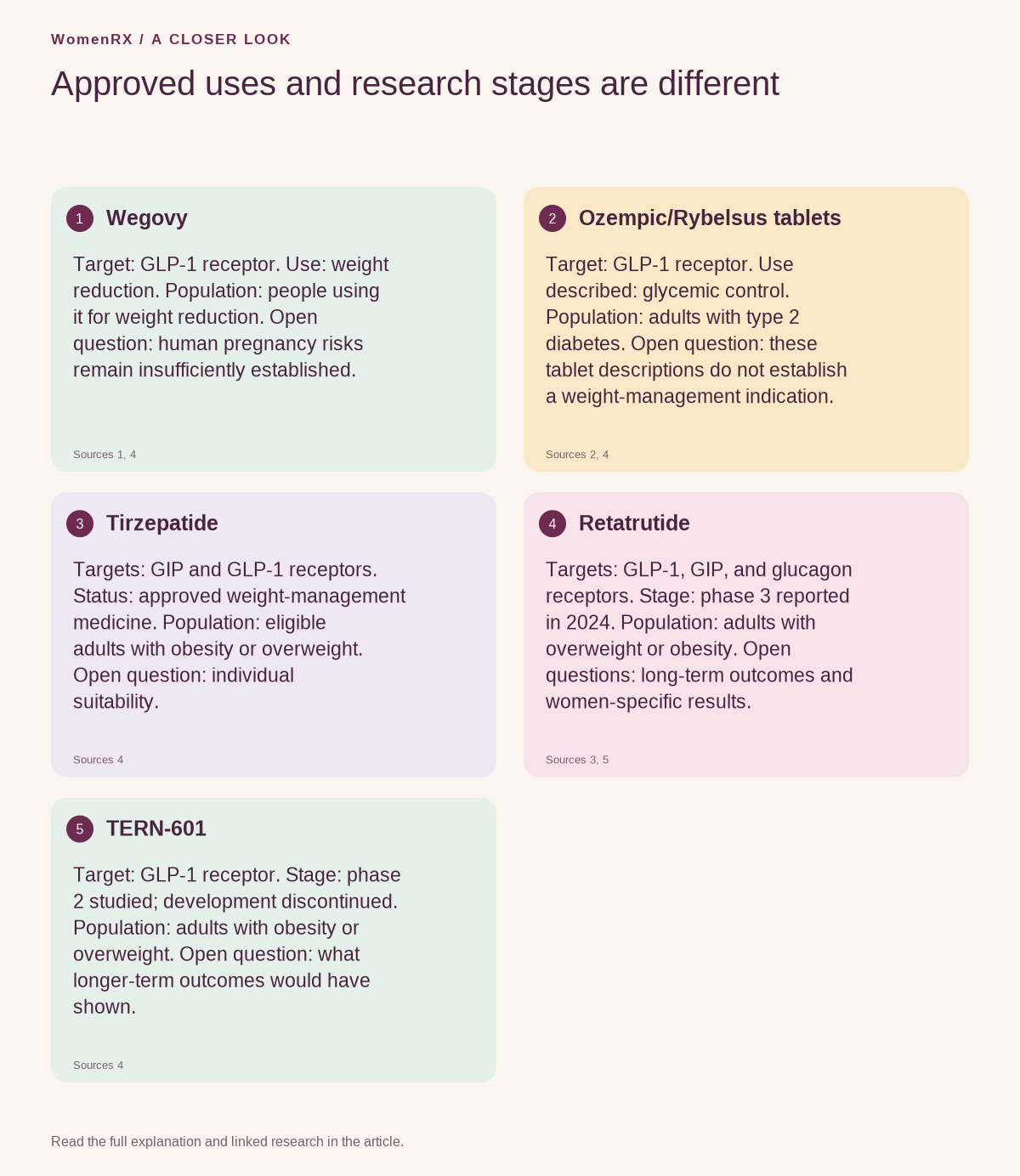
Approved uses and research stages are different
Wegovy: Target: GLP-1 receptor. Use: weight reduction. Population: people using it for weight reduction. Open question: human pregnancy risks remain insufficiently established.14
Ozempic/Rybelsus tablets: Target: GLP-1 receptor. Use described: glycemic control. Population: adults with type 2 diabetes. Open question: these tablet descriptions do not establish a weight-management indication.24
Tirzepatide: Targets: GIP and GLP-1 receptors. Status: approved weight-management medicine. Population: eligible adults with obesity or overweight. Open question: individual suitability.4
Retatrutide: Targets: GLP-1, GIP, and glucagon receptors. Stage: phase 3 reported in 2024. Population: adults with overweight or obesity. Open questions: long-term outcomes and women-specific results.35
TERN-601: Target: GLP-1 receptor. Stage: phase 2 studied; development discontinued. Population: adults with obesity or overweight. Open question: what longer-term outcomes would have shown.4
Read the figure as text
Read each row for the drug’s target, its approved use or dated research stage, the population described, and an open question.- Wegovy: Target: GLP-1 receptor. Use: weight reduction. Population: people using it for weight reduction. Open question: human pregnancy risks remain insufficiently established.14
- Ozempic/Rybelsus tablets: Target: GLP-1 receptor. Use described: glycemic control. Population: adults with type 2 diabetes. Open question: these tablet descriptions do not establish a weight-management indication.24
- Tirzepatide: Targets: GIP and GLP-1 receptors. Status: approved weight-management medicine. Population: eligible adults with obesity or overweight. Open question: individual suitability.4
- Retatrutide: Targets: GLP-1, GIP, and glucagon receptors. Stage: phase 3 reported in 2024. Population: adults with overweight or obesity. Open questions: long-term outcomes and women-specific results.35
- TERN-601: Target: GLP-1 receptor. Stage: phase 2 studied; development discontinued. Population: adults with obesity or overweight. Open question: what longer-term outcomes would have shown.4
More questions, answered
Does a phase 3 trial mean a medicine is nearly available?
No. Phase 3 is still clinical research. A phase 3 label does not mean the medicine is approved or that it will become a routine treatment. Check current product information for approved uses.
Can I assume results apply to women if women were included?
Not necessarily. Inclusion and reporting are different questions. Check the trial record or paper for who enrolled and whether outcomes were analyzed by sex. An overall result alone does not establish a women-specific effect.
Sources you can check
- WEGOVY (SEMAGLUTIDE) INJECTION, SOLUTION WEGOVY (SEMAGLUTIDE) TABLET [NOVO NORDISK PHARMACEUTICAL INDUSTRIES, LP] | US prescribing information and patient instructionsAccessed 2026-09-25Return to first citation
- OZEMPIC (ORAL SEMAGLUTIDE) TABLET RYBELSUS (ORAL SEMAGLUTIDE) TABLET [NOVO NORDISK PHARMACEUTICAL INDUSTRIES, LP] | US prescribing information and patient instructionsAccessed 2026-09-25Return to first citation
- Emerging pharmacotherapies for obesity: A systematic review.Kokkorakis M, Chakhtoura M, Rhayem C, Al Rifai J, Ghezzawi M, Valenzuela-Vallejo L, Mantzoros CS. · Pharmacological reviews · 2025Return to first citation
- Oral GLP-1RA TERN-601 for Adults With Obesity/Overweight: Placebo-Controlled, Multiple-Ascending-Dose, Phase 1 and 2 Studies.Garvey WT, Rosenstock J, Bays HE, Denham D, Kohli A, Haines M, Jones C, Kwan E, Castelloe E, Marmon T, Kuriakose E, Nelson C. · Obesity (Silver Spring, Md.) · 2026Return to first citation
- A review of an investigational drug retatrutide, a novel triple agonist agent for the treatment of obesity.Kaur M, Misra S. · European journal of clinical pharmacology · 2024Return to first citation