How to Inject US Zepbound or Mounjaro Safely
For US Zepbound and Mounjaro, the injection steps depend on whether you have a single-dose pen, a KwikPen, or a vial.
For US Zepbound or Mounjaro, first identify whether you have a single-dose pen, a multi-dose KwikPen, a single-dose vial, or a multi-dose vial. Follow the official Instructions for Use for that exact presentation and the technique you were shown; preparation, dose checks, and disposal differ. If you have another brand or a product from another country, use its own official instructions instead. 12
For US Zepbound and Mounjaro, tirzepatide is injected under the skin once a week, but there isn't one set of steps that works for every package. Each product has instructions for several presentations. The steps below cover those US presentations, not other tirzepatide brands or products from other countries. For those, follow the official Instructions for Use that came with your product. If your prescription changes from one presentation to another, get a demonstration for the new one before using it. In particular, a single-dose pen does not need the needle attachment and priming steps used with a KwikPen. 12
Before you start: identify and check your product
Read the name, strength, expiration date, and presentation on the label. The medicine should be clear and colorless to slightly yellow, without cloudiness or particles. Don't use a damaged device or medicine that has frozen. Wash your hands. Have the supplies listed in your Instructions for Use ready, including a sharps container where required. A vial needs a separate needle and syringe; a KwikPen needs a compatible new pen needle. 12
You or another person can inject into your abdomen or thigh. Another person should give an injection in the back of your upper arm. Choose a different injection spot for each dose, even if you stay within the same general area. If you use a vial, its instructions also say to avoid skin that is tender, bruised, scaly, hard, scarred, damaged, pitted, thickened, or lumpy. 12
If you have a single-dose pen
Keep the gray base cap on while you check the pen and choose your site. When you're ready, make sure the pen is locked, pull the gray cap straight off, and don't replace it or touch the needle. Place the clear base flat against your skin, then turn the lock ring to unlock it. Press the purple button and hold the pen in place for up to 10 seconds. The first loud click means the injection has started; the second means it has finished. Check that the gray plunger is visible before putting the used pen directly into a sharps container. These are steps for the single-dose pen, not the KwikPen. 12
If you have a multi-dose KwikPen
The KwikPen contains multiple weekly doses and uses a new, compatible pen needle for each injection. Remove the pen cap, wipe the red inner seal with an alcohol swab, and attach the new needle as shown in your Instructions for Use. Remove and keep the outer needle shield, then remove the inner shield. Prime the pen before each weekly injection: slowly turn the dose knob until you hear two clicks and the extended line is in the dose window. Hold the pen with its needle pointing up and gently tap the cartridge holder. Push the dose knob in until it stops, slowly count to five while holding it, and check for a drop of medicine at the needle tip. This priming step releases medicine into the air, not into your body. If no drop appears, follow the limited retry and needle-change steps in the illustrated KwikPen instructions rather than guessing. 12
After priming, follow the illustrated dose-window symbols in your own Instructions for Use: turn the dose knob all the way until it stops and the specified dose symbol appears. Don't select a dose by counting clicks. Insert the needle, push the dose knob in until it stops, and slowly count to five while holding it. Confirm the specified symbol is in the dose window before removing the needle. 12
Afterward, use the outer needle shield as directed to remove the needle, put the needle in a sharps container, and replace the pen cap. Don't store the pen with a needle attached. Don't share it, draw leftover medicine out with a syringe, or try to inject medicine remaining after its four scheduled doses. 12
If you have a vial
Check whether its label says single-dose or multi-dose. Both require a separate, appropriate syringe and a new needle and syringe for every injection. Their Instructions for Use show how to clean the stopper, draw air into the syringe, inject that air into the vial, turn the vial upside down, draw up the medicine, and clear bubbles before measuring the dose. The measured volume differs: the single-dose vial instructions specify 0.5 mL, while the multi-dose vial instructions specify 0.6 mL. Don't use one vial's measurement for the other. Have the person training you check that you can read the markings on your recommended syringe. 12
Inject the measured dose under the skin as you were shown. The vial instructions say to keep the needle in your skin for at least five seconds after pushing the plunger down. Don't recap the used needle; put it and the syringe in a sharps container right away. Throw away a single-dose vial after use, even if medicine remains. A multi-dose vial has different instructions for use and disposal, so keep its own leaflet handy. 12
If something doesn't go as expected
A small drop of blood after an injection can happen. Press gently with gauze or cotton; don't rub. If the single-dose pen's gray plunger isn't visible, its instructions say to store the pen safely to prevent a needle stick and contact Lilly for further instructions. If you aren't sure you received a full KwikPen dose, don't start over or repeat the injection; follow its troubleshooting instructions and ask for help. Don't guess at another dose because a device looked or sounded different than expected. 12
If you're pregnant, planning a pregnancy, or breastfeeding, review the medicine itself with your prescriber. This doesn't change where you inject, but it can change the treatment decision. Zepbound's instructions say to stop it when pregnancy is recognized; Mounjaro's pregnancy information calls for weighing potential benefit against potential fetal risk, including the risks of poorly controlled diabetes. For breastfeeding, tirzepatide was undetectable or low in milk samples in a small single-dose study, but its effects on a breastfed infant and milk production are unknown. 12
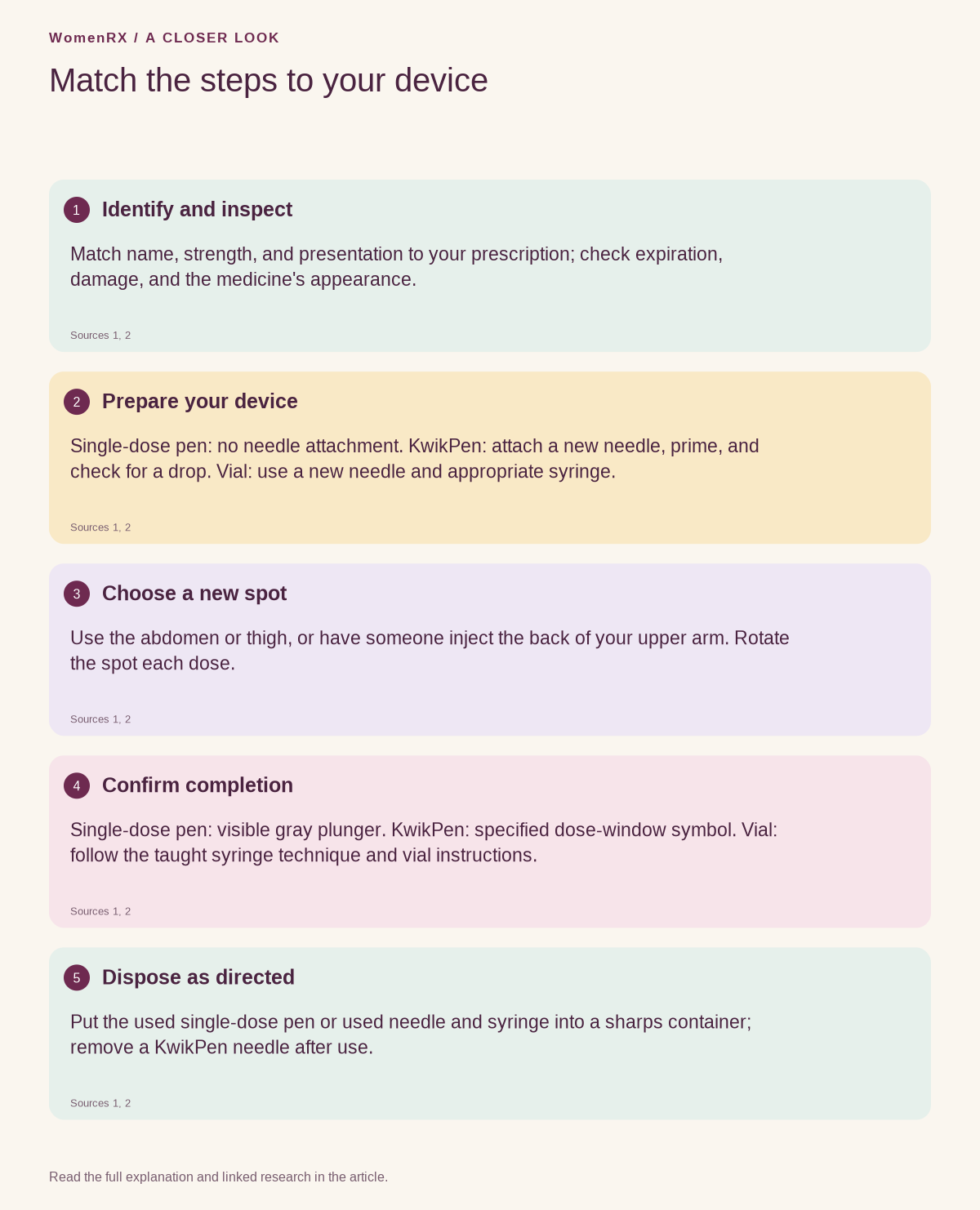
Match the steps to your device
Identify and inspect: Match name, strength, and presentation to your prescription; check expiration, damage, and the medicine's appearance.12
Prepare your device: Single-dose pen: no needle attachment. KwikPen: attach a new needle, prime, and check for a drop. Vial: use a new needle and appropriate syringe.12
Choose a new spot: Use the abdomen or thigh, or have someone inject the back of your upper arm. Rotate the spot each dose.12
Confirm completion: Single-dose pen: visible gray plunger. KwikPen: specified dose-window symbol. Vial: follow the taught syringe technique and vial instructions.12
Dispose as directed: Put the used single-dose pen or used needle and syringe into a sharps container; remove a KwikPen needle after use.12
Read the figure as text
For US Zepbound or Mounjaro, use this sequence to orient yourself, then follow the illustrated Instructions for Use for the exact product in your hand. Other products need their own official instructions.- Identify and inspect: Match name, strength, and presentation to your prescription; check expiration, damage, and the medicine's appearance.12
- Prepare your device: Single-dose pen: no needle attachment. KwikPen: attach a new needle, prime, and check for a drop. Vial: use a new needle and appropriate syringe.12
- Choose a new spot: Use the abdomen or thigh, or have someone inject the back of your upper arm. Rotate the spot each dose.12
- Confirm completion: Single-dose pen: visible gray plunger. KwikPen: specified dose-window symbol. Vial: follow the taught syringe technique and vial instructions.12
- Dispose as directed: Put the used single-dose pen or used needle and syringe into a sharps container; remove a KwikPen needle after use.12
More questions, answered
Do I have to move to a different body area each week?
No. You can use the same general area, such as your abdomen, but choose a different spot within it for each dose. Follow any more specific site directions in the Instructions for Use for your presentation. 12
Can I throw a used pen or needle in the household trash?
Not a single-dose pen or a loose needle. Put a used single-dose pen, vial needle and syringe, or KwikPen needle in a sharps container as its instructions direct. After removing its needle, a used KwikPen may be discarded as directed in its own instructions. Follow local rules for disposing of a filled sharps container. 12
Sources you can check
- ZEPBOUND (TIRZEPATIDE) INJECTION, SOLUTION ZEPBOUND (TIRZEPATIDE) INJECTION, SOLUTION ZEPBOUND KWIKPEN (TIRZEPATIDE) INJECTION, SOLUTION [ELI LILLY AND COMPANY] | US prescribing information and patient instructionsAccessed 2026-09-25Return to first citation
- MOUNJARO (TIRZEPATIDE) INJECTION, SOLUTION MOUNJARO KWIKPEN (TIRZEPATIDE) INJECTION, SOLUTION [ELI LILLY AND COMPANY] | US prescribing information and patient instructionsAccessed 2026-09-25Return to first citation