How to Compare Evening Primrose Oil Labels
Compare the amount of oil with the amount of GLA, then judge each health claim by the specific symptom and life stage studied.
Start with the serving size and total evening primrose oil per serving, then check whether the label separately states gamma-linolenic acid (GLA). Those amounts aren’t interchangeable. Look for specific, verifiable testing details, but don’t treat testing as proof that the product relieves symptoms. Menopause research reports mixed results; it doesn’t establish benefits for PMS or breast pain.
Read the amounts as two separate facts
A bottle may state how many milligrams of evening primrose oil (EPO) are in a serving without stating how much GLA that serving provides. GLA is one fatty acid in the oil, not another name for the total oil amount. A study describing EPO composition reports GLA at 7-10% of the oil, while analysis of one study product found GLA made up 8.54% of its fatty-acid profile. Those figures describe composition; they don’t confirm what’s in every product or let you infer a product’s GLA amount from its front label. 1 2
When comparing labels, note the serving size, total oil per serving, and whether a separate GLA amount is stated. If the label gives only total oil, record GLA as “not stated” rather than assuming a particular amount. Don’t compare two products by capsule weight alone if their serving sizes differ.
Treat testing and symptom claims as separate questions
If a label mentions testing, look for specifics: what was tested, whether results apply to a particular batch, and whether the company identifies the tester or provides results. A vague “tested” statement gives you little to compare. Even detailed testing information addresses product checks, not whether EPO improves a symptom.
For a health claim, ask what outcome was measured, in whom, and against what comparison. A study of one product, combination, or group can’t automatically validate a different product or a different use. For example, a clinical trial of EPO combined with fish oil in women receiving breast-cancer chemotherapy measured inflammatory and nutritional outcomes. It doesn’t establish that EPO alone relieves breast pain, PMS, or menopause symptoms. 2
Keep menopause evidence in its own lane
Menopause findings are mixed, and the outcome matters. One systematic review included six randomized trials with 450 women. It reported that the average decrease in hot-flash frequency compared with control was not statistically significant, while hot-flash duration was reduced; the review rated the evidence moderate to low. 3
A separate review found lower hot-flash severity in studies lasting less than six months, but no significant difference from placebo in hot-flash frequency or duration. Its authors concluded that the evidence wasn’t strong enough for a firm conclusion. The reviews don’t point to a reliable, established effect across hot-flash outcomes. 4
That’s why a menopause claim should name the symptom it promises to help, rather than imply broad relief. And findings about hot flashes shouldn’t be used as evidence for PMS or breast pain: those are different outcomes and need studies that measure them directly. The research summarized here doesn’t establish those benefits.
A quick comparison you can use
For each product, write down: total oil per serving; GLA per serving, if stated; the exact testing details; and the specific symptom and population behind any benefit claim. If a label doesn’t provide an amount or detail, mark it “not stated.” That keeps a clear label fact separate from a marketing promise, without ranking brands or assuming that a higher oil amount means better symptom relief.
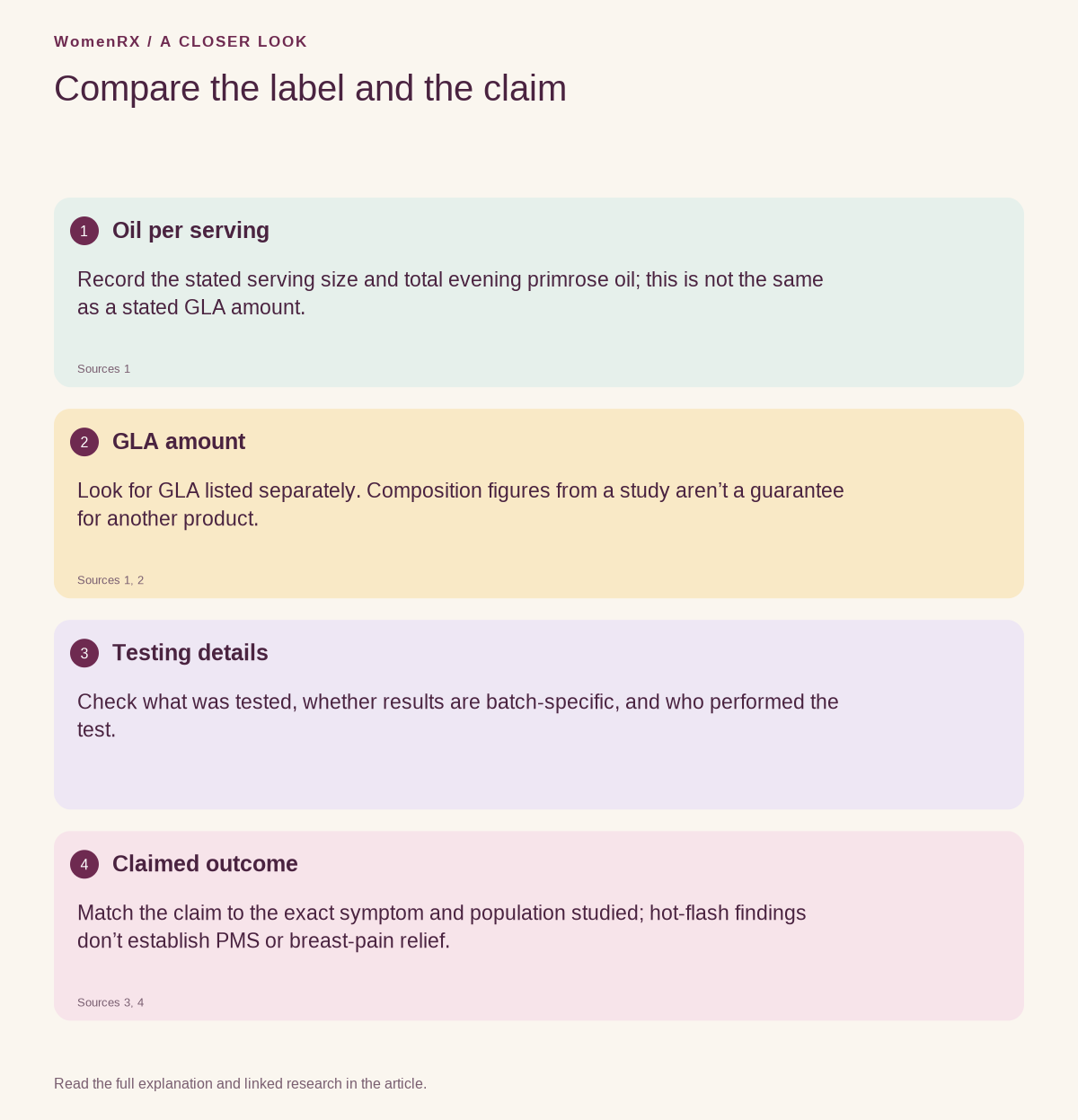
Compare the label and the claim
Oil per serving: Record the stated serving size and total evening primrose oil; this is not the same as a stated GLA amount.1
GLA amount: Look for GLA listed separately. Composition figures from a study aren’t a guarantee for another product.12
Testing details: Check what was tested, whether results are batch-specific, and who performed the test.
Claimed outcome: Match the claim to the exact symptom and population studied; hot-flash findings don’t establish PMS or breast-pain relief.34
Read the figure as text
Separate what the bottle states from what the research tested.- Oil per serving: Record the stated serving size and total evening primrose oil; this is not the same as a stated GLA amount.1
- GLA amount: Look for GLA listed separately. Composition figures from a study aren’t a guarantee for another product.12
- Testing details: Check what was tested, whether results are batch-specific, and who performed the test.
- Claimed outcome: Match the claim to the exact symptom and population studied; hot-flash findings don’t establish PMS or breast-pain relief.34
Sources you can check
- Comparison of the effect of vaginal misoprostol and evening primrose oil capsule with misoprostol alone on the consequences of abortion in women with intrauterine fetal death: a randomized clinical trial.Hashemi H, Hasanpoor-Azghady SB, Farahani M, Amiri-Farahani L. · BMC complementary medicine and therapies · 2023Return to first citation
- Anti-inflammatory effect of combining fish oil and evening primrose oil supplementation on breast cancer patients undergoing chemotherapy: a randomized placebo-controlled trial.Arsic A, Krstic P, Paunovic M, Nedovic J, Jakovljevic V, Vucic V. · Scientific reports · 2023Return to first citation
- The Effect of Evening Primrose Oil on Menopausal Symptoms Management: A Systematic Review and Meta-Analysis.Larki M, Mohammadi S, Makvandi S. · Journal of caring sciences · 2025Return to first citation
- Evening Primrose Oil for Menopause Hot Flashes: Systematic Review and Meta-Analysis.Thevi T, De S, Soe HHK. · Journal of menopausal medicine · 2024Return to first citation