Does Evening Primrose Oil Affect Body Weight?
Two human studies found no added weight benefit from evening primrose oil, but they don’t settle every setting.
In one trial, people taking evening primrose oil lost weight while receiving isotretinoin, but they lost a similar amount without the oil. Another study found no effect on BMI or resting metabolic rate. Neither finding supports using the oil for weight loss, and neither establishes that it causes weight gain. 2 5
What was measured in people
A nine-month clinical trial followed 50 people with acne who were being treated with isotretinoin. Half also took evening primrose oil. Weight and BMI went down in both groups, but the changes didn’t differ between the group taking the oil and the group not taking it. In other words, the weight loss during the study wasn’t shown to come from evening primrose oil. The trial was small and involved people taking a specific medication for acne, so it can’t settle what might happen in every setting. 2
A second trial looked at evening primrose oil and borage oil in overweight young adults with a family history of obesity. After six weeks, neither oil changed resting metabolic rate; evening primrose oil also showed no effect on BMI. Borage oil is a different product, even though it contains the same fatty acid often discussed in connection with evening primrose oil. Its results shouldn’t be treated as proof about evening primrose oil. 5
These two human studies don’t show that evening primrose oil caused weight loss or changed BMI. The isotretinoin trial’s authors also cite other reports of favorable weight-related changes, but citing those findings alone doesn’t establish a reliable weight-loss effect. Nor can these two trials rule out every possible effect of the oil on weight. 2 5
A metabolic marker isn’t the same as weight change
Evening primrose oil contains gamma-linolenic acid, or GLA. Researchers have explored whether GLA might affect metabolism, but a change in a metabolic marker doesn’t automatically mean a person will lose or gain weight. For example, a study in rats with fructose-induced metabolic syndrome reported changes in adiponectin and other biochemical measures after evening primrose oil. That’s a preclinical finding, not evidence that the oil changes body weight in women. 4
Another rat study examined evening primrose oil in the specific setting of weight gain caused by olanzapine. That kind of animal model can raise a research question, but it doesn’t establish an effect for people taking evening primrose oil on its own. 3
This distinction matters when you see weight-loss claims: a proposed mechanism, a change in a blood test, and a measured change in body weight are different kinds of evidence. The human results are limited and don’t establish that the oil is a weight-control treatment. 2 5
What about women or menopause?
Neither human trial reports a women-specific weight analysis or a menopause-specific result. One studied people with acne taking isotretinoin; the other studied overweight young adults. These findings don’t tell us whether effects differ by sex or menopausal stage, so there’s no basis for assuming the oil works differently during perimenopause or after menopause. 2 5
If you’re considering evening primrose oil, the practical takeaway is straightforward: don’t count on it to change your weight, and don’t interpret a scale change as proof that the supplement caused it. Neither human study establishes that the oil causes weight gain, either. 2 5 If your weight changes unexpectedly, there may be another explanation worth checking. 1
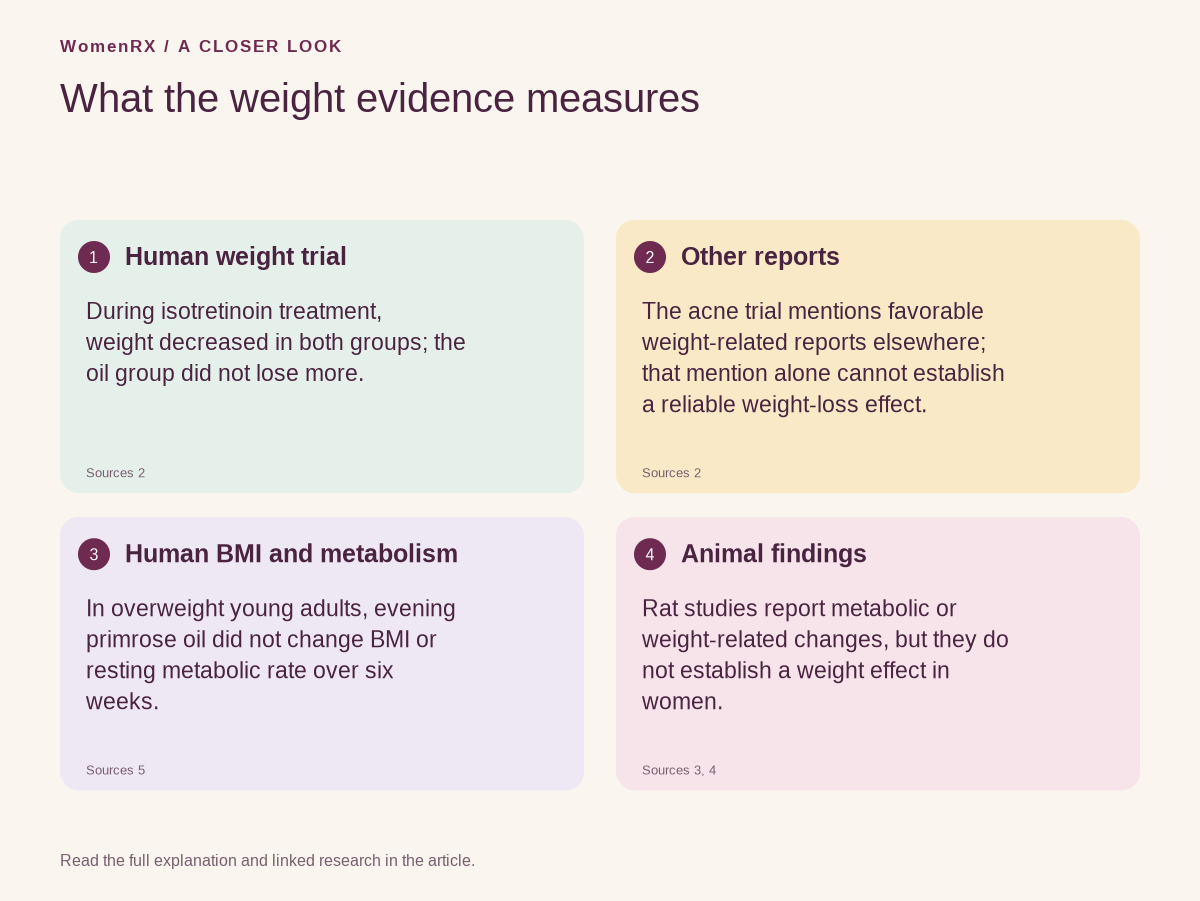
What the weight evidence measures
Human weight trial: During isotretinoin treatment, weight decreased in both groups; the oil group did not lose more.2
Other reports: The acne trial mentions favorable weight-related reports elsewhere; that mention alone cannot establish a reliable weight-loss effect.2
Human BMI and metabolism: In overweight young adults, evening primrose oil did not change BMI or resting metabolic rate over six weeks.5
Animal findings: Rat studies report metabolic or weight-related changes, but they do not establish a weight effect in women.34
Read the figure as text
A measured weight change, a metabolic marker, and an animal result answer different questions.- Human weight trial: During isotretinoin treatment, weight decreased in both groups; the oil group did not lose more.2
- Other reports: The acne trial mentions favorable weight-related reports elsewhere; that mention alone cannot establish a reliable weight-loss effect.2
- Human BMI and metabolism: In overweight young adults, evening primrose oil did not change BMI or resting metabolic rate over six weeks.5
- Animal findings: Rat studies report metabolic or weight-related changes, but they do not establish a weight effect in women.34
Sources you can check
- Body Weight: MedlinePlusAccessed 2026-09-25Return to first citation
- Effect of Evening Primrose Oil Supplementation on Selected Parameters of Skin Condition in a Group of Patients Treated with Isotretinoin-A Randomized Double-Blind Trial.Kaźmierska A, Bolesławska I, Polańska A, Dańczak-Pazdrowska A, Jagielski P, Drzymała-Czyż S, Adamski Z, Przysławski J. · Nutrients · 2022Return to first citation
- Fish oil and evening primrose oil have ameliorative effects on obesity-associated complications in olanzapine-administered rats.Abd-Allah RI, Khalil RG, Fahim HI, Abdel-Reheim ES, Abd El-Twab SM, Ahmed OM. · Obesity research & clinical practice · 2026Return to first citation
- The effect of evening primrose oil (Oenothera biennis) on the level of adiponectin and some biochemical parameters in rats with fructose induced metabolic syndrome.Mert H, İrak K, Çibuk S, Yıldırım S, Mert N. · Archives of physiology and biochemistry · 2022Return to first citation
- Borage oil intake by overweight young adults: no effect on metabolic rate; beneficial effects on plasma triglyceride and HDL cholesterol readings.DiSilvestro RA, Olivo Marston S, Zimmerman A, Joseph E, Boeh McCarty C. · Food & function · 2021Return to first citation