How to Choose a Collagen Supplement Without Guessing
Start with the result you want, then check whether a human trial tested a similar collagen product for that outcome.
For skin, some randomized trials in women found improvements in measures such as hydration, but results differ by product and by the skin outcome measured. Check the collagen source and form, the amount per serving, and whether a trial studied a similar product for your goal. A label cannot show that your product will reproduce a trial result, and this evidence does not establish a best product for women or for joints. 1 2
Choose the result before the product
Collagen supplements aren’t interchangeable just because their labels use the word “collagen.” If you’re considering one for skin, decide which result matters most to you: hydration, elasticity, or wrinkles. Those are different outcomes, and a finding for one doesn’t guarantee a change in another.
Randomized, placebo-controlled trials have tested collagen peptides for skin outcomes. In one trial, 99 healthy Japanese women ages 35-50 took one of two collagen peptide amounts or a placebo for 12 weeks. Skin water content improved and water loss through the skin decreased, but elasticity and skin thickness did not change. That’s a useful reminder to look at the exact outcome, not just a broad claim like “supports youthful skin.” 2
Other trials in women reported improvements in some skin measurements with particular products. For example, a trial of 72 women tested tuna-derived collagen peptides for eight weeks, while a trial of 85 women ages 43-65 tested collagen peptides alongside a standardized face cream for 84 days. The products and study conditions differed, so neither result proves that every collagen supplement will have the same effect. 1 4
Match the label to the evidence
Look for the collagen source, the form, and the amount in a serving. “Collagen peptides” describes collagen that has been broken down into smaller peptides. The tuna trial, for instance, studied a particular tuna-derived peptide product. A label using similar words doesn’t establish that its ingredients, composition, or results are equivalent to the product tested. 1
Also ask whether the study measured your goal. The skin trials cited here measured skin properties. They don’t establish that a product improves joint symptoms, and they don’t compare collagen types or show that a particular type is best for a particular outcome. If a product promises a joint benefit, look for a human trial that actually measured a relevant joint outcome rather than assuming skin findings apply.
A practical label check:
- Source: Is the collagen from fish, cattle, pigs, or another source? This helps you check whether it fits your preferences.
- Form: Does the label identify peptides or hydrolyzed collagen, or use a different ingredient description?
- Amount: How much collagen is in one serving? Compare it with the amount in a relevant trial, without assuming a higher amount works better.
- Other ingredients: Are added ingredients part of the product? If so, a trial of collagen alone may not tell you how the combination performs.
- Goal: Does the product’s evidence match the outcome you care about, or is it making a broader claim than the study measured?
The study amounts varied. One trial in women compared one- and five-gram daily servings for skin outcomes, and another tested a specific five-gram product with standardized skin care. These are descriptions of research, not a recommended dose or proof that one amount is best. 2 4
Use price as a comparison, not a promise
Once you’ve narrowed the options by source, form, amount, and relevant evidence, compare the cost per serving. If serving sizes differ, compare the cost for the amount you’re actually evaluating. A lower price doesn’t mean a product is less effective, and a higher price doesn’t prove it’s better. The studies don’t establish a price or brand ranking.
A supplement label can tell you what the company says is in the container. It can’t, by itself, show that the product was tested in a clinical trial or that it will produce the same result. Even when a trial is positive, its finding applies to the product and participants studied, not automatically to every product with collagen peptides.
Keep the women-specific claim in perspective
Several skin trials enrolled women, including women in different adult age ranges. That makes those findings more directly relevant to women like the participants than findings from a trial that doesn’t report sex. But the trials didn’t compare a “women’s formula” with a standard collagen product, or establish that women need a distinct formula. A women-focused label is not evidence of an added benefit. 1 2 4
The studies enrolled selected groups: one involved healthy Japanese women ages 35-50, another involved healthy women ages 43-65, and the tuna-derived collagen trial enrolled 72 women. Some trials were conducted in East Asian populations. Results may not transfer exactly to people with different health circumstances, ages, or life stages. The studies also lasted weeks to a few months, so they don’t settle what happens with longer use. 1 2 4
What to expect from the safety evidence
Some individual trials reported no adverse events during their study period. For example, one trial of a low-molecular-weight collagen peptide product reported no adverse events among its participants over the study, but a single short trial cannot establish uncommon or long-term effects for all collagen supplements. 3 5
For a sensible comparison, check the source and the full ingredient list, and don’t treat “clinically studied” as a guarantee that the product on the shelf matches the product in the trial. If the label or marketing makes a claim about hair, joints, or a women-specific advantage, look for direct human evidence for that exact outcome before paying extra.
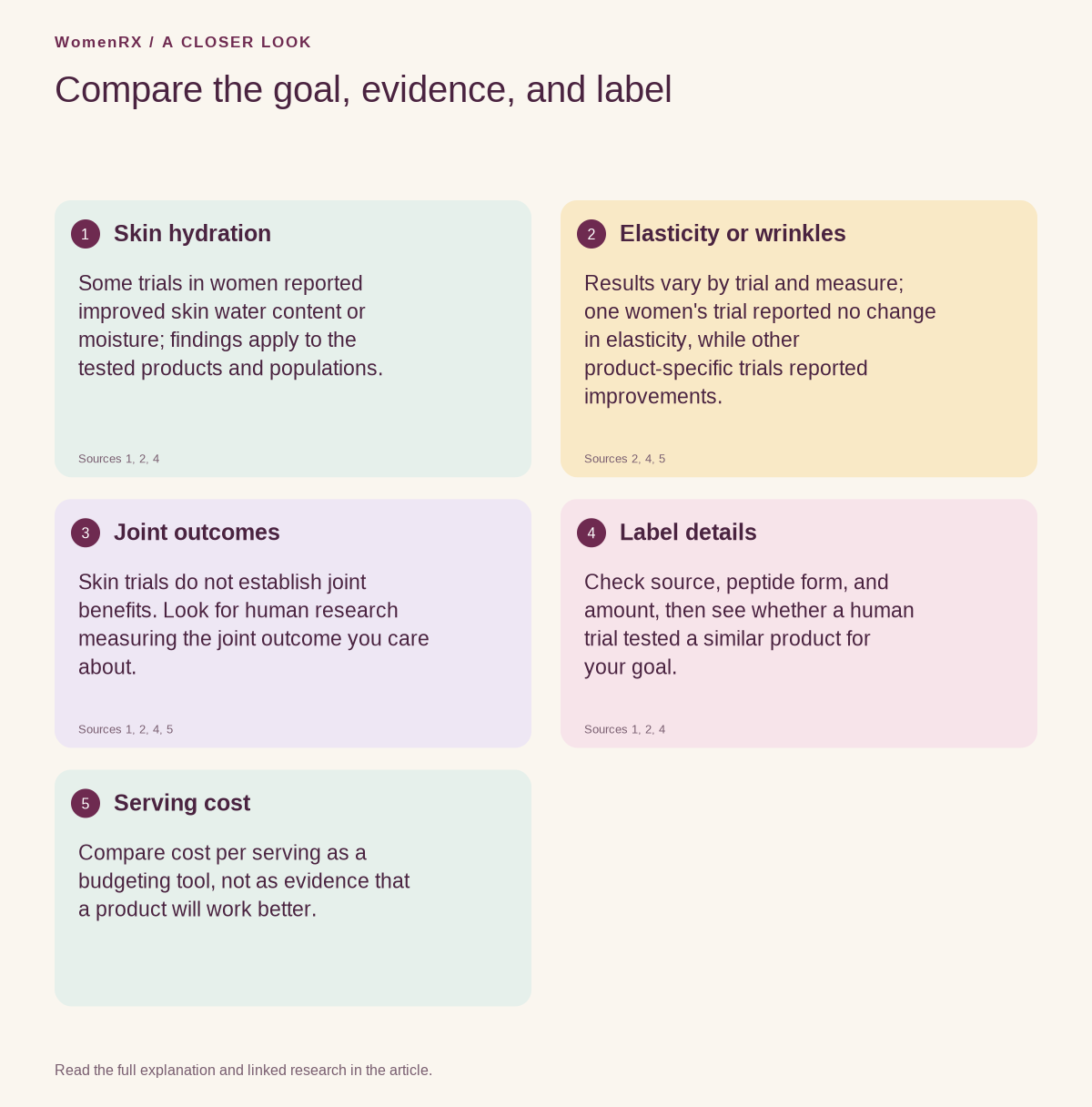
Compare the goal, evidence, and label
Skin hydration: Some trials in women reported improved skin water content or moisture; findings apply to the tested products and populations.124
Elasticity or wrinkles: Results vary by trial and measure; one women's trial reported no change in elasticity, while other product-specific trials reported improvements.245
Joint outcomes: Skin trials do not establish joint benefits. Look for human research measuring the joint outcome you care about.1245
Label details: Check source, peptide form, and amount, then see whether a human trial tested a similar product for your goal.124
Serving cost: Compare cost per serving as a budgeting tool, not as evidence that a product will work better.
Read the figure as text
Use this comparison to separate what a collagen label identifies from what a human trial actually tested.- Skin hydration: Some trials in women reported improved skin water content or moisture; findings apply to the tested products and populations.124
- Elasticity or wrinkles: Results vary by trial and measure; one women's trial reported no change in elasticity, while other product-specific trials reported improvements.245
- Joint outcomes: Skin trials do not establish joint benefits. Look for human research measuring the joint outcome you care about.1245
- Label details: Check source, peptide form, and amount, then see whether a human trial tested a similar product for your goal.124
- Serving cost: Compare cost per serving as a budgeting tool, not as evidence that a product will work better.
More questions, answered
Does skin research show that collagen supplements help joints?
No. Skin hydration, elasticity, and wrinkle measurements don’t establish a joint benefit. The trials discussed here studied skin outcomes, so a joint claim needs relevant human research of its own.
Do women need a collagen formula made specifically for women?
The cited trials include women, but they don’t compare women-specific formulas with other collagen products. A women-focused label alone doesn’t show that the formula works better. 1 2 4
Sources you can check
- The evidence from in vitro primary fibroblasts and a randomized, double-blind, placebo-controlled clinical trial of tuna collagen peptides intake on skin health.Morakul B, Teeranachaideekul V, Wongrakpanich A, Leanpolchareanchai J. · Journal of cosmetic dermatology · 2024Return to first citation
- Oral Supplementation of Collagen Peptides Improves Skin Hydration by Increasing the Natural Moisturizing Factor Content in the Stratum Corneum: A Randomized, Double-Blind, Placebo-Controlled Clinical Trial.Miyanaga M, Uchiyama T, Motoyama A, Ochiai N, Ueda O, Ogo M. · Skin pharmacology and physiology · 2021Return to first citation
- Skin Anti-Aging and Moisturizing Effects of Low-Molecular-Weight Collagen Peptide Supplementation in Healthy Adults: A Randomized, Double-Blind, Placebo-Controlled Clinical Trial.Lee E, Ahn DK, Kim JH, Lee S, Kim HJ, Lee HK, Shin JH. · Journal of microbiology and biotechnology · 2025Return to first citation
- Influence of collagen peptide supplementation on visible signs of skin and nail health and -aging in an East Asian population: A double blind, randomized, placebo-controlled trial.Vleminckx S, Virgilio N, Asserin J, Prawitt J, Silva CIF. · Journal of cosmetic dermatology · 2024Return to first citation
- Oral Supplementation of Low-Molecular-Weight Collagen Peptides Reduces Skin Wrinkles and Improves Biophysical Properties of Skin: A Randomized, Double-Blinded, Placebo-Controlled Study.Kim J, Lee SG, Lee J, Choi S, Suk J, Lee JH, Yang JH, Yang JS, Kim J. · Journal of medicinal food · 2022Return to first citation