How to Check a Peptide Provider and Pharmacy
Check the prescriber, pharmacy, product, and test documents separately; none alone proves a peptide is approved, effective, or safe for you.
Before proceeding, get the prescriber’s name and licensing state, the dispensing pharmacy’s legal name and location, and the exact product and formulation. For a U.S. 503A pharmacy, ask whether it is licensed to dispense or ship to your state and verify the pharmacy’s status with its state board. Ask what a certificate of analysis covers, including the sample, lot, and tests. Each check answers a different question. 2
A polished website, a clinician’s credentials, or a certificate of analysis can each sound reassuring. But they answer different questions. A clinician’s license tells you about the person’s credential, a pharmacy license concerns the dispensing business, and a test document reports on a particular sample and particular tests. None by itself proves that a peptide is FDA-approved, effective for your reason for considering it, or safe for you.
First, identify who is prescribing and dispensing
Ask for the prescriber’s full name, licensing state, and the name of the person who will answer questions and follow up. You should understand who is evaluating whether the product makes sense for your situation, not just who is processing an online order. A license is a credential; it does not establish that a particular peptide or use is appropriate.
Then ask for the dispensing pharmacy’s legal name and location. A website or telehealth service may not be the pharmacy that actually prepares and ships the product. The Obesity Medicine Association’s guidance recommends asking for the pharmacy’s name, location, and whether it is licensed to dispense or ship to your state. It also points readers to the relevant state board of pharmacy for checking pharmacy information. 2
Ask who you can contact at the pharmacy about the product, its ingredients, and testing. If the prescriber and pharmacy have a business relationship, you can also ask how the prescribing decision is made and whether you may use a different pharmacy. Those questions help clarify roles; a relationship alone does not establish that a product is inappropriate.
Treat “503A” as a U.S. compounding category, not a seal of approval
A 503A pharmacy compounds for an individual patient’s prescription under a U.S. legal framework. That designation is not FDA approval of a specific compounded peptide, formulation, or intended use. The rules for which bulk ingredients may be used depend on the ingredient and applicable requirements, so the label “503A” does not answer whether a particular peptide can lawfully be compounded in a particular situation. 2
Ask whether the product is being prepared for you under a prescription, what exact substance it contains, and what form it takes. Don’t assume that similar names mean the same ingredient or that a pharmacy’s category settles questions about the product itself.
These are U.S. terms and checks. A U.S. 503A designation does not establish that a seller is licensed, regulated, or operating lawfully in another country. If a product or provider is outside the United States, check the rules with the relevant regulator in that country rather than applying the 503A label internationally.
Read a certificate of analysis as a record of specific testing
Ask for the certificate of analysis (COA) for the active ingredient and, if available, test results for the compounded batch. Match the paperwork to the product: What substance and lot does it identify? Which laboratory performed the tests? What properties were tested? Does it describe the ingredient received by the pharmacy or the finished product being dispensed?
That last distinction matters. Testing an ingredient does not automatically tell you whether the final preparation has been tested for sterility, potency, endotoxins, or impurities. The guidance describes periodic third-party testing of ingredient batches for such properties as a quality practice. Ask whether that testing was done and whether you can see the results. A COA or lab report can support conclusions only about the sample and characteristics it actually covers. It is not proof of effectiveness, FDA approval, or safety in every respect. 2
If a document has no identifiable lot, the seller cannot explain what was tested, or no one will identify the dispensing pharmacy, you have not verified the product’s source and testing. Pause and ask for the missing information rather than treating the words “certificate of analysis” as a guarantee.
Separate product evidence from provider credentials
Even a verifiable prescriber and pharmacy cannot establish that a peptide works for a particular condition. Ask what evidence supports the exact peptide, formulation, and intended use, and what alternatives are available. The strength of evidence can vary substantially by product and purpose.
For example, a 2024 report described a pilot study of BPC-157 injections in 12 women with interstitial cystitis who had not responded to another treatment. The abstract reported symptom improvement after one procedure, but a small pilot like this cannot establish how well the treatment works more broadly or its safety for other people and uses. The report also stated that BPC-157 was not FDA-approved at that time. 1 This is why a promising result, a clinician’s license, and a pharmacy’s compounding status should not be treated as interchangeable evidence.
If pregnancy or breastfeeding is relevant to your situation, ask about evidence and known risks for that specific product and life stage before proceeding. A provider’s credentials or a product test document does not answer that question. Your useful endpoint is not simply a stack of paperwork: it’s being able to say who is responsible for your care, where the product comes from, what it contains, what was tested, and what remains uncertain.
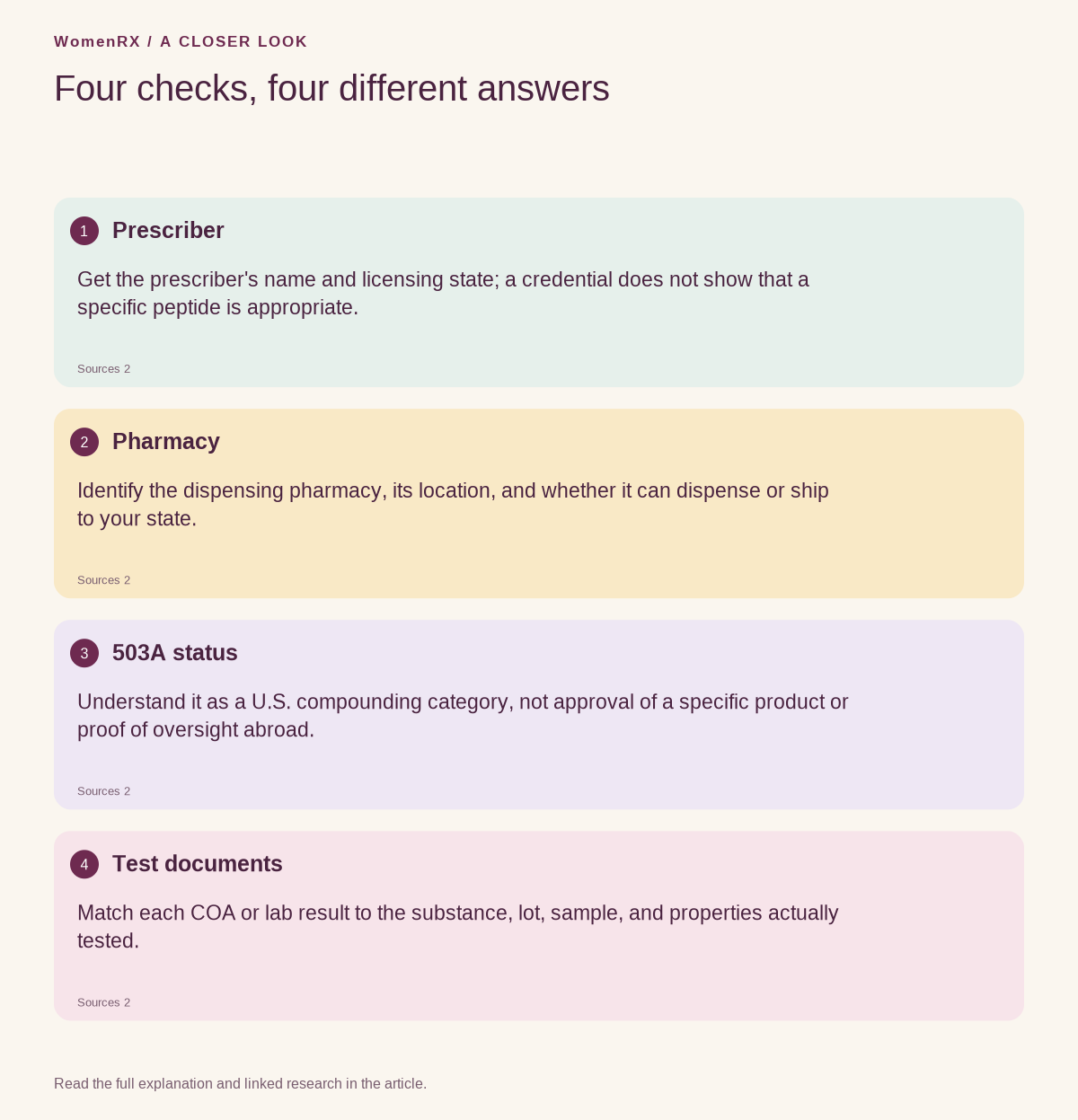
Four checks, four different answers
Prescriber: Get the prescriber's name and licensing state; a credential does not show that a specific peptide is appropriate.2
Pharmacy: Identify the dispensing pharmacy, its location, and whether it can dispense or ship to your state.2
503A status: Understand it as a U.S. compounding category, not approval of a specific product or proof of oversight abroad.2
Test documents: Match each COA or lab result to the substance, lot, sample, and properties actually tested.2
Read the figure as text
Verify each part separately. A credential, pharmacy record, or test document establishes only what it actually covers.- Prescriber: Get the prescriber's name and licensing state; a credential does not show that a specific peptide is appropriate.2
- Pharmacy: Identify the dispensing pharmacy, its location, and whether it can dispense or ship to your state.2
- 503A status: Understand it as a U.S. compounding category, not approval of a specific product or proof of oversight abroad.2
- Test documents: Match each COA or lab result to the substance, lot, sample, and properties actually tested.2
More questions, answered
Does a 503A designation mean a peptide is FDA-approved?
No. It identifies a U.S. compounding framework for prescriptions for individual patients; it does not establish FDA approval of a particular compounded product, formulation, or use. 2
What should I check on a certificate of analysis?
Look for the identified substance and lot, the sample covered, the tests performed, and the testing organization. Ask whether it concerns the ingredient or the finished preparation. The document only supports conclusions about the sample and properties it actually describes. 2
Sources you can check
- Effect of BPC-157 on Symptoms in Patients with Interstitial Cystitis: A Pilot Study.Lee E, Walker C, Ayadi B. · Alternative therapies in health and medicine · 2024Return to first citation
- Frequently asked questions to the 2023 obesity medicine association position statement on compounded peptides: A call for action.Bays HE, Fitch A, Francavilla Brown C, Younglove C, Christensen SM, Alexander LC. · Obesity pillars · 2024Return to first citation