Heart Attack Symptoms in Women: When to Call 911
Chest discomfort is still a common heart attack symptom in women, but breathing trouble or pain elsewhere can matter too.
Call 911 if you or someone nearby has possible heart attack symptoms, even if you’re unsure. Watch for chest pressure, squeezing, fullness or pain; shortness of breath; or discomfort in the arms, back, shoulders, neck, jaw or upper stomach. Symptoms can be mild, come and go, or occur without chest discomfort. They can’t confirm or rule out a heart attack on their own. 1
What symptoms need emergency attention?
Call 911 for possible heart attack symptoms rather than waiting to see whether they pass. Chest discomfort may feel like pressure, squeezing, fullness or pain, often in the center or left side of the chest. It can last more than a few minutes, go away and return, or feel like heartburn or indigestion. It may be mild, not dramatic. 1
Shortness of breath can happen with chest discomfort or on its own, including at rest or with light activity. Discomfort may also involve one or both arms, the back, shoulders, neck, jaw or upper stomach. Chest discomfort with nausea is another warning pattern. 13
If symptoms are happening now, call 911 even if you’re not sure they’re heart-related. Emergency medical services can begin care when they arrive, and a heart attack needs prompt treatment. 12
> If you think it may be a heart attack: Call 911. Don’t use a symptom list to talk yourself out of getting help.
Women don’t have one separate symptom script
Women can have chest discomfort, just as men can. Chest pain is a common reason for emergency-department visits for both women and men. 5 In one Australian study, women made up about half of more than 256,000 ambulance attendances for acute, undifferentiated chest pain. That study examined chest-pain care, not a diagnostic symptom rule for women. 6
Symptoms vary from person to person. Some people have several signs together; others have fewer, or shortness of breath without chest discomfort. A symptom described as “atypical” doesn’t mean it’s harmless, and a symptom often associated with heart attacks doesn’t prove that one is happening. 1
Research on symptoms reported before a heart attack has also found fatigue and sleep disturbance among women in some studies. Much of the evidence summarized in a 2025 review came from cross-sectional or retrospective reports, including studies of women alone. Those findings can’t tell you whether an individual’s tiredness or poor sleep is a heart attack, or establish that these symptoms are unique to women. 4 New or severe possible heart attack symptoms call for emergency attention, not a wait-and-see interpretation based on a pattern from past studies. 1
Symptoms raise concern; tests make the diagnosis
A symptom can be a reason to get emergency help, but it can’t tell you by itself whether a heart attack is occurring. Heart attacks can have different symptoms, and confirming one involves medical tests, including an electrocardiogram (ECG) and blood tests. 13
That distinction matters in both directions: chest discomfort may have causes other than a heart attack, but symptoms that seem mild, familiar or unlike someone else’s experience don’t safely rule one out. The practical takeaway is simple: respond to possible warning signs by calling 911, and let emergency evaluation sort out the cause. 12
There are documented differences in care. A review focused on women’s emergency chest-pain assessment describes concerns about missed or delayed recognition in Canada; an Australian population study found women were less likely to receive several measures of guideline-directed care after ambulance contact for chest pain. These findings describe care-system concerns, not a way to diagnose an individual from symptoms. 56
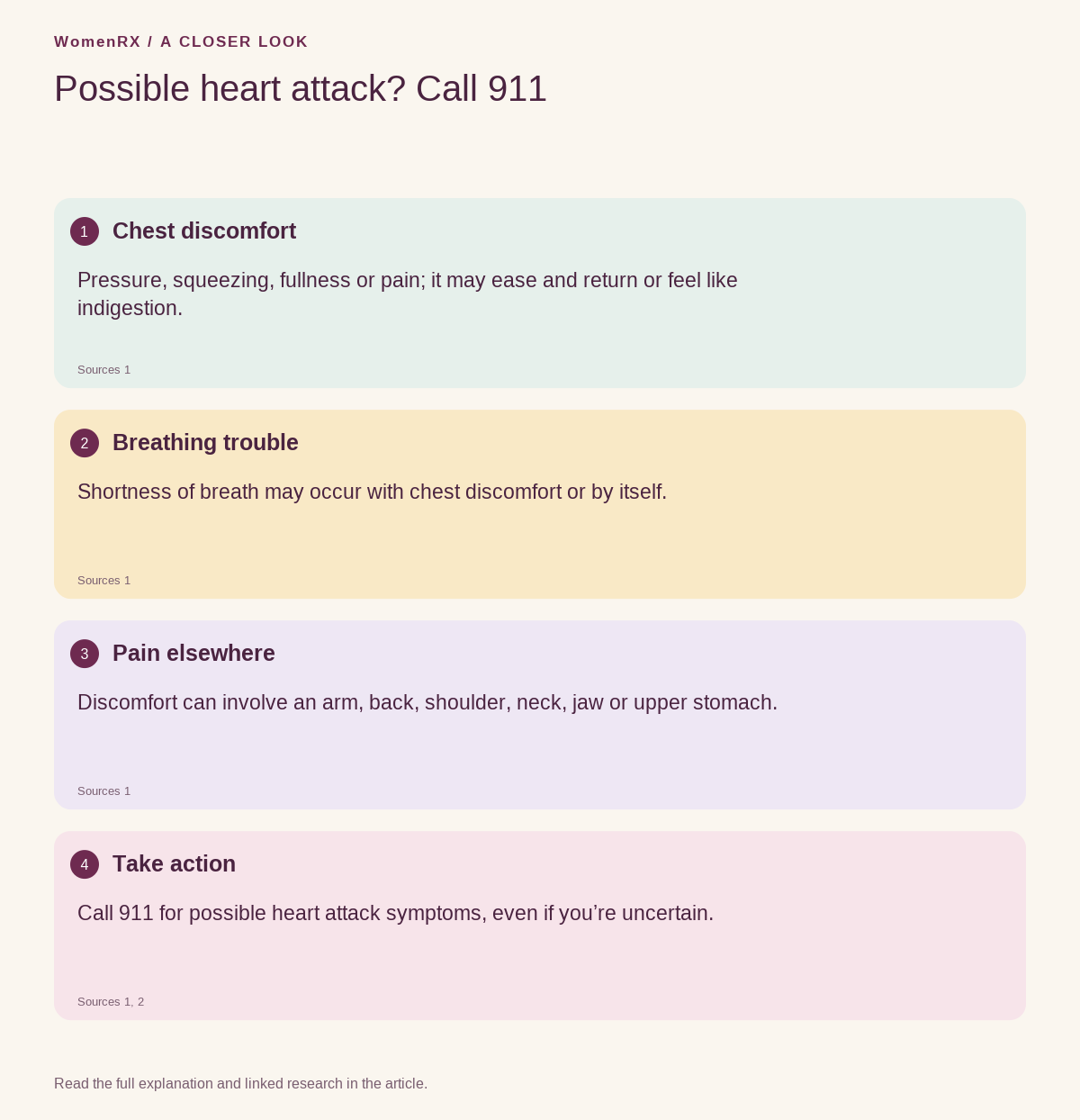
Possible heart attack? Call 911
Chest discomfort: Pressure, squeezing, fullness or pain; it may ease and return or feel like indigestion.1
Breathing trouble: Shortness of breath may occur with chest discomfort or by itself.1
Pain elsewhere: Discomfort can involve an arm, back, shoulder, neck, jaw or upper stomach.1
Take action: Call 911 for possible heart attack symptoms, even if you’re uncertain.12
Read the figure as text
These are warning signs for emergency evaluation, not a score. Having one or more can warrant a call; not having every sign does not rule out a heart attack.- Chest discomfort: Pressure, squeezing, fullness or pain; it may ease and return or feel like indigestion.1
- Breathing trouble: Shortness of breath may occur with chest discomfort or by itself.1
- Pain elsewhere: Discomfort can involve an arm, back, shoulder, neck, jaw or upper stomach.1
- Take action: Call 911 for possible heart attack symptoms, even if you’re uncertain.12
More questions, answered
Can I tell whether it’s a heart attack from the symptoms?
No. Symptoms help signal when to seek emergency care, but an ECG and blood tests are among the tests used to determine whether a heart attack is occurring. 3
Sources you can check
- Heart Attack | Myocardial Infarction | MedlinePlusAccessed 2026-09-25Return to first citation
- Emergency Medical Services: MedlinePlusAccessed 2026-09-25Return to first citation
- Heart attack - NHSAccessed 2026-09-25Return to first citation
- Prodromal Symptoms of Acute Myocardial Infarction in Women: A Systematic Review of Current Evidence.Giordano V, Nocerino R, Mercuri C, Rea T, Guillari A. · Nursing open · 2025Return to first citation
- The Development of a Chest-Pain Protocol for Women Presenting to the Emergency Department.Jaffer S, Noble M, Pozgay A, Randhawa V, Gulati M, Mensour E, Parast N, Tegg N, Theberge E, Harchaoui EK, Mulvagh SL. · CJC open · 2024Return to first citation
- Sex Differences in Epidemiology, Care, and Outcomes in Patients With Acute Chest Pain.Dawson LP, Nehme E, Nehme Z, Davis E, Bloom J, Cox S, Nelson AJ, Okyere D, Anderson D, Stephenson M, Lefkovits J, Taylor AJ, Nicholls SJ, Cullen L, Kaye D, Smith K, Stub D. · Journal of the American College of Cardiology · 2023Return to first citation