Greens Powder and Weight: What Human Studies Can Tell You
A result for one ingredient, such as spirulina, doesn’t show that a greens-powder blend causes weight loss.
Human research on spirulina supplements has found a small standardized reduction in body weight among adults with overweight or obesity, but that result does not establish a weight effect for a named greens-powder blend. The review didn’t report a women-specific estimate. 4 For a particular product, check its calories and ingredients, and whether you’d add it to your usual intake or use it in place of something else.
The key distinction: a blend isn’t one ingredient
“Greens powder” can describe products with different combinations of ingredients. A finding about one ingredient can’t tell you what a finished blend will do: ingredients, amounts, and combinations can differ, and evidence for an individual ingredient may not predict the effect of a product. 1
That makes the product-level question quite specific. To know whether a particular blend changes weight, a human study would need to test that formula and measure body weight. Evidence about a nutrient, an ingredient, or a different multi-ingredient product is not a substitute.
What spirulina research does, and doesn’t, show
Research on spirulina illustrates why an ingredient result needs to be kept separate from a product claim. A 2025 systematic review and meta-analysis combined 23 studies with 1,035 adults with overweight or obesity. It reported a statistically significant reduction in body weight with spirulina supplementation alone, with a standardized effect size of −0.30 (95% confidence interval −0.53 to −0.08). 4
That is a modest standardized effect, not a result in pounds or kilograms. It also doesn’t show that a greens powder would have the same effect. The review assessed spirulina supplementation, not a named commercial greens-powder formula; the studies varied in participants and intervention details. The result is best read as an ingredient-level signal, not proof that greens powders cause weight loss. 4
The review’s abstract does not provide a women-only or sex-stratified weight estimate. So it can’t establish a different effect for women, or for a particular life stage. 4
Could a powder affect weight in the other direction?
A product’s effect can’t be judged from the word “greens” or its ingredient list alone. Look at the calories per serving on the label, then consider how you use it: adding a serving to your usual routine is different from using it instead of another item. Nutrition is shaped by the overall pattern of foods and drinks, not one add-on in isolation. 2
Weight on the scale also includes water, muscle, bone, and fat, so a change in weight doesn’t by itself tell you what changed. 3 The spirulina review reports a body-weight result, but it doesn’t establish that a commercial greens powder changes body fat or explain what any change on your own scale would represent. 4
A practical way to assess the claim
Before buying a product for weight management, check whether the claim is about the exact blend or only one ingredient. If it’s about spirulina, keep the review’s limits in view: a modest standardized result across spirulina studies is not a product-specific prediction. If the claim relies on another ingredient, look for human research that measured body weight for that ingredient, and don’t assume a finding carries over to the full blend. 14
For your own decision, note the serving calories and whether the powder would be added or replace something else. You can choose a powder as a nutrition add-on if it fits your preferences, but the spirulina findings don’t establish that a greens blend is a weight-loss tool. 4
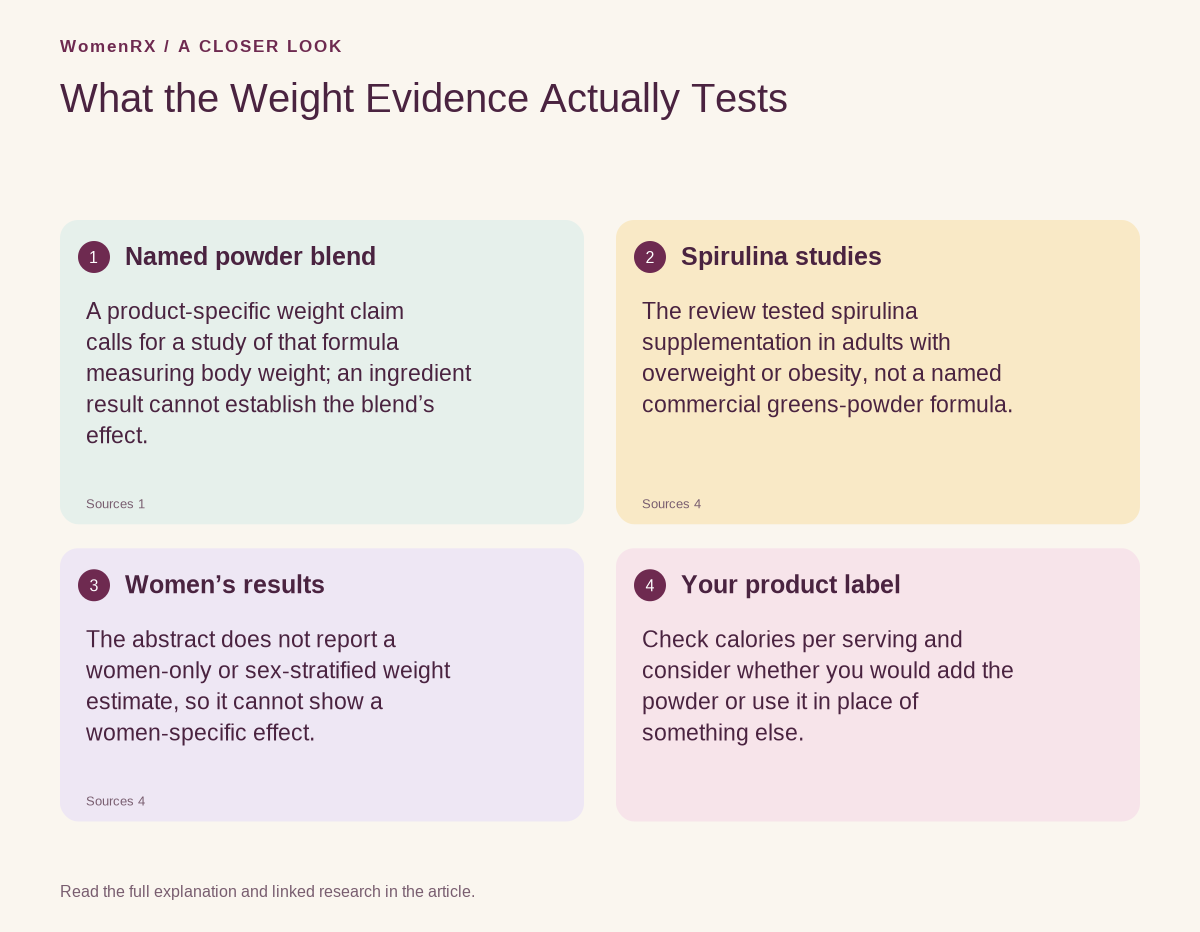
What the Weight Evidence Actually Tests
Named powder blend: A product-specific weight claim calls for a study of that formula measuring body weight; an ingredient result cannot establish the blend’s effect.1
Spirulina studies: The review tested spirulina supplementation in adults with overweight or obesity, not a named commercial greens-powder formula.4
Women’s results: The abstract does not report a women-only or sex-stratified weight estimate, so it cannot show a women-specific effect.4
Your product label: Check calories per serving and consider whether you would add the powder or use it in place of something else.
Read the figure as text
Separate evidence needed for a named greens-powder formula from findings about spirulina supplementation and from practical questions about using a product.- Named powder blend: A product-specific weight claim calls for a study of that formula measuring body weight; an ingredient result cannot establish the blend’s effect.1
- Spirulina studies: The review tested spirulina supplementation in adults with overweight or obesity, not a named commercial greens-powder formula.4
- Women’s results: The abstract does not report a women-only or sex-stratified weight estimate, so it cannot show a women-specific effect.4
- Your product label: Check calories per serving and consider whether you would add the powder or use it in place of something else.
More questions, answered
Does spirulina research prove a greens powder will help me lose weight?
No. A 2025 review found a modest standardized body-weight effect for spirulina supplements in adults with overweight or obesity, but it did not test a named commercial greens-powder formula. It also didn’t report a women-specific estimate. 4
What should I check on a greens-powder label?
Check calories per serving and the specific ingredients. Then consider whether you’d add it to your usual routine or use it instead of something else. Ingredient-level research alone doesn’t establish what the full blend does. 1
Sources you can check
- Dietary Supplements for Weight Loss - Health Professional Fact SheetAccessed 2026-09-25Return to first citation
- Nutrition: MedlinePlusAccessed 2026-09-25Return to first citation
- Body Weight: MedlinePlusAccessed 2026-09-25Return to first citation
- Effects of spirulina supplementation alone or with exercise on cardiometabolic health in overweight and obese adults: a systematic review and meta-analysis.Fu Z, Zhou S, Gu X. · Frontiers in nutrition · 2025Return to first citation