Genital Herpes: Testing, Treatment, and Pregnancy
New or uncertain genital lesions during pregnancy may need PCR confirmation; a characteristic recurrence in someone with a known diagnosis may not.
If you have genital sores, get them assessed while they’re present. 1 During pregnancy, new or uncertain lesions may need PCR testing; a characteristic recurrence with a known herpes history may not. Type-specific IgG answers a different question, and universal HSV blood testing isn’t recommended by the cited guideline. 4 Antivirals can treat episodes, but they don’t remove the virus. 1 3
Start with what’s happening now
Genital herpes can cause blisters or sores, but the virus can also be present without visible symptoms. If you notice new genital sores, getting them assessed while they’re present gives a clinician a chance to consider herpes. 1 During pregnancy, PCR can confirm herpes when lesions are new or the diagnosis is uncertain. A characteristic recurrence in someone with a known herpes history may not need confirmation. If you’re pregnant, have lesions, and have no known history of genital herpes, the guidance recommends combining lesion PCR with type-specific HSV IgG testing to help distinguish a first infection from a recurrence. HSV IgM is not useful for diagnosing genital herpes. 4
A blood test and a lesion swab answer different questions: PCR checks a lesion for virus, while type-specific IgG helps assess prior exposure when there are no clinical lesions. If your partner has herpes but you don’t have sores, mention that when discussing whether blood testing would be useful for your situation. A French practice guideline says there isn’t evidence to support testing every pregnant person for HSV antibodies. That makes testing a question for your particular situation, rather than a routine screen for everyone. 4
What antivirals can, and can’t, do
Acyclovir and valacyclovir are antiviral medicines used for herpes during pregnancy. Treatment can be offered for an episode, including a first episode during pregnancy. For a recurrence, antivirals may help, although a French guideline describes their effect on symptom duration and severity as limited. For recurrent outbreaks outside pregnancy, treatment started as symptoms begin may shorten an outbreak; the virus itself remains in the body. 1 3 7
Treatment is not a cure, and taking an antiviral doesn’t by itself settle questions about transmission or delivery. A review of pregnancy safety research reports that acyclovir and valacyclovir use was not associated with an increase in birth defects, while noting that evidence for some other herpes medicines was limited. If you’re pregnant or planning pregnancy, discuss your specific medicine with your maternity or prescribing team rather than starting or stopping it on your own. 6 2
Pregnancy planning: the timing of infection matters
The key distinction is often whether herpes is an established infection that has recurred or a first genital episode during pregnancy. A new infection close to delivery raises more concern for the newborn than a recurrence. One French guideline estimates neonatal herpes risk at 25% to 44% when a first episode is ongoing at delivery, compared with about 1% for a recurrence. These are guideline estimates, not a prediction of what will happen in an individual pregnancy. 3 7
If you already know you have genital herpes, mention it when discussing pregnancy or at your first prenatal visit. If sores appear during pregnancy, contact your maternity care team promptly so they can assess whether this may be a first episode, confirm the diagnosis when appropriate, and discuss treatment. Guidance from the French College of Gynecologists and Obstetricians recommends suppressive antiviral treatment from 36 weeks for people who have had an episode during pregnancy. It does not recommend routine suppression solely for a history of herpes with no recurrence during pregnancy. Your care team can explain the plan they recommend for you. 3 5 7
Delivery plans can change with symptoms
Many people with a history of genital herpes have a vaginal delivery. The presence of sores or symptoms when labor begins, and whether the episode is new or recurrent, can change the discussion. French guidance recommends cesarean delivery when a first episode is suspected at the onset of labor or occurred less than six weeks before delivery; it says cesarean should be considered for a recurrence in certain circumstances. The obstetric team considers the episode’s timing and what’s happening at labor. A herpes diagnosis alone doesn’t determine the delivery route. 1 3 5 7
A useful plan is to tell your maternity team about any past diagnosis, new sores during pregnancy, and medicines you take for outbreaks. If symptoms begin near your due date, contact them promptly rather than waiting for a routine visit. That gives them time to assess the episode and discuss treatment and labor plans.
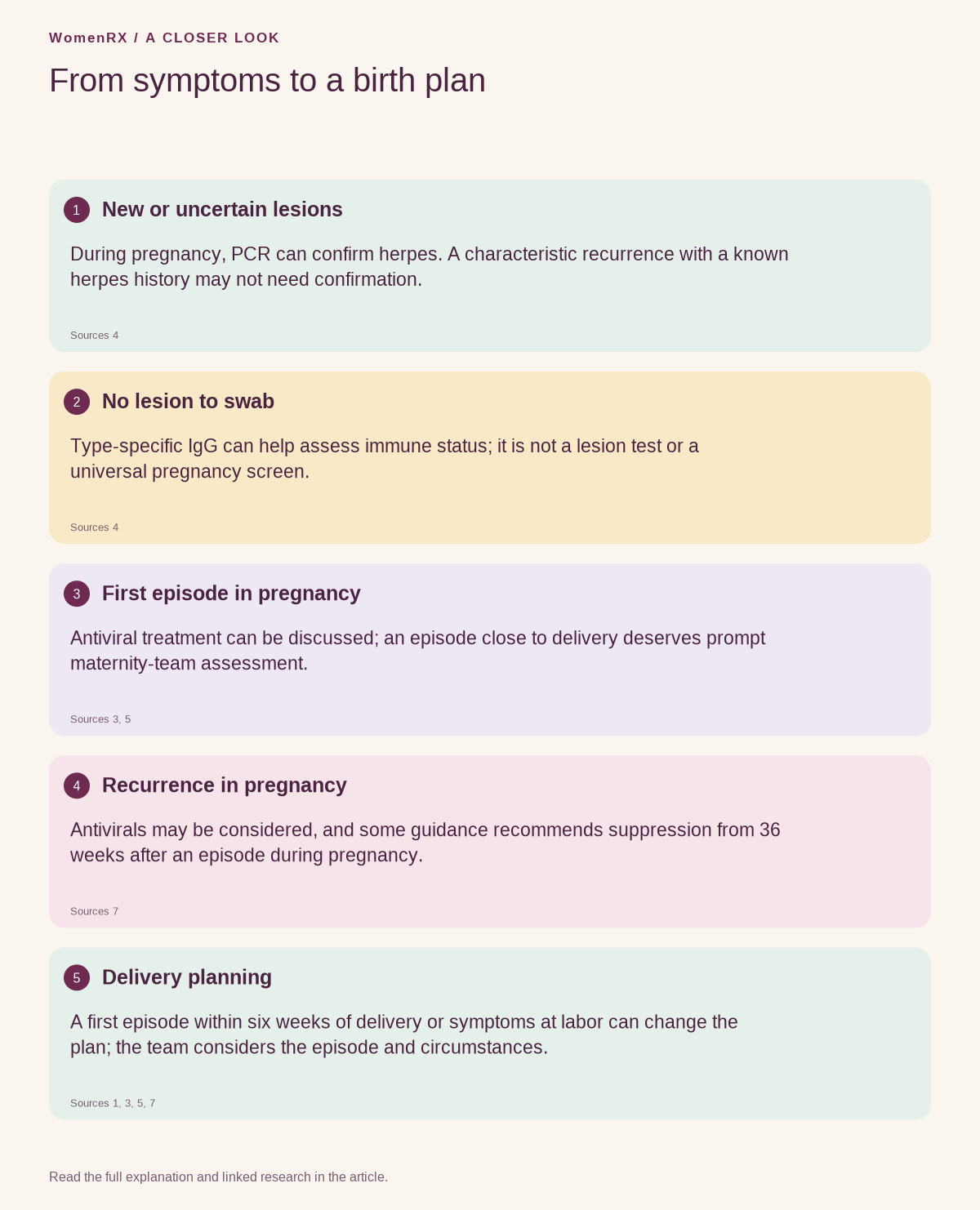
From symptoms to a birth plan
New or uncertain lesions: During pregnancy, PCR can confirm herpes. A characteristic recurrence with a known herpes history may not need confirmation.4
No lesion to swab: Type-specific IgG can help assess immune status; it is not a lesion test or a universal pregnancy screen.4
First episode in pregnancy: Antiviral treatment can be discussed; an episode close to delivery deserves prompt maternity-team assessment.35
Recurrence in pregnancy: Antivirals may be considered, and some guidance recommends suppression from 36 weeks after an episode during pregnancy.7
Delivery planning: A first episode within six weeks of delivery or symptoms at labor can change the plan; the team considers the episode and circumstances.1357
Read the figure as text
The testing discussion differs depending on whether there’s a lesion to swab; pregnancy pathways then connect the episode history to treatment and delivery planning.- New or uncertain lesions: During pregnancy, PCR can confirm herpes. A characteristic recurrence with a known herpes history may not need confirmation.4
- No lesion to swab: Type-specific IgG can help assess immune status; it is not a lesion test or a universal pregnancy screen.4
- First episode in pregnancy: Antiviral treatment can be discussed; an episode close to delivery deserves prompt maternity-team assessment.35
- Recurrence in pregnancy: Antivirals may be considered, and some guidance recommends suppression from 36 weeks after an episode during pregnancy.7
- Delivery planning: A first episode within six weeks of delivery or symptoms at labor can change the plan; the team considers the episode and circumstances.1357
More questions, answered
Does a past herpes diagnosis mean I’ll need a cesarean?
No. Many people with genital herpes have a vaginal delivery. A first episode within six weeks of delivery can affect the plan, as can sores or symptoms when labor begins. The decision depends on the episode and circumstances at labor. 1 3 5
Should everyone get a herpes blood test during pregnancy?
A French practice guideline says there isn’t evidence to support universal HSV antibody testing in pregnancy. When there are no lesions, type-specific IgG can help assess immune status, but whether testing is useful depends on the situation. 4
What if my partner has herpes but I have no sores?
Tell your clinician about your partner’s diagnosis and ask whether a type-specific IgG blood test would be useful in your situation. This test assesses immune status when there are no lesions; the cited pregnancy guideline does not recommend universal testing. 4
Sources you can check
- Genital herpes - NHSAccessed 2026-09-25Return to first citation
- Pregnancy and Medicines | MedlinePlusAccessed 2026-09-25Return to first citation
- Prevention and management of genital herpes simplex infection during pregnancy and delivery: Guidelines from the French College of Gynaecologists and Obstetricians (CNGOF).Sénat MV, Anselem O, Picone O, Renesme L, Sananès N, Vauloup-Fellous C, Sellier Y, Laplace JP, Sentilhes L. · European journal of obstetrics, gynecology, and reproductive biology · 2018Return to first citation
- [Genital herpes and pregnancy: Serological and molecular diagnostic tools. Guidelines for clinical practice from the French College of Gynecologists and Obstetricians (CNGOF)].Vauloup-Fellous C. · Gynecologie, obstetrique, fertilite & senologie · 2017Return to first citation
- [Management of pregnant women with first episode of genital herpes. Guidelines for clinical practice from the French college of gynecologists and obstetricians (CNGOF)].Sananès N. · Gynecologie, obstetrique, fertilite & senologie · 2017Return to first citation
- Safety of antiviral medication for the treatment of herpes during pregnancy.Kang SH, Chua-Gocheco A, Bozzo P, Einarson A. · Canadian family physician Medecin de famille canadien · 2011Return to first citation
- [Management of pregnant women with recurrent herpes. Guidelines for clinical practice from the French College of Gynecologists, Obstetricians (CNGOF)].Anselem O. · Gynecologie, obstetrique, fertilite & senologie · 2017Return to first citation